AI in Wholesale Distribution: Use Cases, Evidence and Tools (2026)

Summary
- In wholesale sales, AI pays off today where it turns ERP order data into signals for each customer: prioritization, churn, cross-selling, reorders and follow-up by voice.
- AI without context produces false alarms. Every recommendation needs field sales knowledge built in; otherwise the sales team stops trusting it within a few weeks.
- Sales tools built for software companies don't carry over one-to-one to wholesale. Each class of tool solves a different problem.
- The first step depends on your starting point: data foundation, customers per field sales rep, and your goal. Without clean master data and repeat-order business, no AI will help.
AI in wholesale pays off today where it turns ERP order data into daily signals for field sales: which customer needs attention, why, and what to bring up. For distributors, five use cases are ready now: customer prioritization, early churn detection, cross-selling, reorders, and visit preparation and follow-up by voice. Writing tools and dashboards don't count.
If you're approving budget now, you want to know which AI tools for wholesale distributors get used every day and which ones nobody opens after three months.
Why are wholesale distributors turning to AI now?
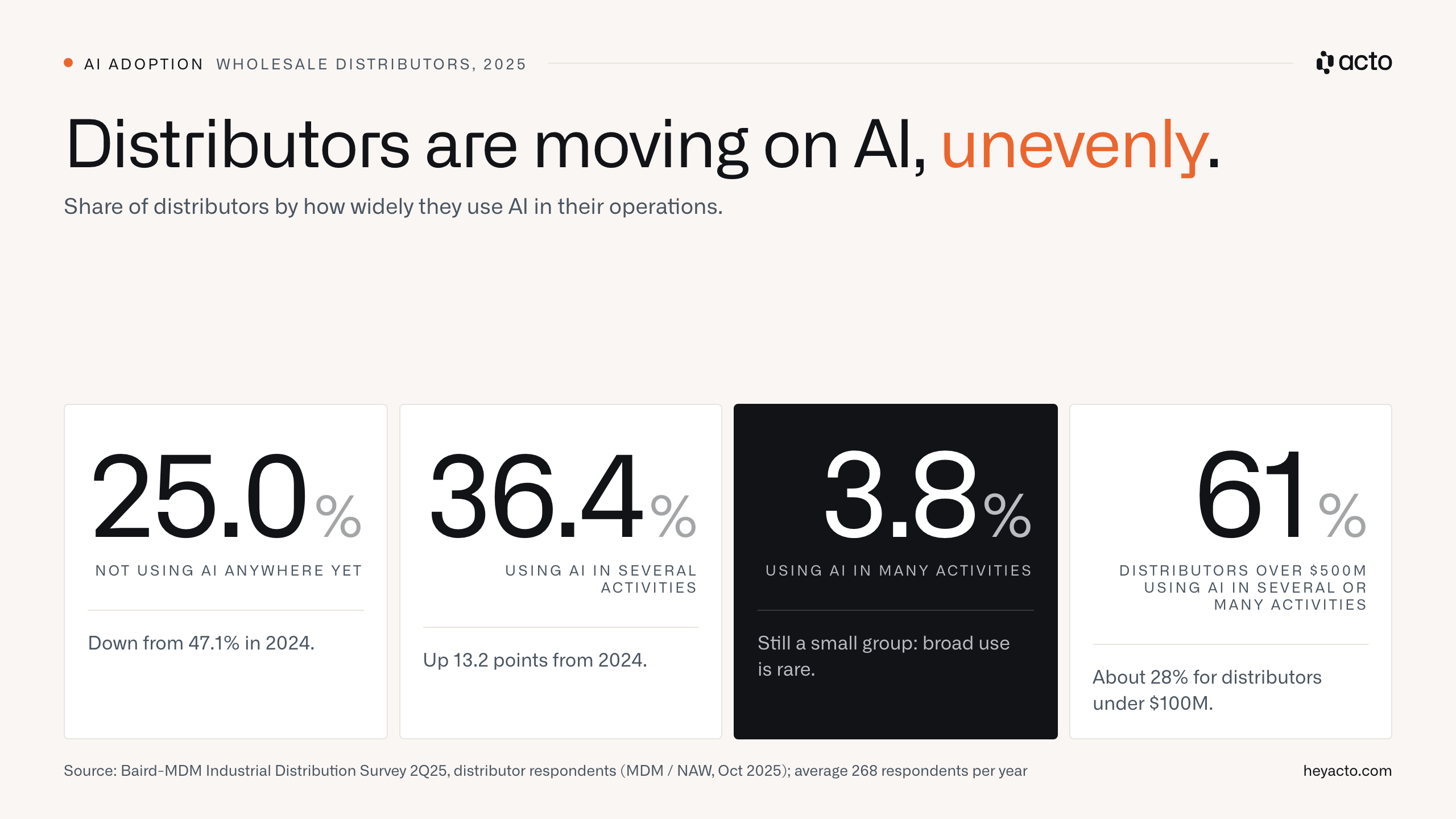
Because three in four distributors now use AI somewhere, and the large ones are far ahead. In the Baird-MDM Industrial Distribution Survey (2Q25, published by MDM and NAW in October 2025), the share of distributors not using AI anywhere fell from 47.1% in 2024 to 25.0% in 2025. 36.4% now use it in several activities, and only 3.8% in many.
Company size is the dividing line: 61% of distributors with revenues over $500M use AI in several or many activities, compared with about 28% of distributors under $100M. Across the whole US economy, the Census Bureau's Business Trends and Outlook Survey puts AI adoption at 17% to 20% between December 2025 and May 2026, with wholesale trade below the national average, as Distribution Strategy Group reports.
The biggest lever is in sales. Deloitte estimates that sales and service labor typically accounts for 5% to 7% of a distributor's expenses, and that generative AI in sales and customer service could add 75 to 100 basis points of EBIT for the average wholesale distributor. Deloitte presents this as its own analysis and doesn't publish the underlying survey data.
Our own data from Europe points the same way. In a worked example from our study of European wholesalers ("Wholesale Sales 2026", in German), 79% to 91% of revenue comes from existing customers, and 73% of the field sales reps in a profile sample of 177 have more than ten years of experience (as of week 40/2026, not representative). When they retire, their customer knowledge leaves with them unless it lives in a system.
What can AI do in wholesale today, and how mature is each use case?
Five AI use cases in wholesale sales are ready to use today: customer prioritization, early churn detection, cross-selling, reorders, and preparation and follow-up by voice. Order entry and pricing are arriving now; the fully autonomous AI salesperson is still hype.
The maturity ratings in the table are our own assessment, based on the projects we support. They aren't a market study.
| Problem | AI application | Metric | Maturity |
|---|---|---|---|
| Hundreds of customers per field sales rep, visits planned by habit | Customer prioritization: signals per customer from order history, with reasoning | Share of signals that sales marks as helpful: 92% at Schäfer Shop | ready today |
| Customers quietly shift product categories to the competition | Early churn detection: deviation from the order pattern per customer and product category | Churn rate, 4 to 17% of customers per year depending on account care (Acto churn benchmark) | ready today |
| Complementary products go unbought | Cross-selling / next best offer: comparison with similar customers by industry, size and basket | Products per customer: on average 2.1 more at Plate when customers were approached after a notification | ready today |
| Reorders go to the competition | Reorders: repurchase interval per customer and item | Time between orders: 35% less at Plate | ready today |
| Reps write reports on their laptop in the evening | Visit preparation and follow-up by voice | Time saved: up to 8 hours per employee per week at Schäfer Shop | ready today |
| Email inquiries get retyped by hand | Quote and order entry: AI reads the inquiry, matches items, prepares the order | Lead time from inquiry to order | emerging |
| Margins differ between similar customers | Price and margin: comparison of contribution margins in homogeneous customer groups | Contribution margin per customer versus comparison group | emerging |
| Overstock and shortages | Demand forecasting / inventory: sales forecast per item and location | Delivery capability, stock coverage | ready today in purchasing and replenishment |
| Wish to hand customer advice over to AI entirely | Fully autonomous AI salesperson | no reliable metric | still hype |
The top four signal rows have one thing in common: their raw data has been sitting in the ERP for years. A customer who orders screws every 14 days and still hasn't ordered by day 20 is exactly the kind of signal nobody catches reliably across several hundred customers. Our article on potential-based sales shows how this turns into prioritizing customers by potential.
The analytical core of cross-selling is white-spot analysis. The question "what should I bring up now?" is answered by the principle of next best action. Our five use cases for predictive analytics show which forecasts your order data can support. Quote entry and pricing work in pilots but still break down in daily use, because item master data is messy and terms vary from customer to customer.
Where do wholesale distributors use AI beyond sales?
Beyond sales, wholesale distributors use AI in purchasing and replenishment, in delivery logistics, and for product data and quotes. We don't work in these areas ourselves, so this overview draws on examples from across the industry.
Purchasing and replenishment
In purchasing and replenishment, AI calculates demand from sales per item and location and suggests order quantities. Germany's Mittelstand-Digital Zentrum Handel, a publicly funded competence center for retail and wholesale, lists basket forecasting and inventory management among the three examples in its explainer video on AI in wholesale (in German). It's the same data sales works with. Purchasing asks the order history which item will run short soon; sales asks which customer is buying less.
Delivery logistics
In delivery logistics, AI bundles deliveries into routes and plans which driver serves which customers and when. This kind of service and delivery route planning is the third example in the Mittelstand-Digital Zentrum's video. It has little to do with route planning in field sales, where reps plan their own customer visits.
Product data and quotes
For product data and quotes, the German distributor Zander (plumbing, heating, air conditioning and electrical supplies) shows how far AI gets today. Zander classifies its products under the ETIM industry standard through a service provider that several distributors share via their trade association. According to York Lemb of the Zander Digital Service Group, AI now handles more than 60 to 70 percent of that work (interview on synaigy's insights! podcast, in German). For tenders, Zander uses AI to find similar past projects, check whether the product or an equivalent is in its range, and hand inside sales a draft quote.
All three areas depend on the same foundation as sales. Without clean product data, no AI can find an equivalent product for a quote, and without a complete order history, no replenishment system can calculate demand reliably. Sales AI starts from the customer instead and shows who is ordering less, and why.
Who already uses AI in wholesale sales? Three real-world examples
Large distributors have built their own sales AI. Two examples show what it looks like day to day; the third is one everyone knows from online retail.
Würth: a voice assistant for every field sales rep
Every one of Würth's 3,500 field sales reps has Pico, the company's own chat and voice assistant built on a large language model. It can pull information together in seconds or suggest promising ways to approach a customer, according to Handelsblatt (in German).

METRO: M.Sam for 150 to 800 customers per rep
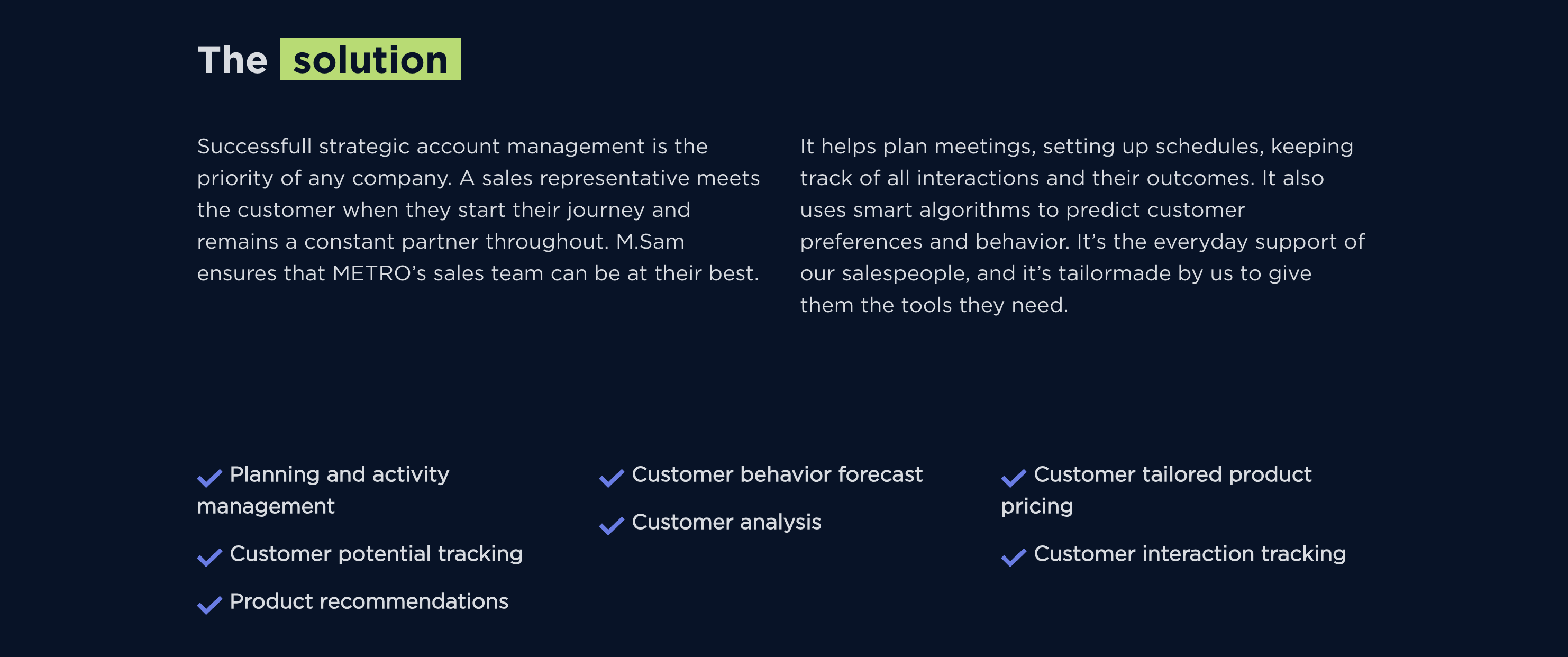
A sales rep at METRO manages between 150 and 800 business customers. The in-house app M.Sam plans meetings, forecasts customer behavior, and recommends products and customer-specific prices. METRO reports a 25% reduction in admin time, with the app in use in 16 countries (METRO's own figures).

Amazon: "Frequently bought together"
Everyone knows the principle from online retail: algorithms show what similar customers also buy. In wholesale distribution, the same logic is hidden in the order history of similar customers, but nothing brings it to the sales rep automatically.
Würth and METRO have their own development teams. Mid-sized distributors without that kind of team turn to specialized sales AI; the tool table below lays out the options.
Why does AI without context produce false alarms?
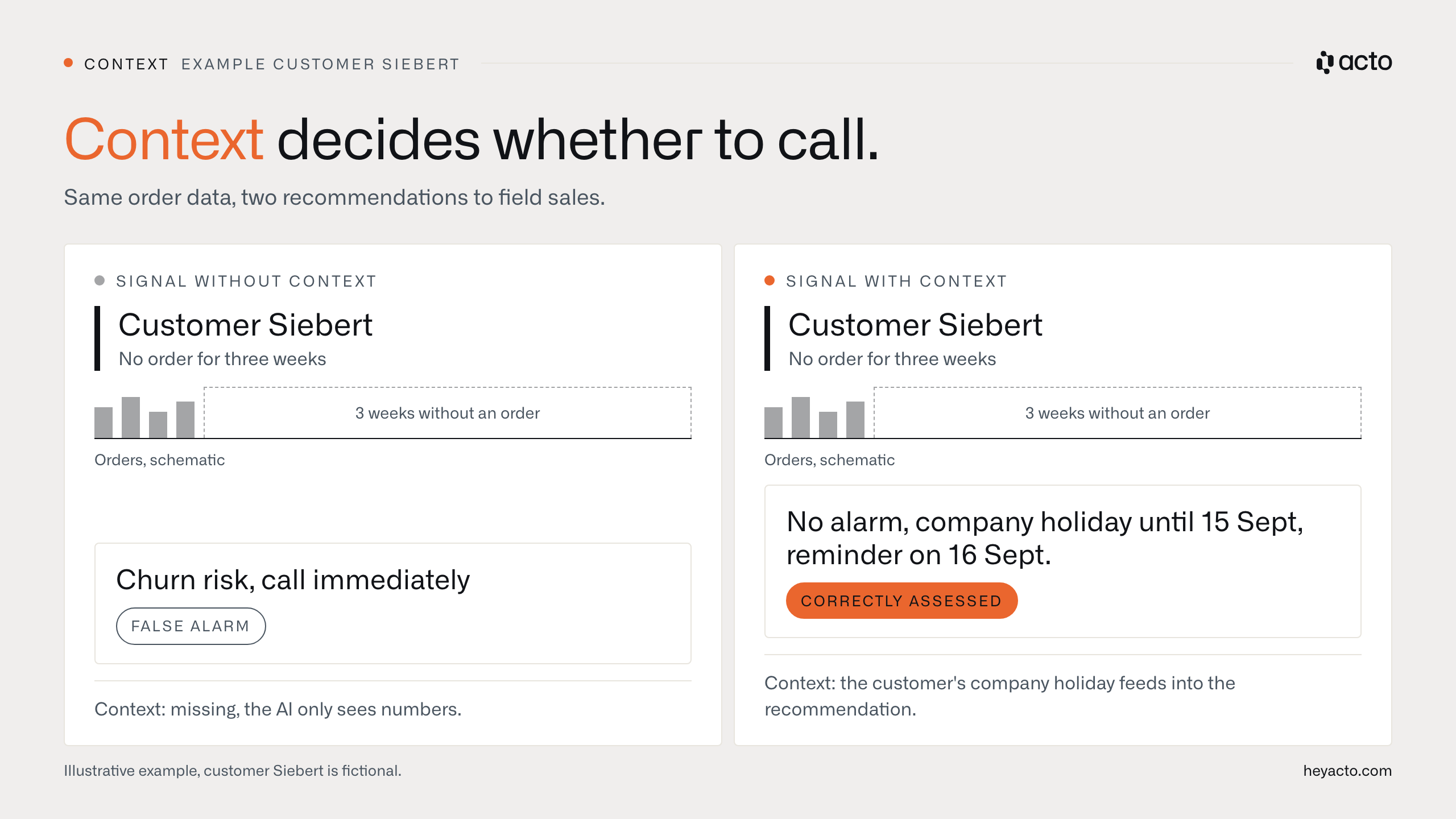
AI without context produces false alarms because order data shows what changes, but not why. After a few false warnings, field sales stops trusting the AI, and every recommendation after that goes to waste.
Here's an example (made up, not a real customer): Siebert hasn't ordered anything in three weeks. An AI that only sees numbers reports "churn risk, call immediately". With context, the message reads: "No alarm, company holiday until 15 Sept, reminder on 16 Sept."
The same problem comes up when there are gaps in the data. A manufacturer put the concern to us like this:
"If I try to show percentage revenue changes, up or down, based on the data I have, and I can't tell whether he maybe ordered the products through wholesale for 3 months, 6 months or not at all, that leads to the wrong conclusions later on too."
– Interview partner at a manufacturer, customer conversation
Context comes from systems and from people's heads. Four of the seven things an experienced field sales rep knows about their customers are already in the ERP: purchase patterns of similar customers, seasonal patterns, repurchase intervals, ordering rhythm. The rest lives only in the rep's head: the relationship (who makes the purchasing decisions), how the customer uses the products (two-shift operation) and the background ("the son will take over soon").
That's why feedback from every customer visit flows into the next recommendation. We build this in from day one, because churn starts quietly: customers move one product category at a time, and total revenue looks healthy for a long time because the standard items keep selling.
What do studies and pilot projects show on AI in wholesale?
In pilot projects with a control group, wholesale reps who work with AI signals saw revenue increases of between 5.4 and 11.2%. These are pilot results under specific conditions, and nobody can guarantee them for your business.
The numbers behind field sales explain why signals help. A wholesale field sales rep looks after 247 customers on average (median 175), based on an analysis of 106 companies from sales conversations and an Acto survey (2024 to 2026, study "Wholesale Sales 2026" (in German)). The same study found that in 47% of conversations, visits are planned on gut feeling or experience, and in only 8% with the help of the CRM, as we show in our article on visit planning in field sales.
| Customer | Result | Comparison | Limitation |
|---|---|---|---|
| Schäfer Shop | +11.2% revenue | A/B test against control group | no further details |
| Plate | +10% revenue | pilot team against control group | among the users in the pilot team |
| Böllhoff | +8.6% revenue | Acto users against non-users | period not stated |
| Hitado | +5.4% revenue | users against non-users in the pilot | pilot group of six employees |
These figures come from Acto projects with European distributors, several of them active internationally, and do not come from an independent study. For an independent view, see the field study by the University of Cologne in B2B wholesale on churn prediction (Gattermann-Itschert and Thonemann, 2022).
Your own results depend on three things: the share of repeat-order business, the quality of the order history, and whether field sales actually visits the customers the signals point to. Measure analysis time saved, extra selling time and revenue separately.
Which AI tools exist for each use case, and where does Acto stand?
There are five classes of AI tools for wholesale sales: CRM AI, ERP AI, specialized sales AI for wholesale, pricing tools and general AI assistants. They solve different problems, and none covers every row of the use case table.
In the interest of transparency: Acto is a vendor in one of these classes, and the order below isn't a ranking.
| Tool class | Strength | Limit in wholesale sales | Typical use |
|---|---|---|---|
| CRM AI (e.g. Salesforce Einstein, Microsoft Copilot) | works with CRM, email and calendar; strong on pipelines and correspondence | does not analyze the ERP order history per customer | new-customer pipeline, email drafts, call notes |
| ERP AI (e.g. in SAP) | close to orders, prices and stock | results tend to land in replenishment and purchasing rather than with field sales | replenishment, demand forecasting, purchasing |
| Specialized sales AI for wholesale (e.g. Acto) | signals per customer from the ERP order history, with reasoning, in Outlook, CRM or app | does not set prices, plan warehouses or generate leads; needs repeat-order business | prioritization, churn, cross-selling, reorders, preparation and follow-up |
| Pricing tools | price recommendations and margin management | do not tell field sales which customer to call today | price and margin |
| General AI assistants (ChatGPT and others) | summaries, conversation guides, simple analyses of exports | no ongoing analysis per customer; result only as good as the export | individual tasks in daily sales work |
CRMs were built for new-customer pipelines: interest, qualification, quote, close. In wholesale, revenue comes from existing customers and depends on ordering rhythm, seasonality and how much of the range each customer buys. An AI built on pipeline logic misses exactly these patterns, which is why tools built for software sales don't carry over one-to-one. Our article Which CRM for wholesale? compares the CRM systems that do fit.
When doesn't AI in wholesale sales pay off?
AI in wholesale sales does little without a recurring order pattern. That applies to project business without reorders, B2C, and manufacturers that sell mainly through wholesale and can't see their end customers' orders.
With very few customer accounts, the effort rarely pays off; our typical customers start at about 1,500 active customer accounts. If you're looking for leads or doing cold calling, sales AI for existing customers is the wrong tool. And AI doesn't replace a relationship, least of all for products that need a lot of explaining:
"The more advice a product needs, the more likely the customer will tune out at some point and say, I can't deal with the agent, I need some advice."
– Daniel Hesmer, Comm. Director, Walraven (Revenue Signals, episode with Daniel Hesmer)
Where should you start with AI in wholesale?
The first step with AI in wholesale depends on three things: the state of your data, how many customers each field sales rep looks after, and your goal. If you have clean order data and many customers per rep, start with a pilot against a control group.
| Starting point | First step | Why |
|---|---|---|
| ERP order history available, many customers per field sales rep | Pilot with sales AI, control group and KPIs defined beforehand | you can prove the impact with numbers |
| Duplicate master data, unclear processes | clean up customer master data and processes first, then AI | every recommendation inherits the errors in the data |
| Small organization without CRM | lean sales AI instead of a CRM | saves you from maintaining a system that, for existing customers, mostly just records what happened |
| CRM in use and maintained | add existing-customer signals from the ERP as a sidebar in the CRM | sales keeps working in the tool it knows |
| Goal: less admin time | follow-up by voice first | the quickest win field sales will notice |
| Goal: margin | evaluate a pricing tool | pricing is a discipline of its own |
Every sales project pulls one of two levers: revenue per visit or number of visits. Signals improve the first; voice and less admin improve the second. Our article Selling proactively in wholesale describes how a team moves from taking orders to actively selling. The article on field sales management covers how both levers show up when you lead the team.
On data quality, we agree with a guest on our podcast:
"But AI won't fix the problems you have today. The question is: what's your data foundation, and what do your processes look like? […] Don't start with AI itself. Start by laying the foundations so you can use AI later, or so AI can work as well as possible for you."
– Daniel Hesmer, Comm. Director, Walraven (Revenue Signals, episode with Daniel Hesmer)
Watch the episode: manufacturers, wholesale, 1:n relationships in sales and AI (video in German)
How does Acto implement sales AI in wholesale?
Acto is a sales AI for wholesale and for manufacturers with their own B2B direct sales. Every day, Acto reads the ERP order data and shows field reps which customer matters, why, and what to bring up. Reps see it in Outlook, the CRM or the app, and can also hear it by voice in the car.
Smaller sales organizations use Acto instead of a CRM; larger ones embed it as a CRM sidebar and also use it in Outlook. Acto reads any ERP, from SAP to custom-built systems, and writes back only to the CRM, never to the ERP. Acto is not a BI tool, not a general copilot and not a route planner.
- Prioritize customer visits: signals with reasoning, based on ordering rhythm, product categories and comparison with similar customers.
- Prepare for meetings: a briefing of about two minutes before each appointment, covering open topics and opportunities.
- Follow up on meetings: dictate the visit report by voice, and the feedback flows into the next recommendation.

Four customer signals with reasoning: open quote, growing gap between orders, cross-sell hint and a customer inactive for 172 days.
That way, when a field sales rep like our fictional Mr. Petersen retires after 30 years in his territory, his successor can still use what he knew.
Your next step: in the use case table above, mark the two or three cases that cost you the most revenue, and check whether you can export your ERP order history for each.
On a call, we'll assess your starting point and show you which use cases work with your ERP data today.
FAQ
How long does it take to introduce sales AI, and how much IT does it need?
Getting Acto live takes four to six weeks and two to three days of IT work. ERP data arrives via nightly export or SFTP, and the ERP itself stays unchanged. You start with a pilot phase and KPIs we define together.
Can't I just start with ChatGPT or Copilot in sales?
You can start right away with ChatGPT or Copilot, for conversation summaries, conversation guides, follow-up emails and simple analyses of an Excel export. What these assistants don't do is analyze each customer's order history every day. That takes a tool that reads the data itself.
What if my most experienced salesperson doesn't trust the signals?
Put them in the pilot group. Every signal needs reasoning they can check and a way for them to correct it based on what they know. Their corrections are exactly the context that prevents false alarms.
Which AI tools do wholesale distributors use for sales?
Distributors use five classes of AI tools in sales: CRM AI for pipelines and correspondence, ERP AI for orders and inventory, specialized sales AI that turns ERP order history into signals per customer, pricing tools for margin, and general AI assistants for one-off tasks. No class covers every use case; the comparison table above shows where each one fits. Acto is a provider in the specialized sales AI class.
Does AI replace field sales?
No. AI makes your best reps' knowledge available to the whole team. Hitado estimates that onboarding new salespeople is now six times faster: it used to take about a year, and with Acto it takes one to two months. The relationship with the customer stays with the human.