Wholesale Distributor Sales: The 2026 Guide to Growth and Margin Protection
Summary
- Distributor sales means tens of thousands of products, hundreds of accounts per rep and thin margins, so attention has to follow value.
- Segment customers by current revenue and future potential, then act on signals such as changing order cycles and missing products.
- A five-step playbook (data, prioritisation, signals, automated admin, coaching) turns reactive sales teams into proactive ones.
Selling in wholesale and distribution works differently from selling software or consumer products. It means tens of thousands of products, hundreds of customers per rep and margins that often sit in the single digits. This guide covers what distributor sales involves today, which challenges dominate in 2026, how to segment customers by impact, and a practical playbook for proactive, data-driven selling.
What is wholesale distributor sales, really?
Wholesale distributor sales means moving goods from manufacturers to retailers, contractors, installers and business buyers. It goes far beyond taking orders. It combines:
- Procurement expertise: negotiating with suppliers and managing costs.
- Customer relationships: keeping customers loyal in a price-driven market.
- Operational efficiency: running warehousing, logistics, delivery and after-sales reliably.
- Category knowledge: advising customers on what they need, when, and in which quantities.
Done well, distributor sales is a competitive advantage in its own right, and much more than a middle step in the supply chain.
Why is wholesale distributor sales so challenging in 2026?
Distributors face several pressures at once:
- Thin margins: in distribution, small price movements have a large effect on earnings. McKinsey estimates that a 1 percent price increase can boost EBITDA margin by more than 22 percent. The same leverage works in reverse when discounts creep in.
- Large, complex ranges: many distributors carry tens of thousands of items, some far more. McKinsey describes a distributor with hundreds of thousands of SKUs and thousands of customers. No rep can keep all of that in their head.
- Account overload: in our customer projects, a single field rep often looks after 300 to 1,000 accounts. Smaller accounts get little attention, and changes in their buying behaviour go unnoticed.
- Changing buyer expectations: in a Gartner survey of 632 B2B buyers, 61 percent said they prefer a rep-free buying experience. When buyers do talk to a rep, they expect relevance, not a routine check-in.
- Manufacturers selling direct: more producers sell directly to end customers through their own field teams and online shops, which puts the distributor's role under pressure.
The result: distributor sales teams are overstretched, react instead of steering, and lose customers along the way.
How should distributors segment their customers?
Not every customer deserves the same attention. In wholesale distribution, ABC segmentation is the standard, and it remains highly effective:
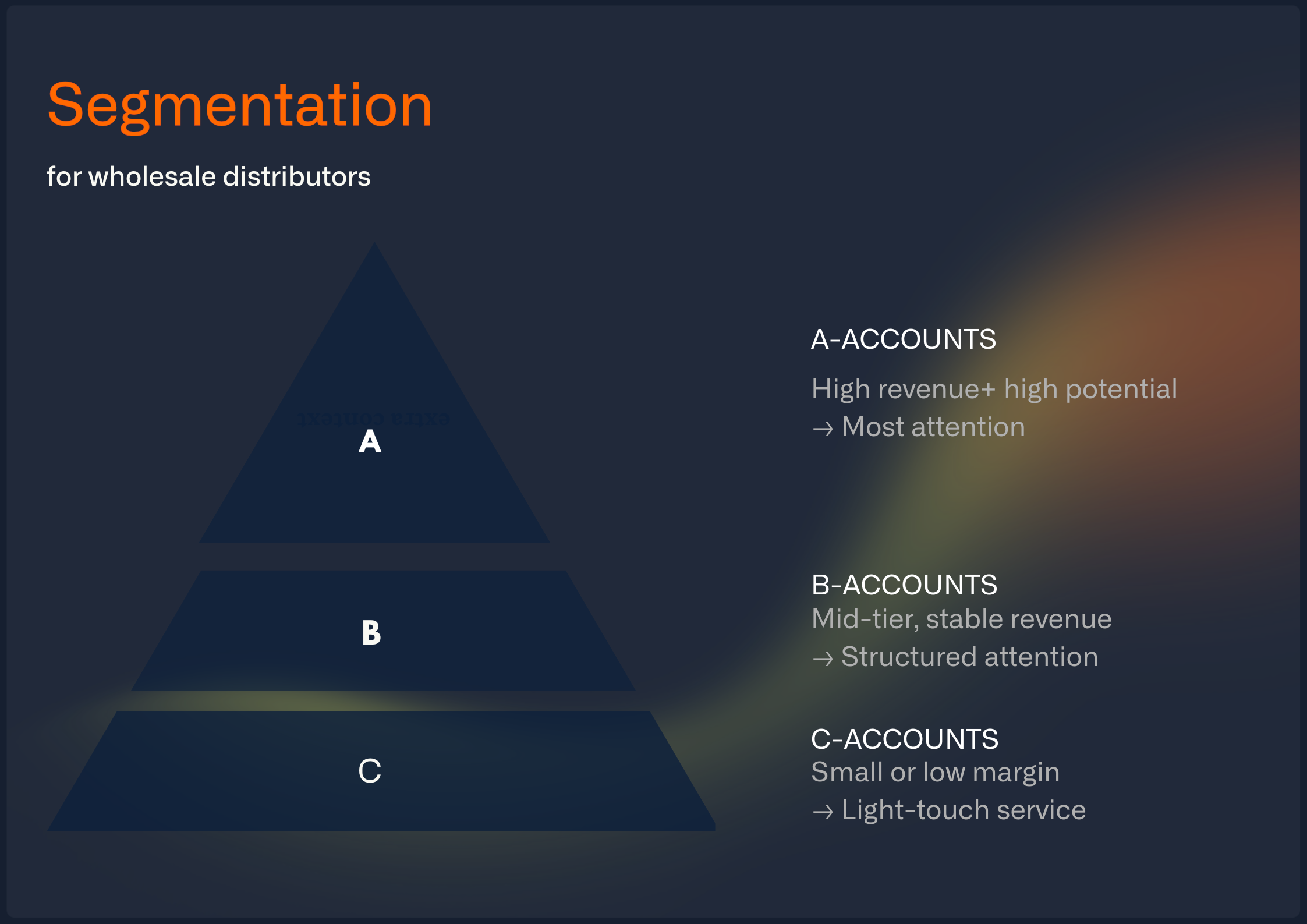
- A-accounts: high revenue and high growth potential. They drive the bulk of the margin and deserve regular, proactive attention, tailored offers and strategic conversations.
- B-accounts: solid mid-tier customers with steady revenue and less growth. They need structured, plannable check-ins and targeted cross-selling.
- C-accounts: small or low-margin customers. Important to keep, but not the focus. Efficiency rules here: standardised offers, digital ordering, light-touch communication.
The principle: attention follows value. The higher an account's impact, today or tomorrow, the more active selling time it gets.
A common mistake is to segment only by last year's revenue. A B-customer who buys most of their range from a competitor can hold more potential than a saturated A-customer. That is why segmentation should also consider future potential, for example through share of wallet analysis or white space analysis.
| Segment | Typical profile | Coverage model | Main sales goal |
|---|---|---|---|
| A-accounts | High revenue and high potential | Regular in-person visits, strategic account planning | Protect and expand: early churn warnings, cross-selling, contract renewals |
| B-accounts | Steady revenue, moderate potential | Planned visits plus phone and video calls | Grow share of wallet with targeted cross-selling and upselling |
| C-accounts | Small or low margin | Inside sales, webshop, event-driven visits | Serve efficiently, spot customers that are growing into B |
Segments are a starting point, not a fixed rule. A sudden drop in orders at a C-customer or a large open quote at a B-customer can justify a visit this week. More on this: potential-based selling and B2B account management.
The playbook: how to win in wholesale distributor sales
Most distributor sales teams still work reactively: they chase whoever calls, handle complaints and visit customers out of habit or gut feeling. The teams that grow in 2026 turn this around and make distributor sales proactive and data-driven.
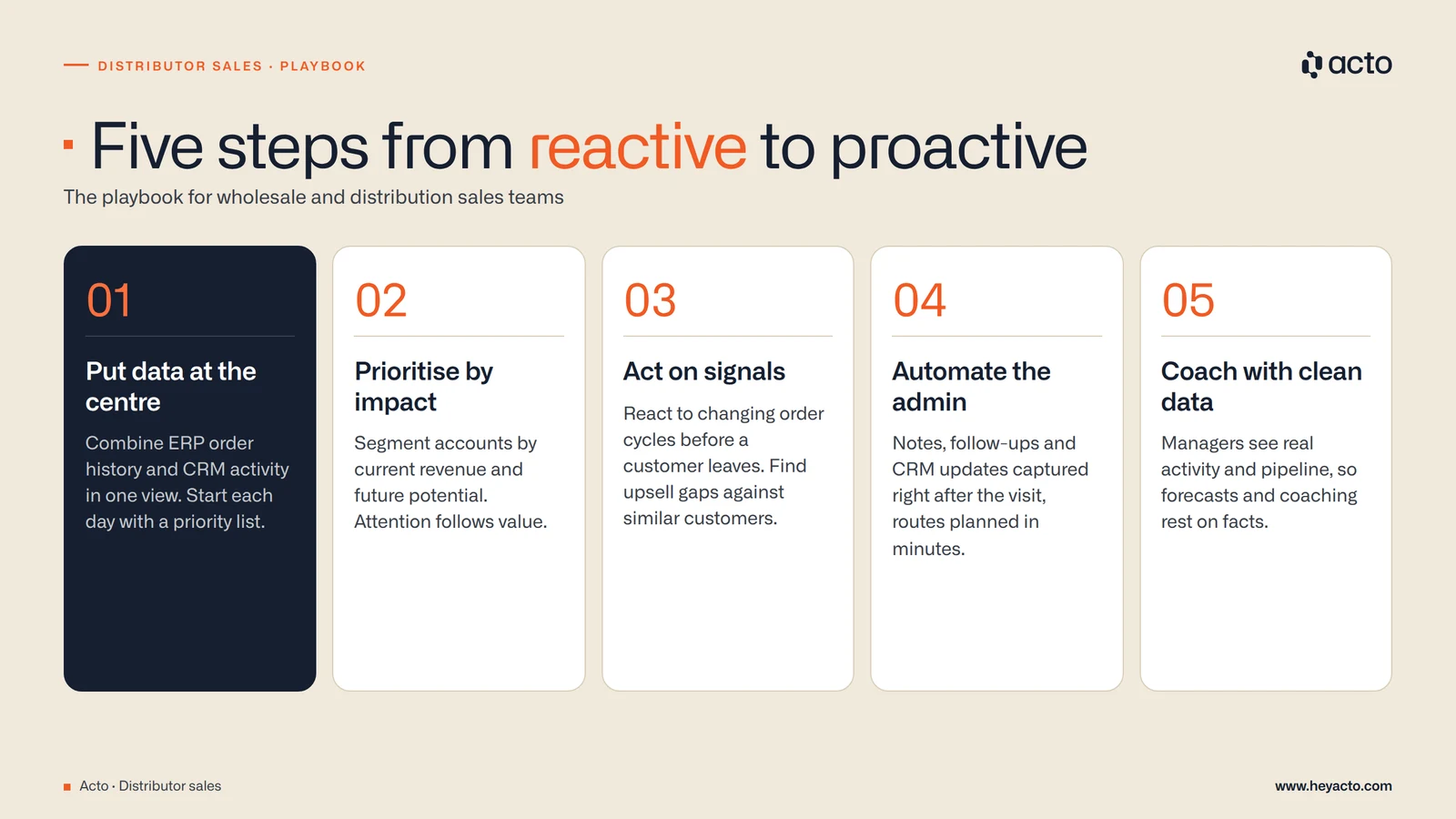
1. Put data at the centre of sales
- Combine ERP order history and CRM customer interactions in one view.
- Use buying patterns to spot who is due to reorder and where volumes are starting to drop.
- Make sure every rep starts the day with a clear priority list, not a blank calendar.
.png)
2. Prioritise accounts by impact
- Apply ABC segmentation consistently.
- Assess both current revenue and future potential.
- A-accounts get the most attention, B-accounts structured touchpoints, C-accounts efficient, light-touch service.
3. Move from reacting to acting
- Spot churn early: act when order cycles change, not once the customer has gone. More on this: how to prevent customer churn.
- Find upsell opportunities systematically: compare similar customer profiles and see what they buy that this customer does not. More on this: cross-selling in B2B and upselling in wholesale.
- Use meeting briefs: last orders, open quotes, risks and product recommendations at a glance. With Acto, a rep is ready for a meeting in about two minutes, in the app or directly in Outlook.
4. Automate the admin
- Capture notes, follow-ups and CRM updates automatically, ideally by voice right after the meeting.
- Do route planning in minutes rather than hours.
- Selling time should be customer time, not spreadsheet time. Across industries, reps spend only 28 percent of their week actually selling, according to Salesforce.

5. Coach with clean data
- Managers can only coach well if they see the real state of accounts and pipeline.
- With every call, meeting and opportunity documented, they can spot early who is losing accounts and which reps generate the most cross-selling.
- Forecasts and coaching rest on facts, not gut feeling. More on this: field sales KPIs.
The common thread: proactive, data-driven, impact-oriented. Teams that get there reduce churn, sell more across the range and use their time where it matters.
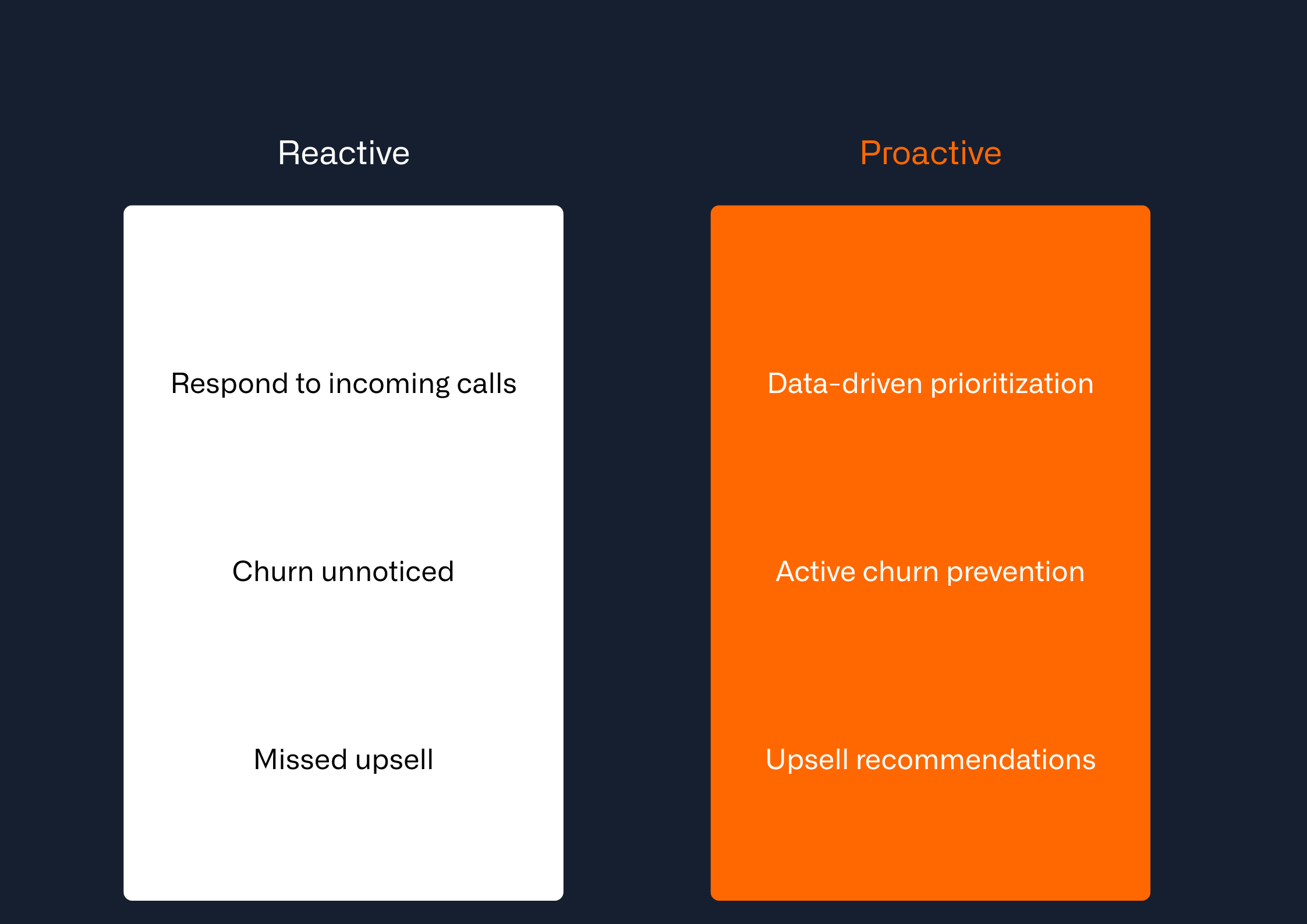
What proactive distributor sales delivers in practice
Distributors and manufacturers that run their field sales on ERP-based signals report clear effects. Results from Acto customers:
| Company | Industry | Result |
|---|---|---|
| Schäfer Shop | Office and business supplies | +11.2 percent revenue (A/B test), up to 8 hours saved per rep and week, 92 percent of signals marked helpful |
| Böllhoff | Fastening technology | +8.6 percent revenue (A/B test) |
| Plate | Office supplies | +10 percent revenue, 1 to 1.5 hours saved per day, 35 percent shorter time between orders |
| Hitado | Medical technology | +5.4 percent revenue |
Customer results as reported in Acto case studies. More examples: customer stories.
Common mistakes in distributor sales
- Treating all customers the same: resources get spread too thin.
- Too much admin: reps spend less than a third of their time selling (see above).
- Spreadsheets as the steering system: by the time the data is used, it is already out of date.
- Separating sales and operations: promises break faster than trust can be rebuilt.
- Ignoring AI: AI in wholesale is already in daily use. Teams that do not use it leave the field to competitors who do.
The future of wholesale distributor sales
The fundamentals stay the same: buy in volume, deliver efficiently, keep customers. What is changing is how distributors sell:
- Hybrid models: strategic customers in person, others through inside sales, webshops and standardised processes. With most B2B buyers preferring to research on their own, the field visit has to deliver something the webshop cannot.
- Real-time transparency: stock, prices and delivery status visible to customers and reps alike.
- Intelligence in sales: signals for upselling, churn and pricing delivered straight into the rep's day. Gartner expects that by 2027, 95 percent of seller research workflows will begin with AI, up from less than 20 percent in 2024. More on this: AI in field sales and revenue intelligence for wholesale.
Distributors that make the switch now gain twice: higher margins and more loyal customers.
Conclusion
Wholesale distributor sales is not "just moving boxes". It is the art of balancing scale, margin and customer loyalty in one of the toughest business models there is.
The winners in 2026 are the teams that:
- prioritise customers by impact,
- use data for decisions,
- act proactively instead of reactively,
- strengthen leadership through coaching and transparency.
The question is not whether distributor sales is changing. The question is: how fast will your team adapt?
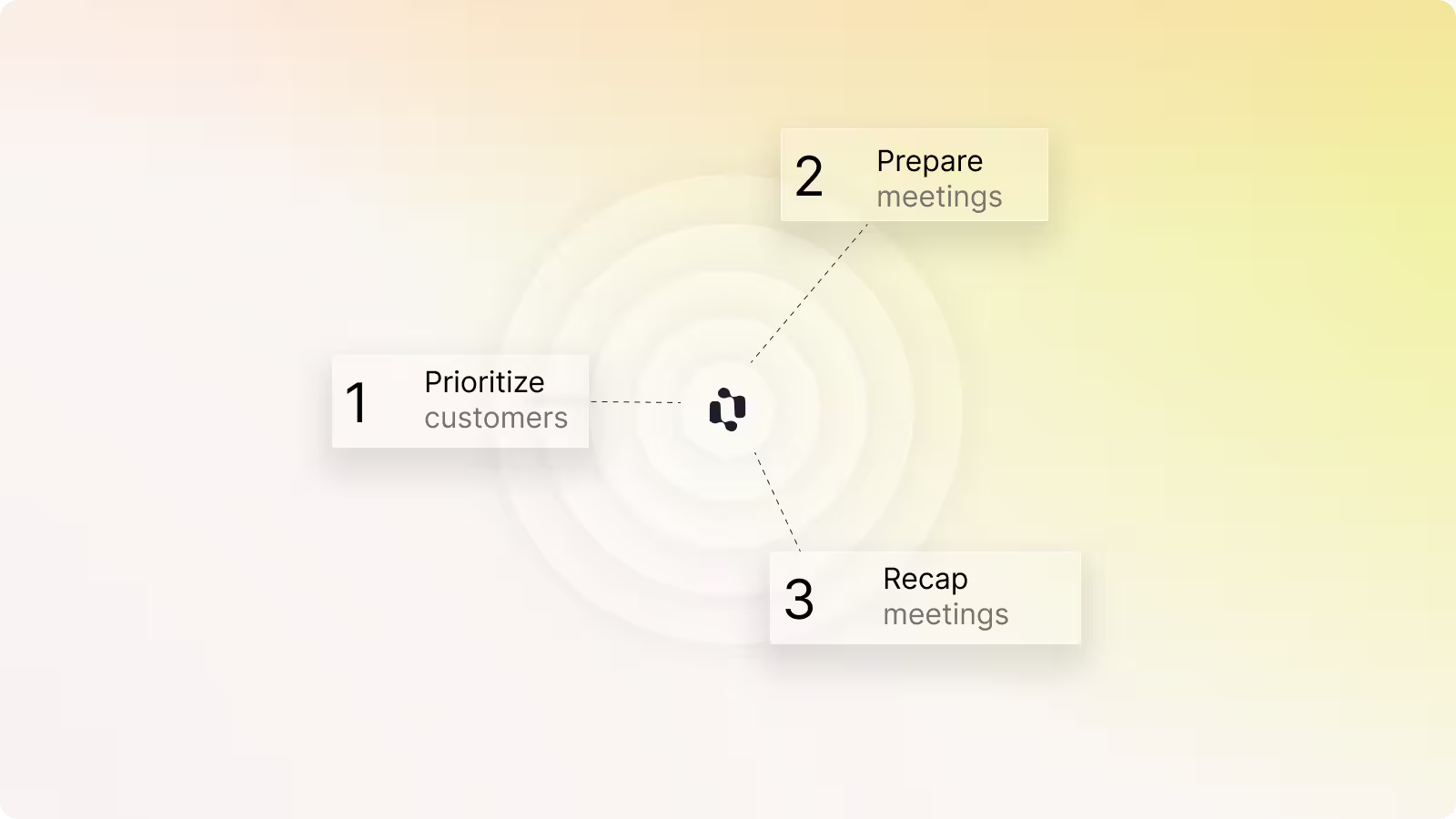
Want to see how proactive selling works with your own ERP data? Book a free consultation with our team.
FAQ: wholesale distributor sales
What does a sales rep at a wholesale distributor do?
A distributor sales rep looks after a portfolio of existing customers and new prospects, advises on products and ranges, negotiates prices and conditions, follows up on quotes and keeps an eye on changes in buying behaviour. In field sales, much of that work happens on customer visits.
How many customers does a distributor sales rep manage?
It varies widely by industry and model. In our customer projects, field reps often look after 300 to 1,000 accounts. At that scale, reps need clear priorities to know which customers need a visit this week.
How can distributors grow revenue with existing customers?
Most growth potential sits in the existing customer base: products a customer buys elsewhere, reorders that are overdue, and quotes that were never converted. Systematic analysis of ERP order data reveals these opportunities. More on this: how to grow revenue in wholesale and growing existing B2B customers.
Which software helps wholesale distributors sell proactively?
CRM systems document activity, but they rarely analyse buying behaviour. Sales intelligence tools such as Acto analyse ERP and CRM data and turn them into visit recommendations, meeting briefs and follow-up tasks. Acto takes in data from SAP, Microsoft Dynamics, Salesforce and other systems via export, SFTP or database access, delivers signals to Salesforce, Dynamics and Outlook, and stores data in Frankfurt. More on this: field sales apps compared.