How to Prevent Churn in B2B: The Practical Playbook Sales Leaders Use to Protect Revenue

Summary
- B2B churn is predictable. It shows up as subtle changes in buying behavior long before a customer leaves.
- Most companies never see those signals because they sit buried in ERP and CRM data that reps don’t have time to analyze.
- Churn prevention becomes reliable when you:
(1) detect early signals, (2) react quickly, (3) automate follow-up. - Modern sales teams use revenue intelligence to surface churn risks and guide the next best action directly in existing workflows.
Why preventing churn in B2B matters more than winning new business
In B2B, a single lost account can erase months of acquisition efforts.
One customer often means:
- repeated orders,
- multiple product lines,
- and long-term revenue.
When churn hits, it rarely comes as a dramatic cancellation.
It starts quietly:
- fewer orders,
- smaller baskets,
- slower replies,
- rising complaints.
Finance only sees it when the revenue report turns red — and by then the customer is already gone.
The real reason B2B churn stays invisible
Field sales teams in wholesale and manufacturing:
- manage hundreds of accounts
- across thousands of SKUs
- while spending most of their time on the road
Dashboards and spreadsheets simply don’t fit into that workflow.
So churn signals sit inside ERP and CRM — untouched.
Not because people don’t care, but because:
- there’s no time to analyze trends,
- reps work off gut feeling,
- follow-ups live in inboxes and memory.
The result: churn becomes a surprise, not a signal.
The churn prevention system that actually works
Across high-performing B2B sales teams, the process looks similar.
Three building blocks:
1. Detect early churn signals automatically
Churn is not random.
It has patterns.
Signals worth monitoring:
- reduced order frequency
- shrinking basket size
- missed routine reorders
- switching to cheaper product alternatives
- more service incidents
- new buyer or procurement changes
- long gaps between replies
Traditionally, spotting this required manual analysis.
Today, revenue intelligence tools scan ERP and CRM data and surface at-risk accounts automatically.
A rep doesn’t need to hunt for the signal.
They simply get a prompt:
“These customers show unusual buying behavior — here’s the context.”
This is how software quietly prevents churn:
not by adding another dashboard, but by pushing the insight to the moment the rep can act.
2. React fast with a clear conversation path
Once risk is detected, time matters.
A simple, repeatable rescue playbook:
1. Reach out quickly
“Noticed your regular order didn’t come through — can I help with anything?”
2. Diagnose the reason
- supply issues?
- price pressure?
- competitor quote?
- product fit?
3. Offer something concrete
- faster delivery
- alternative SKUs
- bundled pricing
- service check-in
4. Lock the next step
- send a quote
- schedule a visit
- trial shipment
- follow-up call
The rep doesn’t need a script —
they need the right timing and the right context.
3. Make follow-up automatic (this prevents silent churn)
Silent churn happens when the customer actually responds…
and nobody follows through.
This is the part that hurts revenue most.
Modern teams prevent it by:
- recording a quick voice note after a call,
- turning it automatically into CRM updates,
- auto-creating tasks and reminders.
A 20-second note becomes:
- written summary,
- follow-up task,
- next-step reminder.
No admin.
No forgotten promises.
No quiet churn.
What churn prevention looks like in the field
A few real-world patterns from wholesale and manufacturing:
Missed reorder pattern
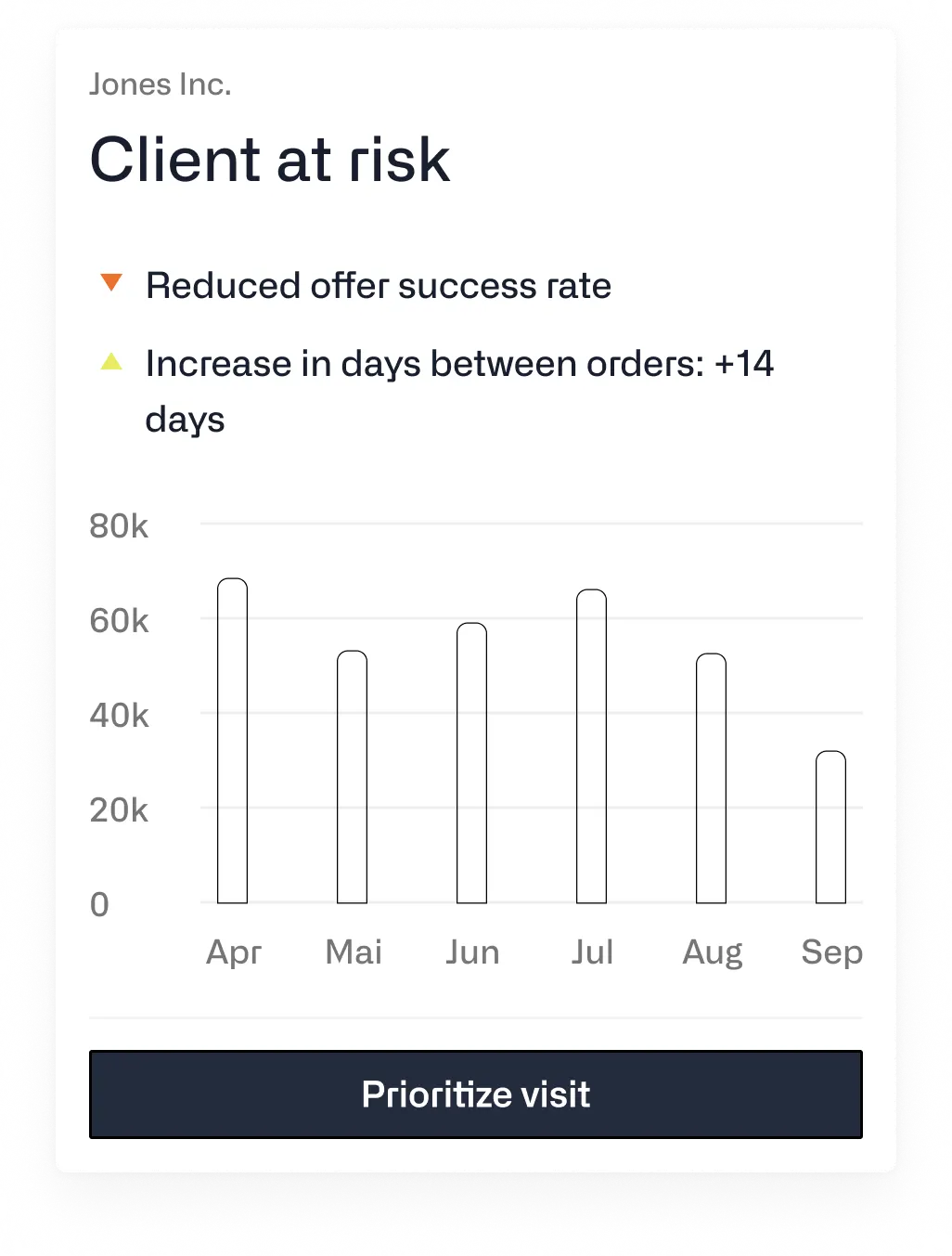
A customer who buys every 6 weeks suddenly goes silent at week 10.
Software alerts the rep → rep calls → discovers a stockout issue → offers alternative product.
Customer stays.
Upsell gained.
Shrinking basket
Order volume drops slowly across three orders.
System notices → rep checks in → competitor discount revealed → pricing adjusted → contract saved.
Service signals
Complaints increase in a product category.
Affected accounts get flagged → proactive outreach → issues fixed → churn avoided.
The data was always there.
The difference is that the rep sees it at the right moment.
Quick checklist: how to prevent B2B churn
Stop
- guessing who’s at risk
- waiting for quarterly reports
- living in dashboards nobody opens
- relying on memory for follow-up
Start
- scanning ERP + CRM for churn signals
- sending alerts directly to reps
- using short, structured conversations
- automating follow-up tasks
When this system runs, churn drops and repeat revenue grows — without extra headcount.
The bigger shift: from guessing to guided selling
Churn prevention used to mean analysts, spreadsheets, and post-mortems.
Now it’s operational:
- signals surface automatically,
- reps act immediately,
- follow-ups never disappear.
This is what revenue intelligence brings to field sales:
not “more data” — but the right signal at the right time.
Final takeaway
Churn in B2B is predictable.
The signals are in your data already.
When sales teams see them early, respond quickly, and never lose follow-up, revenue stays exactly where it should: with you.
And if you want this to happen without adding dashboards or admin work, revenue intelligence tools like Acto simply make it part of everyday sales work — in email, CRM, and mobile, right where reps already are.
Lastest blog posts
Lorem ipsum dolor sit amet, consetetur sadipscing elitr
Lorem ipsum dolor sit amet, consectetur adipiscing elit. Suspendisse varius enim in eros elementum tristique. Duis cursus, mi quis viverra ornare, eros dolor interdum nulla, ut commodo diam libero vitae erat. Aenean faucibus nibh et justo cursus id rutrum lorem imperdiet. Nunc ut sem vitae risus tristique posuere.