Predictive Analytics in Wholesale: 5 Use Cases and How to Make Them Work

Summary
- Predictive analytics goes beyond backward-looking reports: it forecasts what is likely to happen and recommends what to do next
- The 5 key use cases in wholesale: early churn detection, upselling and cross-selling, pricing, demand forecasting and customer reactivation
- The biggest practical problem: tools go unused because they are too complex. Prioritised daily recommendations for reps work better than dashboards. Not a fit yet for companies with fewer than 100 active customers or no ERP
Picture this: you look after 300 customers, your company carries 50,000 products, and you have 45 minutes a week to prepare. Which customer do you call first?
Ask field reps in wholesale and most will answer honestly: the customers with the best coffee. Or the loudest ones. Or whoever called last.
Pascal Salmen, co-founder of Acto, describes the problem like this (translated from German):
"When you shop on Amazon, you get suggestions such as 'Customers who bought this also bought…' or 'You might also like'. Predictive analytics does exactly that for sales in wholesale […] A rep advises 300 to 1,000 customers at the same time across a range of 100,000 products. No wonder they lose track."
(Source: etailment.de, in German)
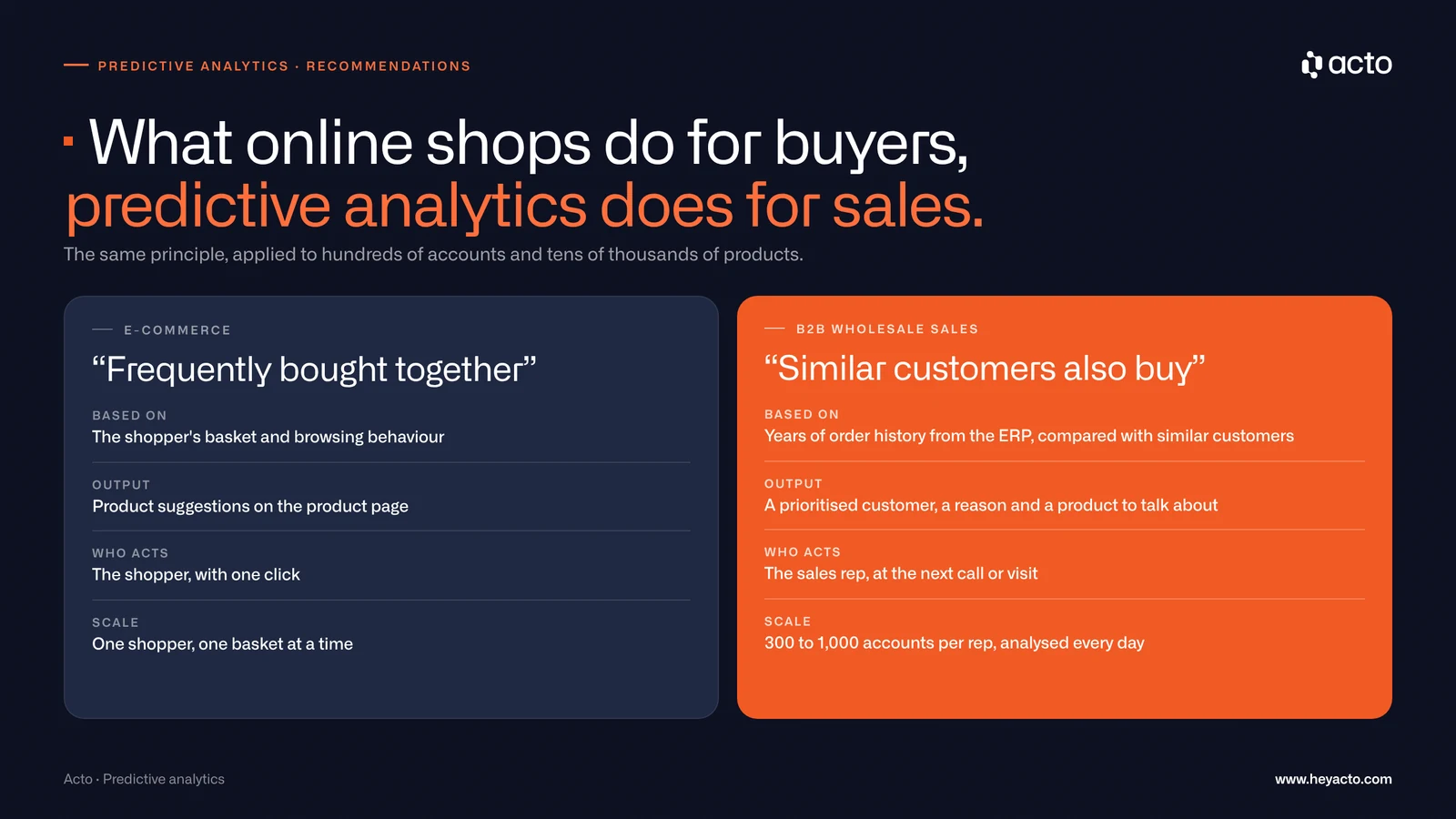
That is the problem predictive analytics actually solves in wholesale. The technology exists and the data usually sits in the ERP already. What is missing is prioritisation: knowing which of hundreds of customers needs attention today.
Interest is high. In the B2B Market Monitor 2024 by IFH Köln (in German), 99 percent of the manufacturers and wholesalers surveyed either already use an AI assistant in B2B sales, are planning one or are at least considering it. In a separate IFH review of 2024 (in German), 38 percent of B2B companies name AI as a central priority, ahead of customer experience (36 percent) and sustainability (31 percent). The same institute also notes that a lot of that potential is lost during implementation. In our experience, poor usability is a far more common cause than a weak algorithm.
This article covers both sides: the five concrete use cases for predictive analytics in wholesale, and the reason why so many implementations still fail.
What is predictive analytics, and how does it relate to BI dashboards?
Before we get to the use cases, a short definition. Not an academic one, but with wholesale examples that make sense straight away.
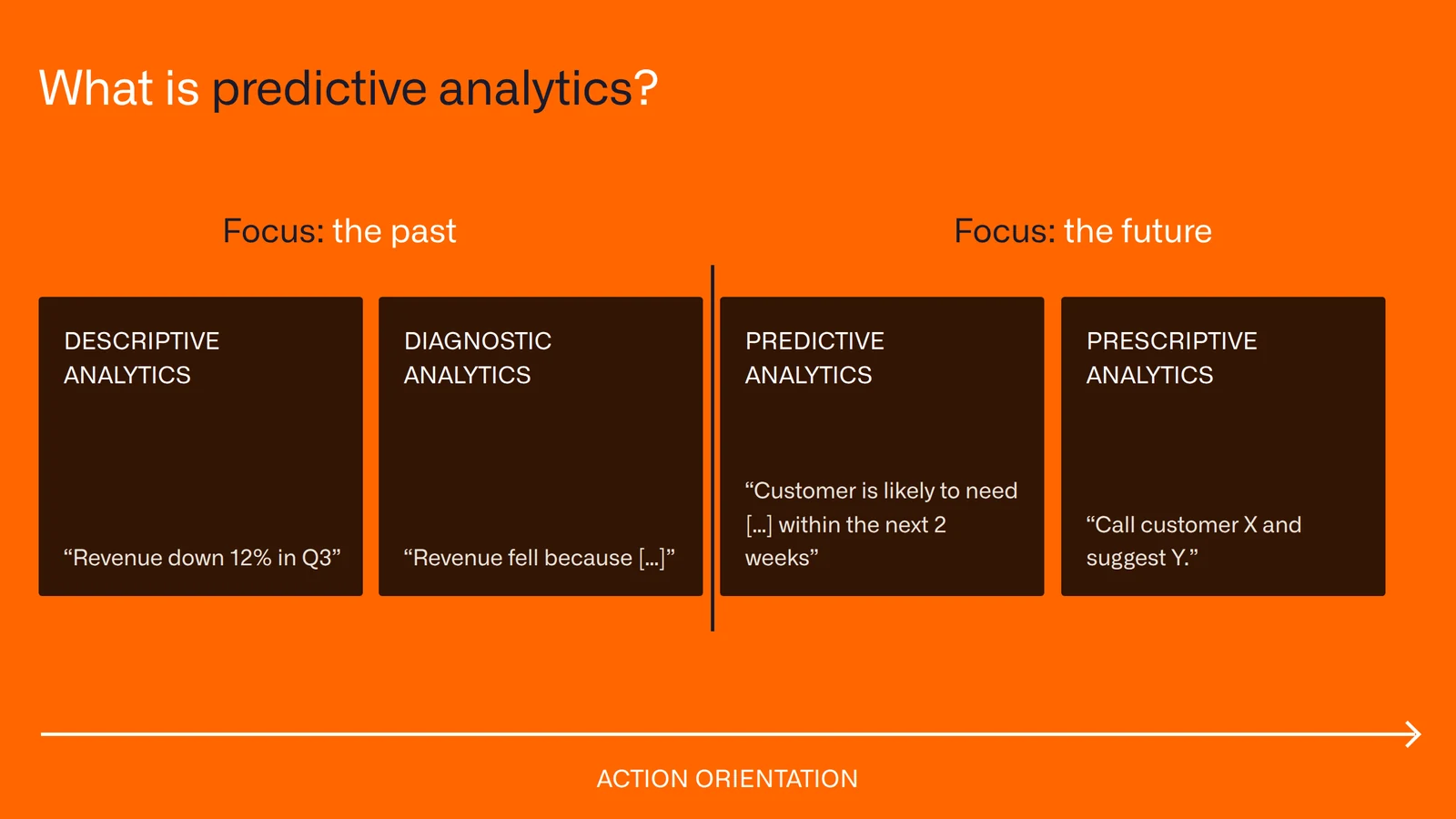
There are four levels of data analysis:
- Descriptive analytics describes the past. Your ERP tells you: "Revenue in Q3 fell by 12 percent." Useful, but always too late.
- Diagnostic analytics explains causes. Why did revenue fall? The analysis shows that three key accounts ordered much less. Still looking backwards.
- Predictive analytics forecasts what is likely to happen. Which customer is likely to churn within the next six weeks? Which product category will see stronger demand next quarter? This is the decisive step from reacting to acting.
- Prescriptive analytics recommends concrete actions. Call customer X today. Offer product Y. Keep prices for customer group Z within this range.
The key difference from classic BI dashboards: BI shows you what happened. Predictive analytics tells you what is coming and what you should do about it now. A wholesaler that only analyses the past will always respond too late to churn, demand peaks and price pressure.
More on the difference between the two approaches: What is the difference between predictive and prescriptive analytics in sales?
The 5 most important use cases for predictive analytics in wholesale
These five use cases come up in practically every conversation we have with sales leaders in wholesale, whether in food, building materials, industrial supplies or HVAC. They show where the real revenue and margin potential lies in day-to-day field sales.
The common thread: we always look at them from the perspective of the sales rep, not the data scientist.
1. Early churn detection: stop customers leaving before it happens
In B2B, customers rarely cancel officially. They simply order less. Then less often. Then not at all. By the time the field team notices, months have often passed, and a competitor has long since taken over the relationship.
This is known as "soft churn" or silent churn, and it is one of the most expensive blind spots in wholesale sales. The economics are well documented. As Harvard Business Review summarises:
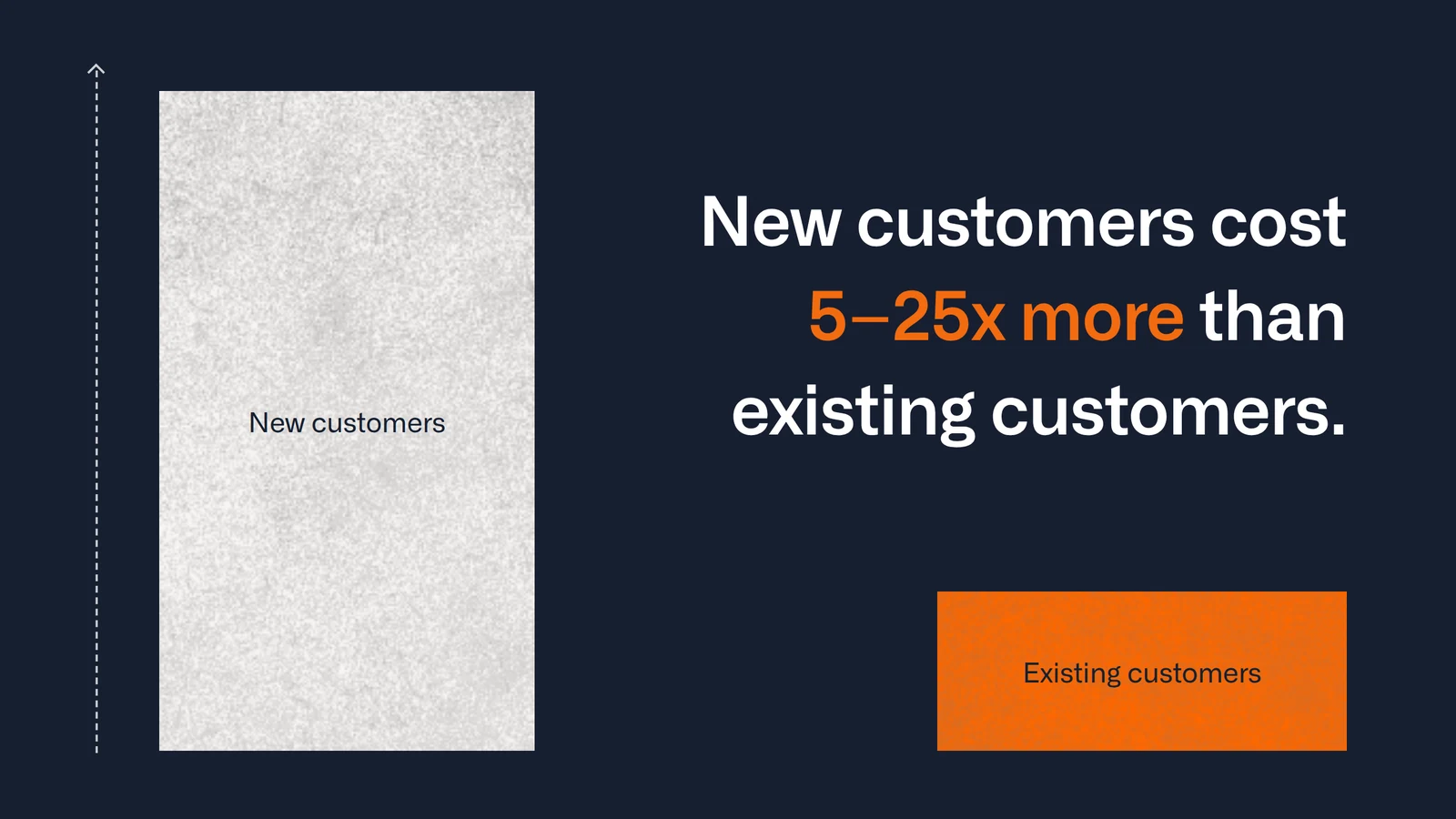
Depending on the study and the industry, acquiring a new customer is five to 25 times more expensive than retaining an existing one.
A sales director at an HVAC wholesaler put it in a nutshell during one of our customer meetings (translated from German): "Our B and C customers don't really feel looked after. We only react when something goes wrong."
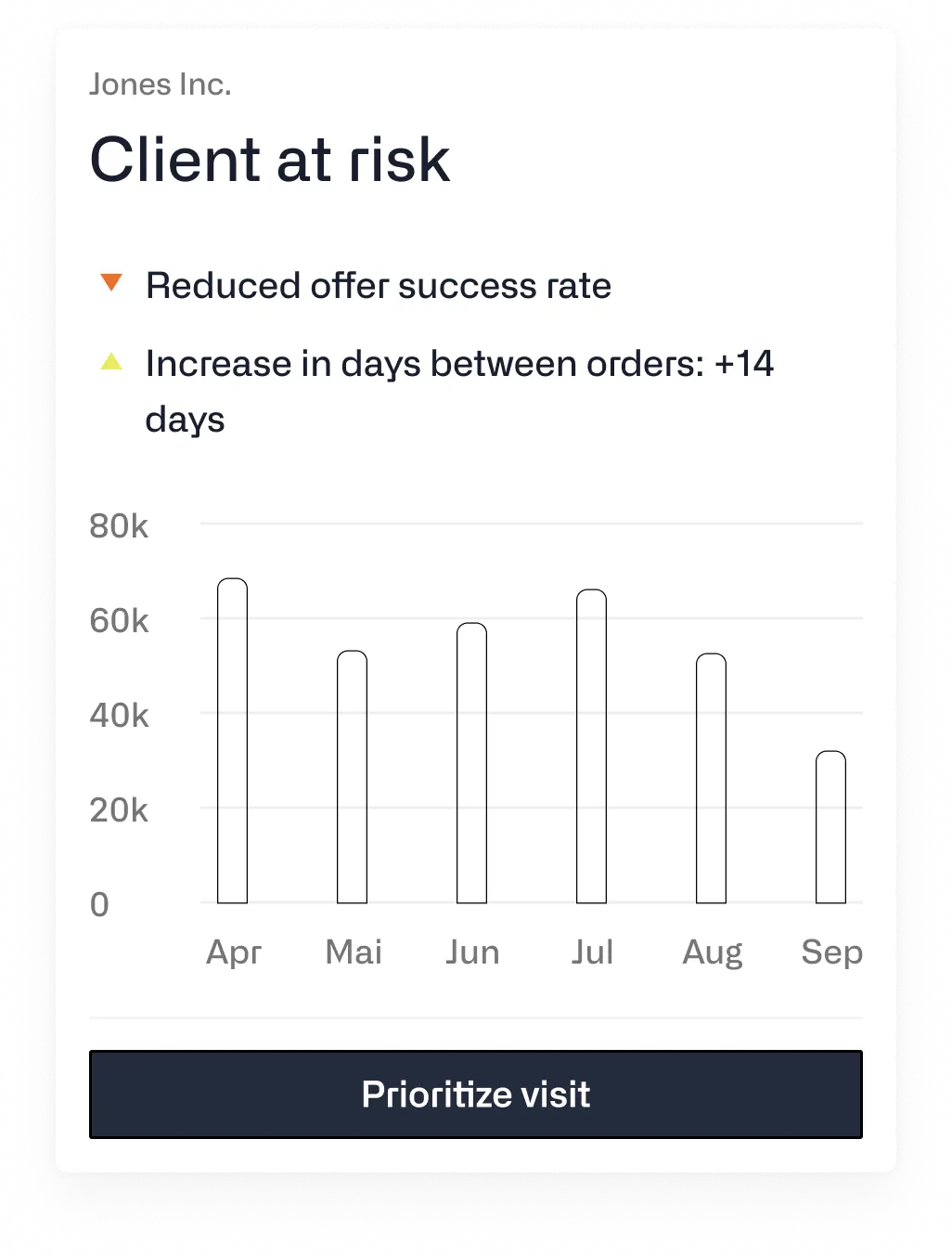
Predictive analytics picks up early warning signs automatically: falling order frequency, shrinking basket size, changes in which product categories a customer buys. It does so weeks before the customer is really gone, and it analyses all 300 customers at once, including the quiet ones. A deeper dive into the signals and countermeasures: How to prevent customer churn in B2B.
What this looks like in practice: at Hitado, a medical technology distributor, the whole inside sales team works with Acto every day. Ilka Greco, Head of Inside Sales at Hitado, describes it like this:
"All inside sales reps at Hitado use Acto daily as the central foundation for customer management. Each day, they receive 10 prioritized signals highlighting the most relevant customers to contact. This enables targeted and efficient customer engagement, and we have significantly reduced churn."
(Hitado case study)
No dashboard with 47 tabs and no digging through reports. Ten customers, each with a signal and a recommended action.
2. Upselling and cross-selling: find hidden potential in existing customers
Existing customers are the most profitable source of growth in wholesale. Every sales leader knows that.
The problem: a rep who looks after 276 customers cannot work out by hand, for each of them, which products they do not buy yet but should.
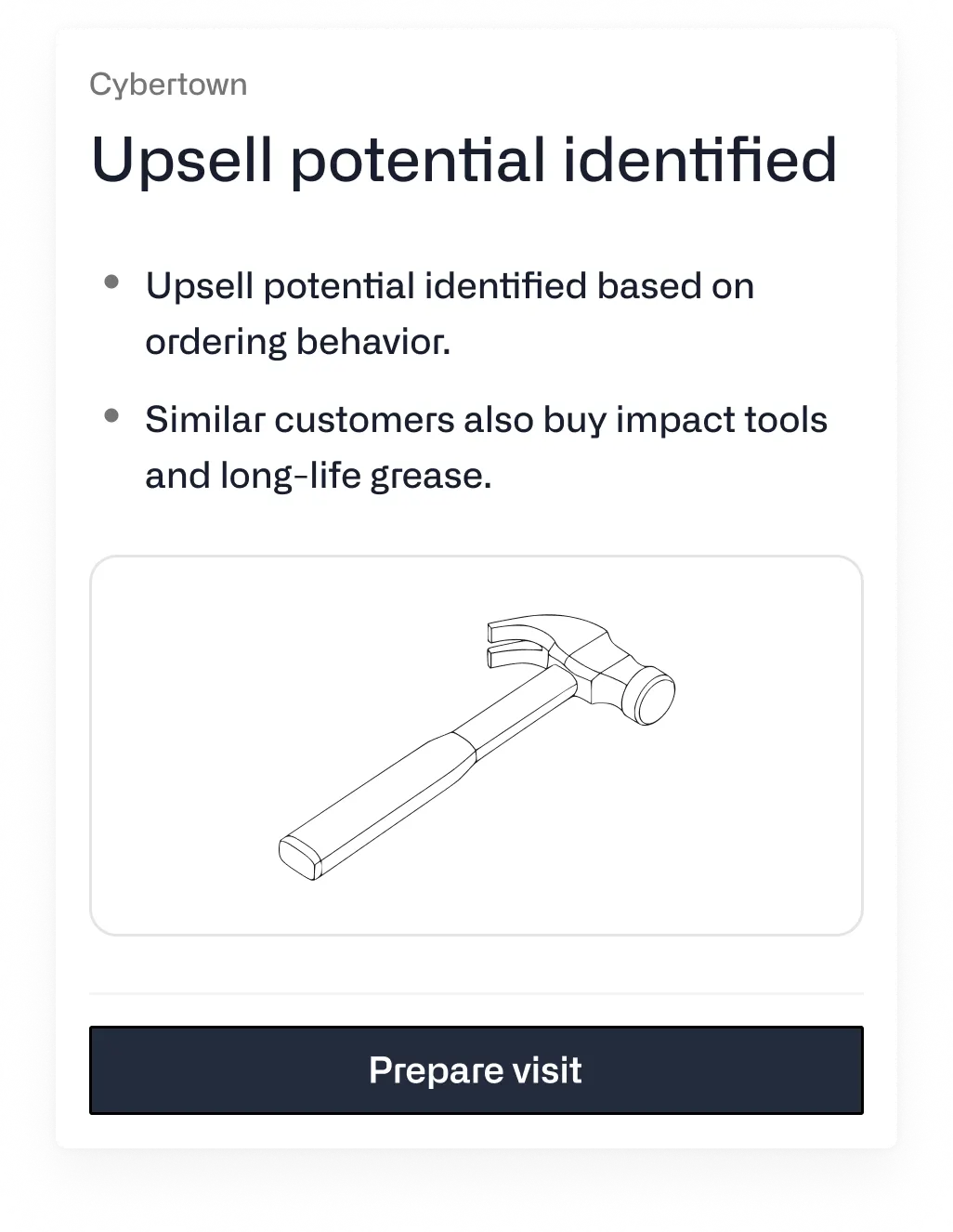
Predictive analytics solves this with collaborative filtering. The system compares a customer's buying pattern with similar customer profiles. Customer A buys products X and Y. Comparable customers regularly buy Z as well. Nobody has ever offered Z to customer A. That is a concrete upsell signal, generated automatically from ERP data. How these models work in detail: Recommender systems in B2B sales.
Böllhoff, an international specialist in fastening technology, saw 8.6 percent more revenue among Acto users compared with non-users in its pilot, driven by upsell opportunities that would otherwise have gone unnoticed. For the field team, this means no more guessing which product to bring up at the next visit. The system shows which customer has catching up to do in which category, ranked by likelihood to buy and by how similar suggestions were received in the past. More tactics: Upselling in wholesale and Cross-selling in B2B.
3. Dynamic pricing: the right price at the right time
Wholesale has no single price list that applies to everyone. Every framework agreement is individual, and every customer relationship has its own price history. The problem: price lists are static, market conditions are not.
In an analysis of distributors, McKinsey describes pricing as "by far the most powerful lever for improving overall margins and increasing profits". According to the same analysis, the distributors that outperform are those whose reps spend less time pricing thousands of items and more time selling, growing share of wallet and delivering on the distributor's value proposition.
Predictive analytics uses the order history to show when a customer reacted to price changes, when margin increases were accepted and where discounts were simply given away. The result is a customer-specific price range with a clear recommendation for the rep before the meeting. A hypothetical example: "No discount needed for this customer; historically, 87 percent of their orders were placed at full price."
That sounds complex. In daily work, it is a one-line recommendation in the meeting prep, derived from years of purchase history that no person could analyse by hand. Acto also flags margin declines and customers whose margin is low compared with similar customers.
4. Demand forecasting: manage stock with foresight instead of reordering reactively
The classic mistake in inventory planning is to take last year's figures and hope demand develops in a similar way. That works as long as no new competitor appears in a region, no supplier drops out and no major customer changes its ordering behaviour.
Predictive analytics combines several factors at once: seasonality, customer growth or decline, changes in the product range and external signals. The result is a forecast that reflects structural change instead of simply extending last year's pattern.
An important note, given the sales focus of this article: demand forecasting is primarily a topic for purchasing and operations. For the field team, the relevant follow-up question is a different one. If the system knows that a customer typically needs more in Q4, the rep can start the conversation early, before the customer orders elsewhere because they did not plan for a longer lead time. A reactive inventory topic turns into an active sales conversation. The same logic applies to recurring orders: How to drive repeat purchases.
5. Customer reactivation: wake up dormant customers on purpose
Inactive customers are a heavily underrated source of growth in wholesale. They already know the company, the effort to win them back is low, and the reason for their inactivity is often a single bad experience rather than a real shift in loyalty to a competitor.
The problem: who can actually be reactivated, and who is gone for good? With 300 customers and limited field capacity, not every inactive account can get the same attention.
Predictive analytics estimates the likelihood of reactivation based on purchase history, industry development and comparable customer profiles. The result is a prioritised list of inactive customers, sorted by potential, with the products they last bought and a concrete suggestion for the conversation.
Data-driven segmentation pays off. Schmitz & Wieseke (in German), a sales consultancy that works with the Sales Management Department of Ruhr University Bochum, reports that companies that cluster their customers deliberately are more successful, including 6.89 percent more revenue with existing customers.
.webp)
What do you really need for predictive analytics in wholesale?
A lot gets overstated here. The short answer: you do not need flawless data, a data science team or a dedicated IT department.
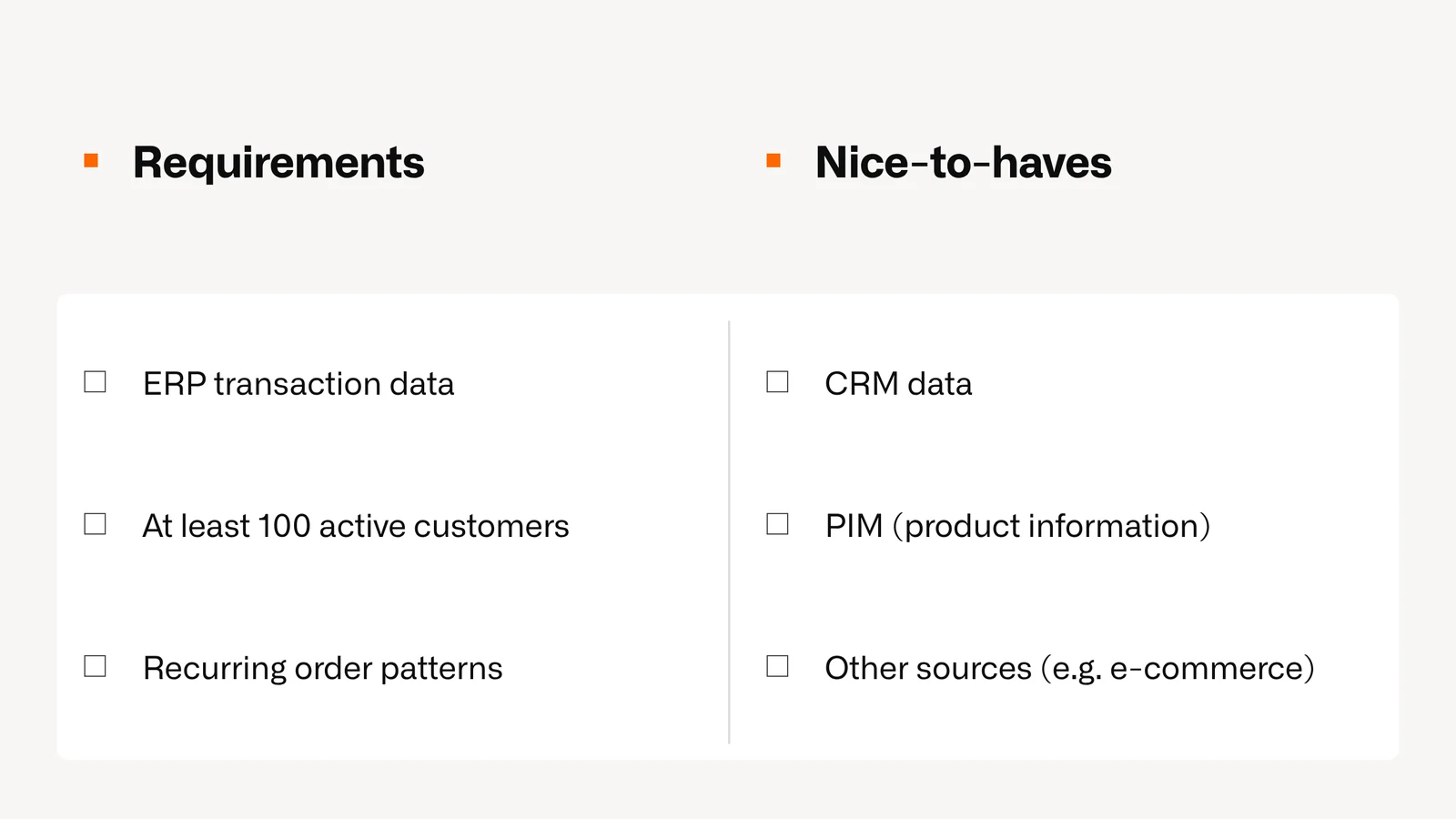
What you do need:
ERP transaction data as the foundation. Order history, baskets, order frequency. Almost every wholesaler with a working ERP system has this. At least 12 months of history is a sensible starting point.
At least 100 active customers. As a rule of thumb, below that the data is too thin for reliable pattern recognition.
Consistent data, not pristine data. This is the crucial difference. According to IFH Köln (in German), the main brakes on AI in B2B are data protection, integration into existing systems and insufficient knowledge of possible applications. The amount of data itself is not on that list.
What you do not need to get started: a data lake, your own algorithms, months of data cleansing or an in-house analytics team.
The most common real hurdle is a different one. Data silos between ERP and CRM make a complete view of the customer impossible. Sales activities sit in the CRM, order data in the ERP, and the two systems do not talk to each other. Modern integration approaches address exactly that. With Acto, many customers simply deliver a scheduled data export to an exchange server, so Acto never needs live access to the production ERP. Direct integrations with SAP, Salesforce, Microsoft Dynamics and Outlook are also available. Go-live takes four to six weeks, with less than three days of effort for the customer's IT team.
Challenges in practice, and how to overcome them
Three challenges come up again and again. None of them is unsolvable, but all of them are routinely underestimated.
| Challenge | Common wrong reaction | Better approach |
|---|---|---|
| Poor data quality | Waiting for "flawless" data | Start with the ERP data you have, then iterate |
| Resistance in the team | Forcing the tool on everyone top-down | Win people over with a pilot group and quick wins |
| System integration | Integrating everything at once | Stabilise one data flow first |
Our recommendation for getting started: begin with early churn detection. The quick win becomes visible fast, the data foundation is clear, and the business case almost writes itself. Run the pilot with KPIs agreed upfront, such as revenue, contact frequency and time saved, so the result can be judged against a baseline.
The underestimated problem: analytics is only as good as its daily use
This is the part most articles on predictive analytics in wholesale leave out.
McKinsey names it directly: "A wealth of sales insights are discoverable today through advanced analytics, but they often don't translate into sustainable revenue for a few reasons: the front line does not trust the data, the insights are overly complex, or reps simply feel that their own experience and expertise are being ignored."
In other words, the gap between insight and action in everyday sales is the weak point far more often than the algorithm.
A predictive analytics system that nobody opens has exactly the same ROI as no system at all. And in many companies that is the reality: impressive dashboards, poor adoption. Why? A field rep with eight customer appointments a day has no time to work through a dashboard with 40 KPIs and twelve filter options. They need an answer in 30 seconds: who do I call today, and why? If a tool cannot answer that question in 30 seconds, it will not be used.
What separates analytics that works from analytics that gathers dust is mostly design, and only to a small degree the quality of the algorithm.
The Schäfer Shop team confirms this from its own experience: Acto's AI-driven insights and automation save their sales team up to 8 hours every week. The amount of data is the same as before; the relevant findings are simply ready when the rep needs them.
The IFH Köln figures point in the same direction: almost the entire B2B sector expects large revenue potential from AI-supported sales steering, yet a lot of that potential is lost during implementation. A frequent reason in our experience: tools built for analysts rather than for field reps.
The fix lies in design far more than in training: daily, prioritised recommendations instead of dashboards with 40 KPIs, and a ready-made signal with a recommended action instead of complex self-service analysis.
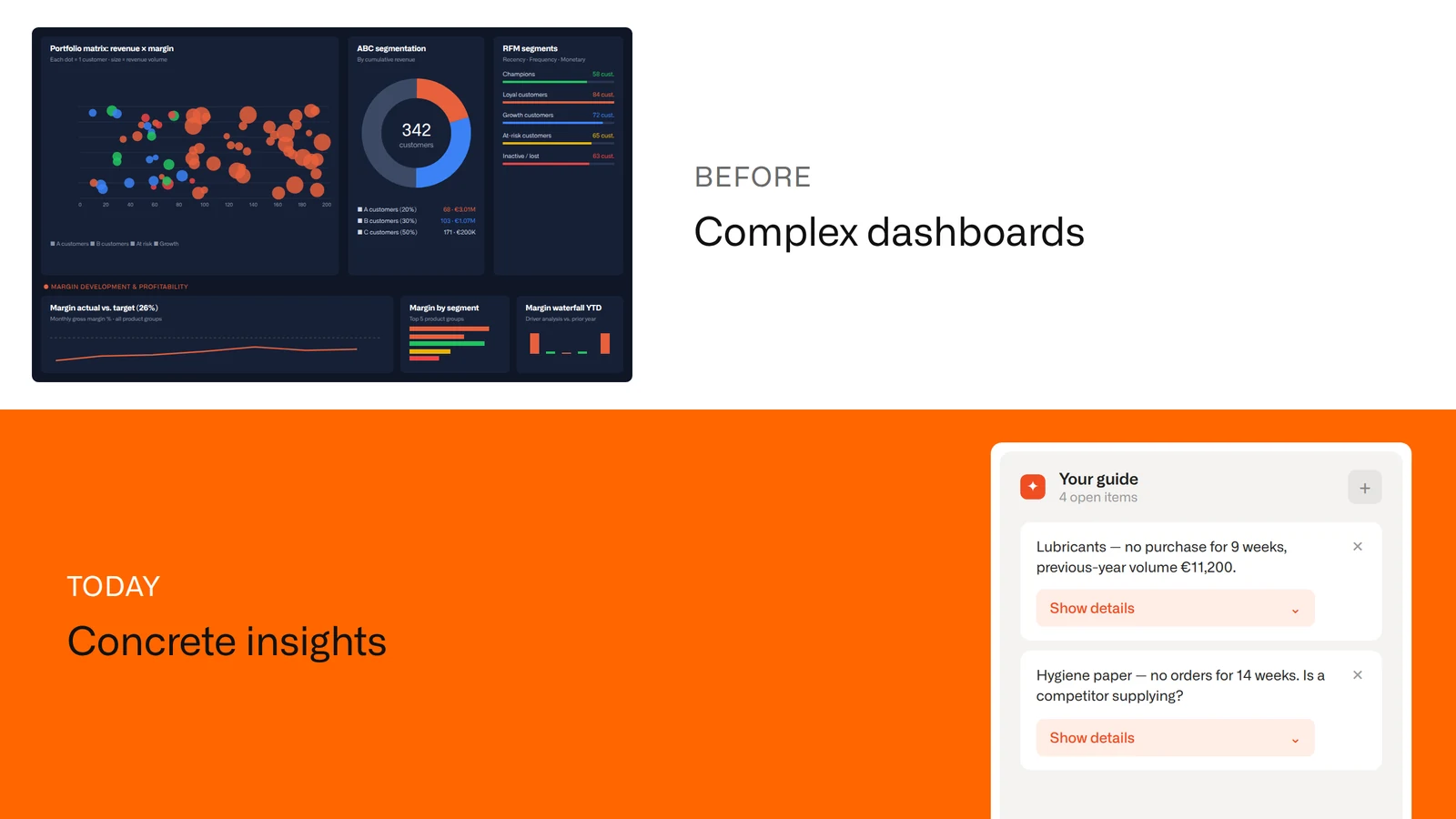
What this looks like in field sales: AI in field sales: examples, trends and inspiration. And how a recommendation becomes the next step for the rep: Next best action in B2B sales.
Acto: predictive analytics for everyday wholesale sales
To position it honestly: Acto is an AI companion for field sales built for wholesale and for manufacturers with direct sales, designed from the perspective of a rep with 300 customers and 30 seconds per decision. It does not replace your BI tool, your CRM or the analytics dashboards used by management.
In the background, Acto runs customer-specific machine learning models for churn risk, growth potential and product recommendations on ERP and CRM data. The 21 signal types include churn risk, revenue and order declines, products a customer has stopped buying, missed repurchases, cross-selling clusters, reactivation, margin changes, open quotes and expiring contracts. In the foreground, the rep sees prioritised customers, each with a concrete signal and a recommended action, in the Acto app or in Outlook. Preparing for a meeting takes about two minutes, and visit reports can be recorded by voice right after the meeting. That information flows into the next round of prioritisation.
.png)
The results from customer pilots, each compared with a control group: Schäfer Shop +11.2 percent revenue, Plate +10 percent revenue, Böllhoff +8.6 percent and Hitado +5.4 percent.
Go-live takes four to six weeks, with less than three days of IT effort. No data science team is needed, and Acto connects to the ERP and CRM systems already in place. Data is hosted on servers in Germany.
Böllhoff's sales team sums up the principle behind it:
"Acto manages all the data complexity so our team can focus entirely on what matters most: our customers."
(Böllhoff case study)
When predictive analytics is not the right fit yet
Predictive analytics can change how a sales team works, but only if the basics are in place. These are the criteria where we also tell prospects at Acto that the timing is not right yet:
- Fewer than 100 active customers. The data is too thin for reliable pattern recognition. A well-maintained CRM helps more than a forecasting model here.
- No digital order data. If orders are still processed without digital records, there is no transaction basis to analyse. Digitise first, then prioritise.
- No ERP system in use. Without structured historical data, every form of pattern recognition lacks its raw material. The foundation is simply missing.
- Purely inbound or e-commerce sales without a field team. If customers only order on their own and nobody in sales actively shapes the relationship, a prioritisation tool for reps is the wrong instrument. Other solutions fit better, such as automated email triggers or recommendation engines on the shop platform.
What helps in that case: data hygiene first, then consistent ERP maintenance. Once the customer base and the data foundation are in place, predictive analytics is a natural next step.
Naming these limits openly shows that the tool was built for a specific audience.
Conclusion: predictive analytics is a sales decision
The five use cases at a glance: early churn detection, upselling and cross-selling, dynamic pricing, demand forecasting and customer reactivation. All five have one thing in common: they only pay off when the field team uses them every day.
For wholesalers, the open questions are how to use predictive analytics and when to start. If you want to go further with your existing customer base, read our guide to data-driven account management in B2B.
Want to see how Acto brings this into your field sales day? Book a free consultation with our team.
FAQ: predictive analytics in wholesale
What is the difference between predictive analytics and business intelligence?
BI describes the past: what happened? Predictive analytics forecasts the future: what is likely to happen, and what should you do now? In wholesale terms, BI shows you that a customer's revenue has dropped. Predictive analytics tells you which customer is likely to churn in the next six weeks, before it happens. The key step is the move from reacting to acting. More on this: 5 analytics use cases for data-driven sales decisions.
What data do I need for predictive analytics in wholesale?
You already have the most important data sources: ERP transaction data with order history, baskets and order frequency. At least 12 months of history and around 100 active customers are sensible starting requirements. Flawless data is not a precondition, but consistent data is. CRM data helps, but it is not a hard blocker for getting started.
Is predictive analytics worth it for mid-sized wholesalers without an IT team?
Yes. Modern tools are built for mid-sized companies without a data science team. Implementation runs via existing ERP and CRM interfaces or a scheduled data export. With Acto, IT effort is less than three days. The field team needs no training in data analysis; reps receive ready-made recommendations they can act on straight away.
How long does it take to implement predictive analytics software?
That depends on the tool. Specialised B2B sales tools such as Acto go live in four to six weeks. Custom data science projects or BI platform rollouts often take considerably longer. Our recommendation: start with a ready-made tool, validate the first use case in a pilot with agreed KPIs, then scale.
How can I spot impending customer churn in B2B early?
Early signals include falling order frequency, shrinking basket size, fewer product categories ordered than in the same period last year, and no response to contact attempts. Predictive analytics detects these patterns automatically and prioritises at-risk customers for the field team, weeks before the customer is really gone. The system analyses all 300 customers at once, including the quiet ones.