Upselling in Wholesale: Strategies for More Revenue from Existing Customers
Summary
- Upselling in wholesale works differently from B2C: no impulse purchases, no anonymous customers, but framework contracts, purchasing departments and established order routines.
- The biggest untapped revenue potential lies with existing customers: acquiring a new customer costs five to 25 times more than retaining one (Harvard Business Review).
- Price ladders, purchase-pattern deviations and C-customer upgrades are the most underrated levers, and finding them systematically takes prepared CRM and ERP data, not gut feeling.
Upselling means a customer buys more, something better, or a higher-value version of what they originally planned to buy. In B2C, that is an algorithm in the shopping basket, a banner, a push notification. In wholesale, it is a conversation.
That sounds simple. It isn't.
There are no impulse purchases in B2B wholesale. Buyers work within budgets, approval limits and supplier contracts. If someone orders 48 units, they order 48 units because that is what their order template says. They could easily buy 50.
| B2C | B2B wholesale |
|---|---|
| Basket algorithm Algorithmic product recommendations right in the checkout. |
Field sales conversation Personal advice wins the order. |
| Pop-ups and banners Visual impulses right in the funnel. |
Framework contracts and budgets Purchasing runs through fixed structures. |
| Anonymous buyers No personal relationship, only clicks. |
Order routines and timing Professional buyers: preparation makes the difference. |
| No conversation needed Self-service drives the purchase. |
Long-term customer relationship Trust and history shape every upsell. |
| Emotional buying impulses Decisions often made in seconds, strongly driven by emotion. |
Data-based recommendations Upselling is based on history, assortment and potential. |
Most articles on upselling are about pop-ups, basket widgets and Amazon recommendations. For wholesalers and distributors with a field sales team, that is about as helpful as a recipe for someone without a kitchen.
Why upselling in wholesale so rarely works, even though everyone talks about it
According to the January 2025 business survey by BGA (in German), the German Federation of Wholesale, Foreign Trade and Services, two thirds of German wholesalers reported falling sales in the second half of 2024. BGA president Dr. Dirk Jandura said he had never seen worse figures.
In a market like this, upselling to existing customers is one of the few growth options that does not need an extra advertising budget. Acquiring a new customer is anywhere from five to 25 times more expensive than retaining an existing one, according to Harvard Business Review. And yet upselling hardly happens in day-to-day field sales. Why?
Reason 1: field sales visits the wrong customers
When sales directors are honest, the same sentence comes up in many conversations: "In the end, you go where the coffee tastes best."
A-customers get a disproportionate share of attention because the relationship is good, the conversations are pleasant and the results are predictable. C-customers get visited when there happens to be time, which means never systematically. Their upselling potential is never addressed because nobody ever analyses it.
A sales analysis by CONSENZUM management consultancy (in German) describes the same pattern: around 20 percent of customers represent 80 percent of revenue, and sales uses at least 20 percent of its resources for just 5 percent of the business. Even many A-customers mainly buy just one product or product group, and the additional sale never happens.
Reason 2: no time to prepare
A rep who visits eight customers a day has no time to dig through the last twelve months of ERP purchase history before each appointment. So the visit ends up being about routine reorders, not about developing the account. Upselling doesn't happen in reactive mode. Reps are willing to sell more. The preparation it takes simply doesn't fit into a full day of visits.
Reason 3: the data is there, but nobody reads it
CRM and ERP systems are full of purchase patterns, deviations, gaps, volume trends and customers ordering just below the next discount tier. This data ends up in dashboards that nobody opens, because nobody has time to interpret them. Gut feeling wins, the data loses.
Then there is the C-customer problem: in many wholesale businesses, C-customers make up a large share of the customer base. They hold untapped potential that no new-customer acquisition budget can replace. How to grow existing customers systematically without new budgets is described in a separate article.
The 4 most effective upselling strategies for wholesalers
The following strategies are built for field sales, with real customers, long relationships and complex assortments.
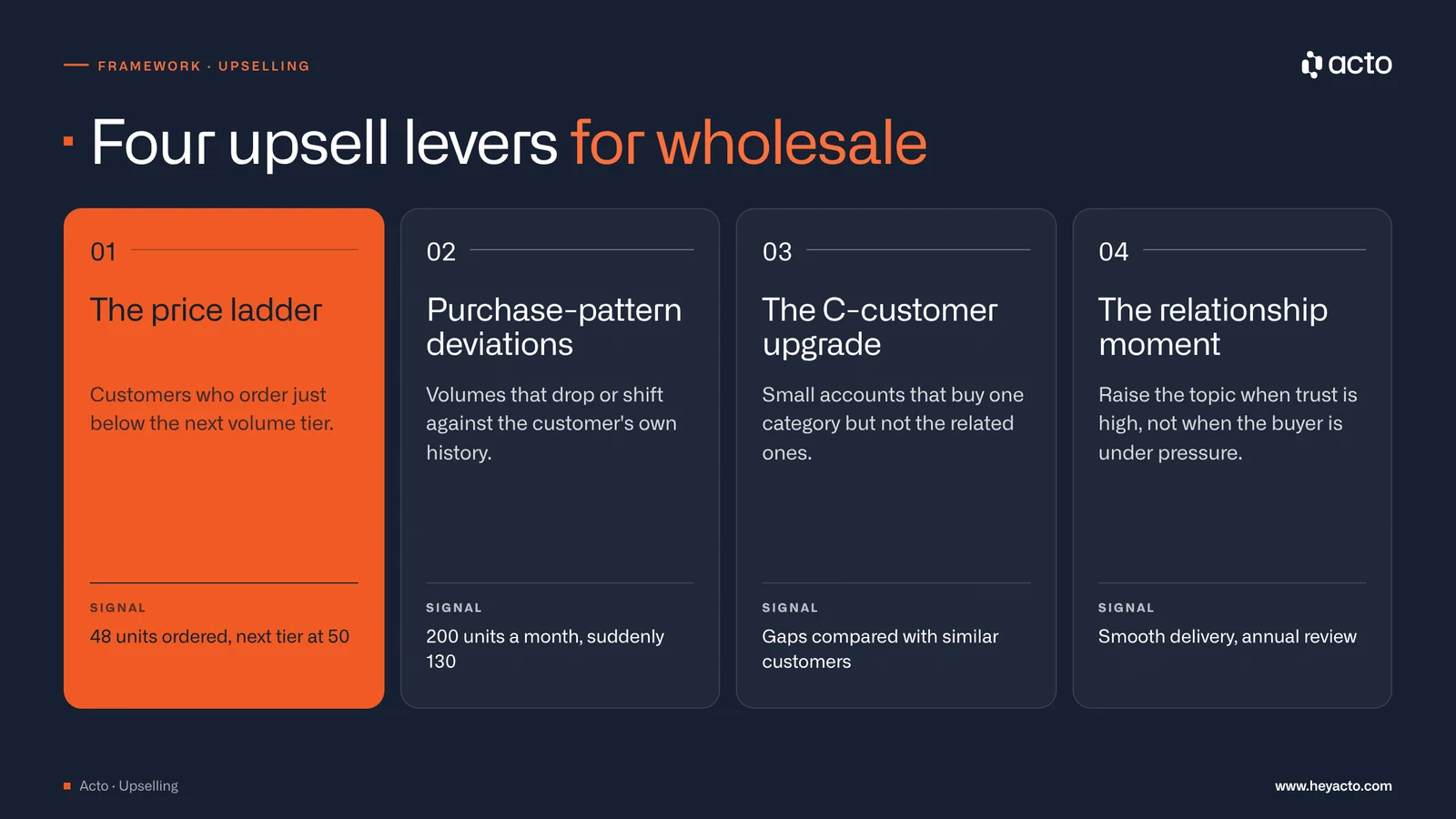
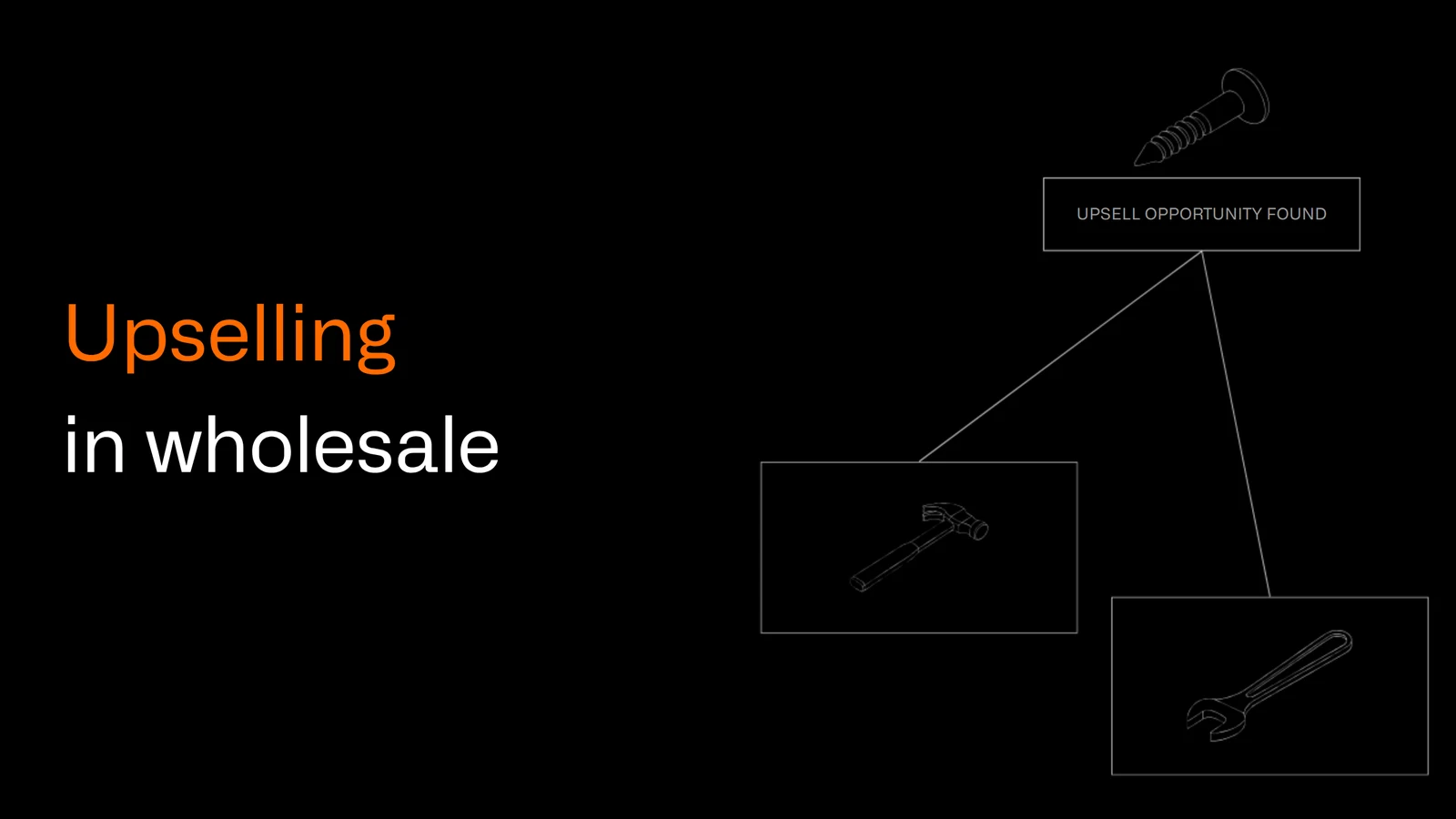
1. The price ladder: volume discount tiers as an upselling mechanism
A customer buys 48 units. The next discount tier starts at 50. The price difference almost always justifies the two extra units. Yet this conversation rarely happens, because the rep simply doesn't have it on their radar.
How to approach it:
- Map your tiers: list the products and categories with volume discounts and note where the tier thresholds are.
- Find customers just below a threshold: filter recent orders for quantities that fall within a few percent of the next tier.
- Calculate the benefit for the customer: work out what two more units cost and what the customer saves on the whole order.
- Bring it up at the right moment: ideally before the next order is placed, not after the delivery note has been printed.
The price ladder works especially well in categories with clear volume steps: MRO products, fastening technology, consumables. If you show the customer the concrete price advantage, an upselling attempt becomes advice. How volume logic relates to share of wallet is covered in a separate article.
2. Deviations in purchase patterns as upselling triggers
If a customer has ordered a steady 200 units of product X per month for the past six months and suddenly drops to 130, there are two possibilities: demand has fallen, or they are buying elsewhere.
Both scenarios are a reason to talk. In the first case, you can help. In the second, you can react while the relationship is still intact.
How to put it into practice:
- Define a baseline per customer and product: average volume over the past six to twelve months.
- Set a threshold: for example, a deviation of more than 20 to 30 percent over two consecutive months.
- Check the context before the visit: seasonality, a project that ended, a known change at the customer.
- Ask an open question in the conversation: "Your orders for X have dropped recently. Has something changed on your side?" The answer tells you whether there is an upsell, a cross-sell, or a churn risk.
Purchase-pattern deviations are the most precise upselling triggers a wholesaler has. Gut feeling sometimes spots them. A data model spots them every time. White space analysis, which identifies gaps in a customer's assortment, takes this one step further.
3. The C-customer upgrade
Writing off C-customers as unprofitable across the board is a mistake. The better question is: which C-customers have the structural potential to become B-customers?
A C-customer who buys steadily in one category and not at all in a related one has simply never received the right offer.
How to approach it:
- Compare C-customers with similar B- and A-customers: same industry, similar size, similar core products.
- Identify the categories they don't buy from you but similar customers do.
- Estimate the potential: what would the revenue be if this customer bought like the average of the comparison group?
- Contact them with a concrete offer, often more efficiently via inside sales or by phone than with a field visit.
At Hitado, this approach led to more C-customers being upgraded to B- and A-customers, because inside sales could contact them strategically for the first time. Ilka Greco, Inside Sales Lead at Hitado:
"We've shifted almost all small-account monitoring in day-to-day operations to Acto, responding directly to its signals. Nothing falls through the cracks anymore."
4. The relationship moment: when the conversation works
Upselling in B2B is a question of timing more than of product.
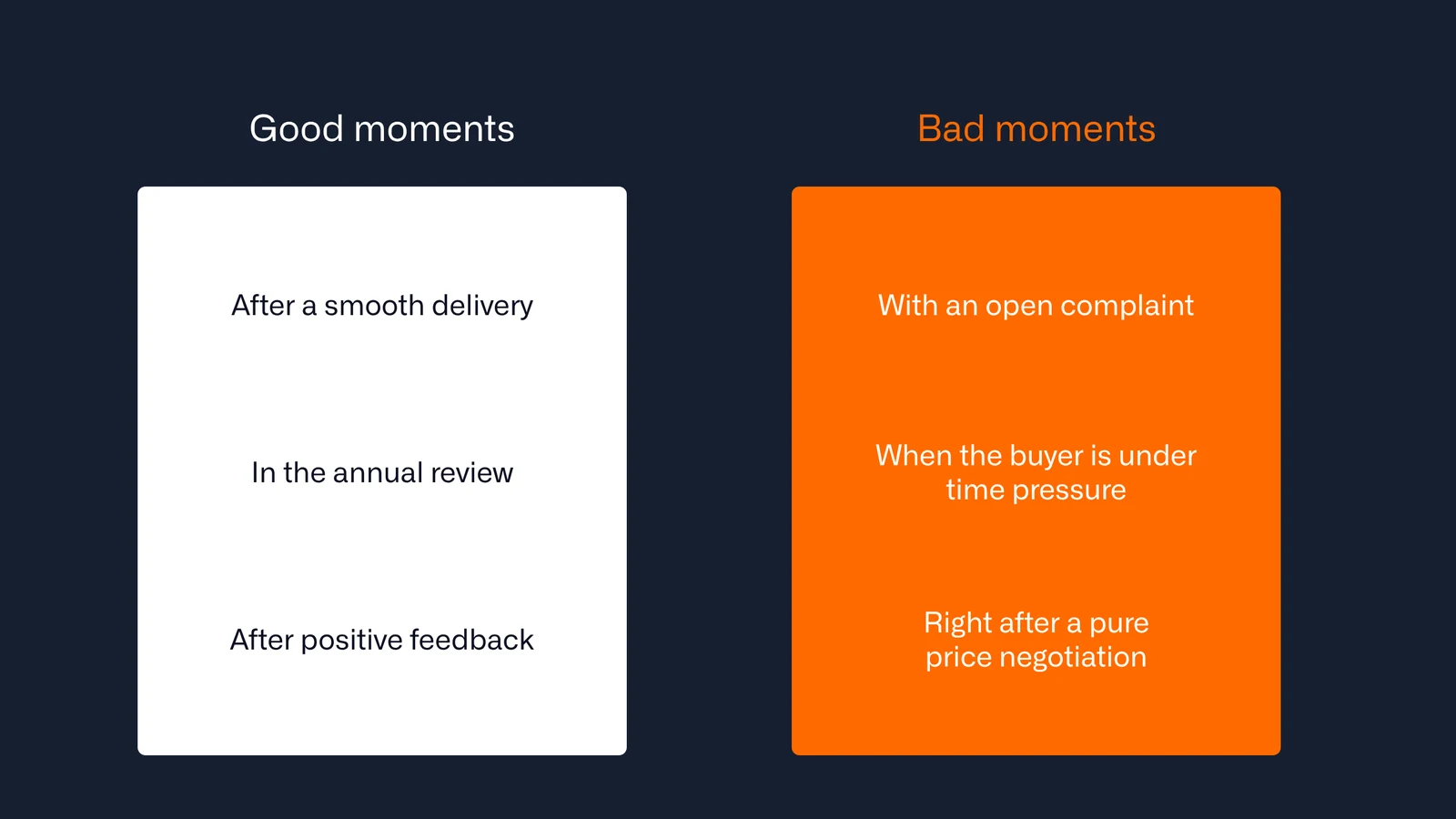
Unlike in B2C, nobody forgets in wholesale. At the next visit, the buyer remembers exactly how the last conversation went. Reps who push at the wrong moment put both the upsell and the relationship at risk. Read more about using repeat purchases as an entry point for upselling.
How AI and data detect upselling opportunities in wholesale automatically
This is where the real scaling problem lies.
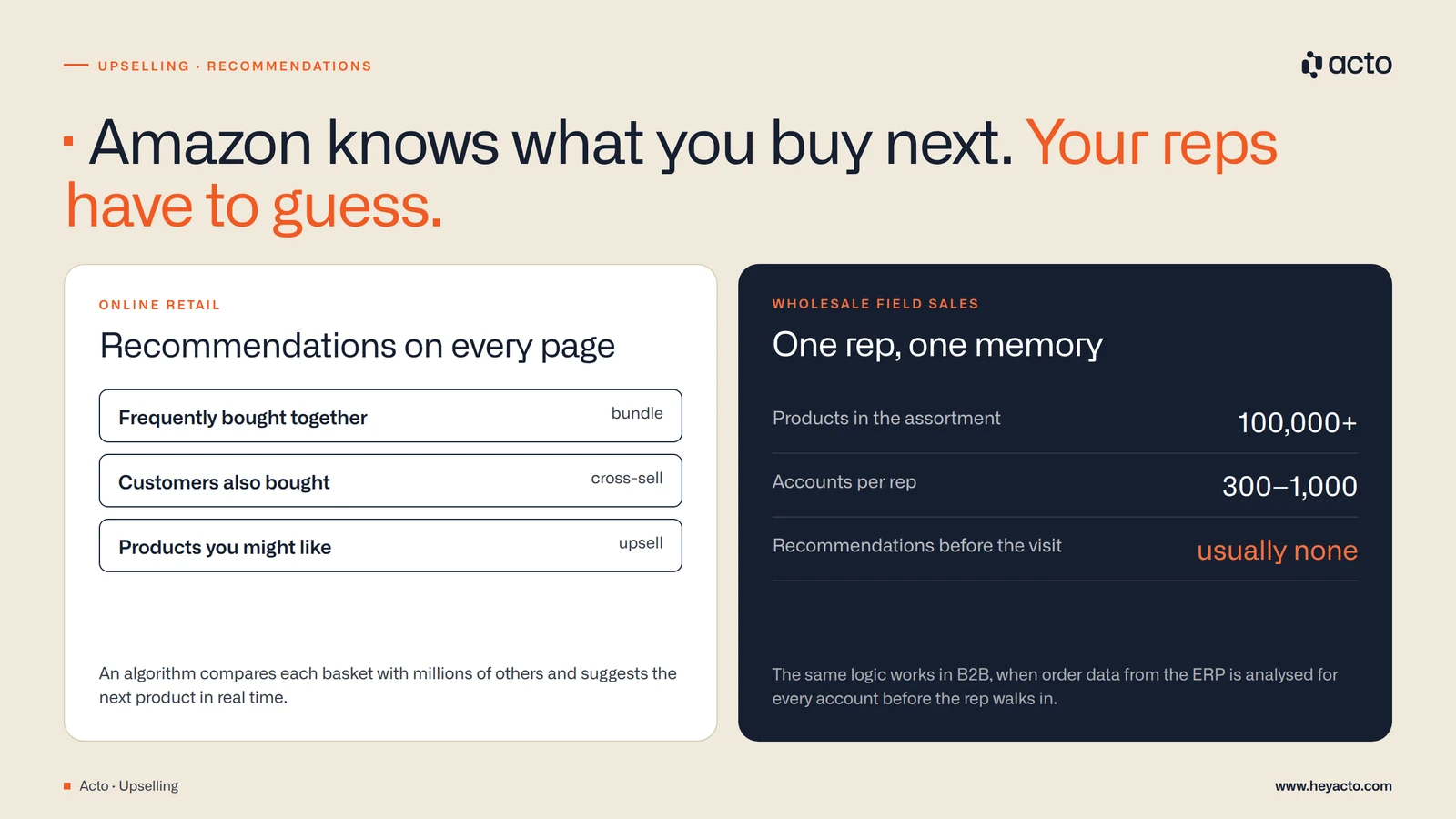
A rep who looks after 300 to 500 customers, with an assortment of 50,000 to 100,000 products behind them, cannot manually analyse where the upselling potential lies for each customer.
Online retail solved this long ago. When you shop on Amazon, you get suggestions such as "Frequently bought together" or "Customers who bought this item also bought". According to McKinsey, as cited by the University of Florida's Warrington College of Business, 35 percent of what consumers purchase on Amazon comes from product recommendations. AI can do the same for field sales in wholesale, where a rep advises 300 to 1,000 customers across a range of 100,000 products. It is no surprise that nobody can keep track of all of it without help. How these systems work is explained in our article on recommender systems in B2B sales.
CRM and ERP already contain everything needed for systematic upselling: purchase history, volume trends, assortment gaps, customers close to the next discount tier, churn signals. What is missing is the preparation of that information at the right time.
The market is moving in this direction. According to the B2B Market Monitor 2024 by ECC KÖLN (in German), 79 percent of manufacturers and wholesalers already use AI for predictive analytics and 76 percent for individual product recommendations. AI-supported sales is no longer a pilot project in the industry.
AI-supported systems analyse transaction data and detect patterns that nobody finds manually:
- Upsell potential: customers who buy less of a product, or a lower-value variant, than similar customers
- Cross-selling clusters and bundles: products that customers with a similar profile buy together
- Volume tier proximity: orders just below the next discount threshold
- Product drop-off and missed repurchases: items a customer used to buy regularly and has stopped ordering
- Low margin compared with similar customers: accounts where price or product mix leaves room
- Open quotes: offers that were only partly converted into orders
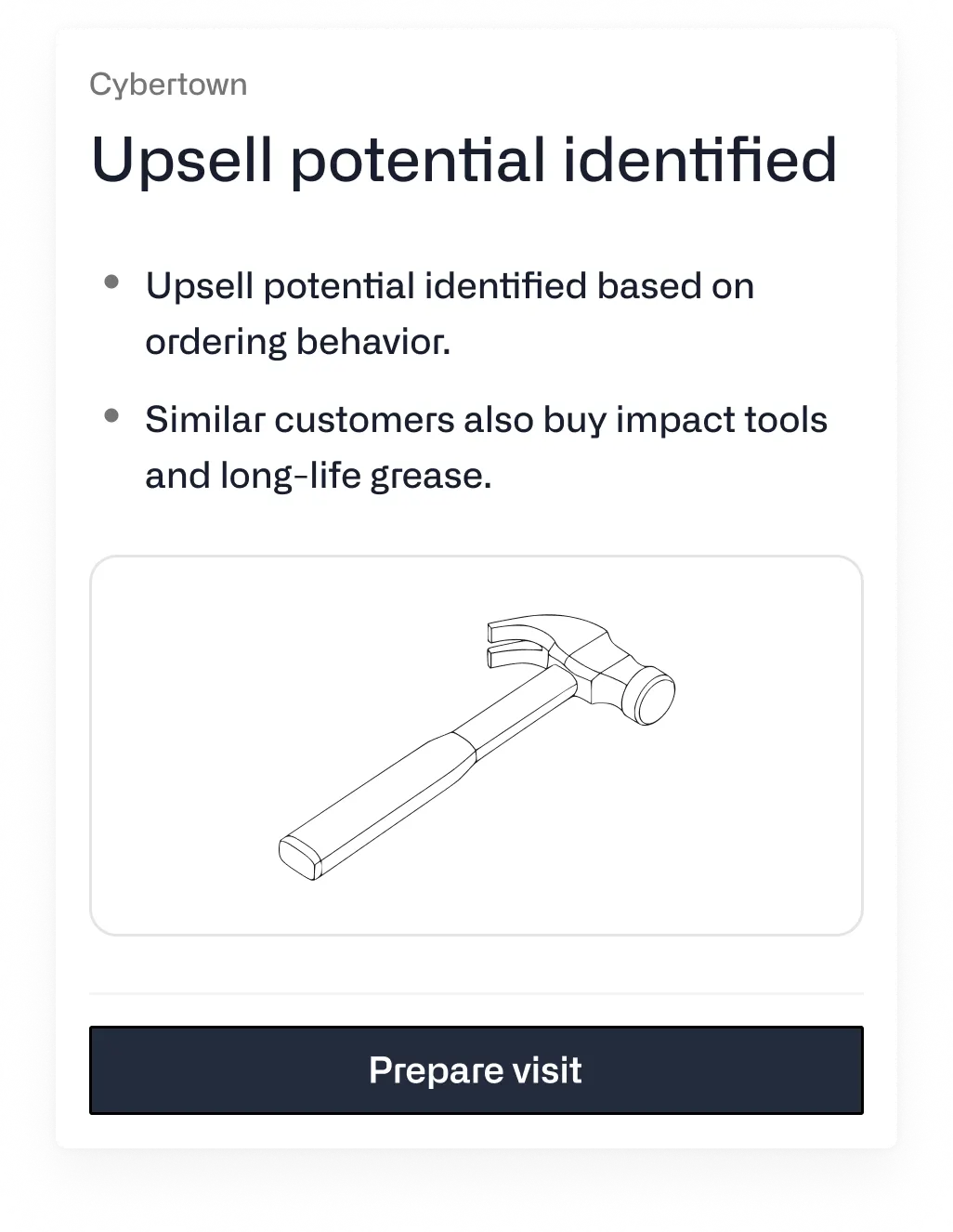
These signals are turned into concrete recommendations before the rep drives to the customer. They arrive as a prioritised list: these three customers today, this is the reason for the upsell, this is the argument.
What this means in practice:
Schäfer Shop, one of Germany's largest B2B online retailers, describes the effect from a sales perspective. Fabian Wolff, Area Sales Manager:
"I start every day with a prioritized list of highly relevant signals—from revenue declines to cross-sell opportunities. It saves me countless hours of research that I can now spend with customers and on targeted selling."
The result: 11.2 percent revenue growth, and reps marked 92 percent of signals as relevant. Böllhoff, a specialist in fastening technology, achieved 8.6 percent revenue growth among Acto users compared with non-users through data-supported visit preparation.
How to set up a potential analysis for potential-based selling methodically, before AI recommendations can be used to good effect, is covered in a separate article.
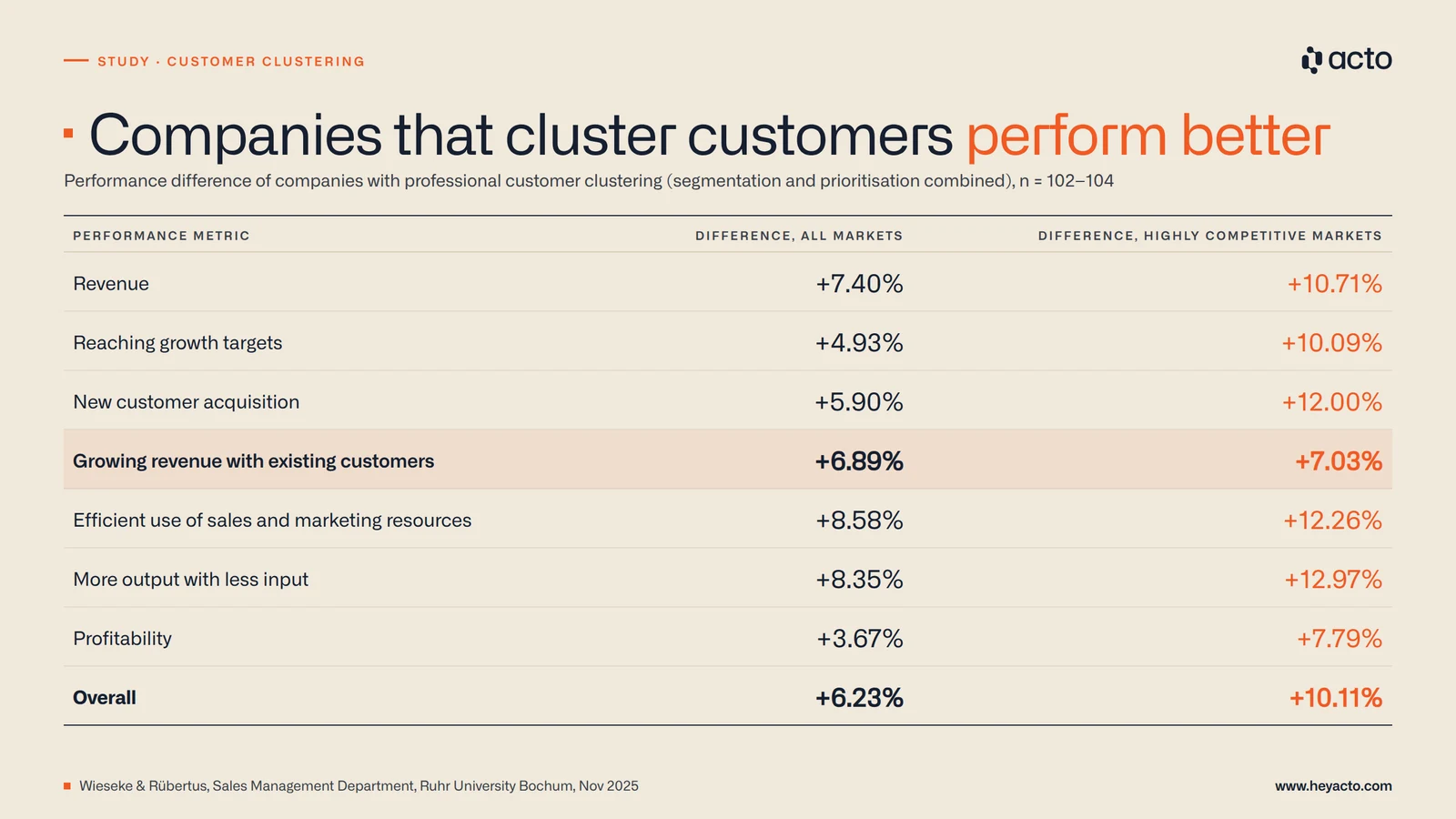
Academic research shows the same effect. A study by Prof. Jan Wieseke and Dr. Jonas Rübertus of the Sales Management Department at Ruhr University Bochum (in German) found that companies that segment and prioritise their customers systematically achieve 6.89 percent more revenue with existing customers.
When upselling in wholesale doesn't work
Upselling is no universal remedy. Three scenarios in which it fails or backfires:
When the basic relationship is broken
A customer with an open complaint, unresolved delivery problems or long-standing dissatisfaction will react to upselling attempts with frustration. B2B relationships run on trust. If trust needs repairing, do that first before you try to expand.
When there is no real added value
Upselling that feels like pressure damages B2B relationships in the long run. The difference lies in how it is framed. A rep who explains that two more units bring the customer into a cheaper discount tier is giving advice. A rep who simply wants to sell more, without a reason, is a nuisance. In wholesale, the buyer remembers both.
When the data is missing or outdated
AI-supported upselling detection is only as good as the data it is based on. If CRM and ERP are not maintained, transactions are not recorded properly and master data is out of date, the recommendations will be wrong. At best, wrong recommendations lead to no upsell. At worst, they lead to the wrong offers, which irritate the customer.
Upselling in wholesale with Acto: what it looks like in practice
Acto connects to your CRM and ERP, for example SAP, Microsoft Dynamics or Salesforce, and analyses the existing transaction data for upselling signals: customers close to the next discount tier, purchase-pattern deviations, assortment gaps, churn signals.
Feature 1: prioritisation by upselling potential
Which customers offer the biggest upselling lever today? Acto answers this question from order data, independent of visit habits or personal sympathy. In the morning, the rep sees whom to contact today and why. At Schäfer Shop, reps identified three times as many upselling opportunities as before.
Feature 2: meeting preparation with concrete upselling signals
For every customer on the route: which upselling argument is relevant? What has changed in the purchase history? Which discount tier is within reach? A rep is ready for a meeting in about two minutes, with the briefing in the Acto app or directly in Outlook. The Böllhoff sales leadership describes the effect like this:
"Acto manages all the data complexity so our team can focus entirely on what matters most: our customers."
- Lisa Smith, Sales Leader eSales at Böllhoff
Feature 3: follow-up that feeds the next recommendation
After the visit, the rep records the visit report by voice. What the customer said about volumes, competitors or upcoming projects feeds into the next prioritisation, so the next upselling conversation builds on the last one. More on this in our article on AI in wholesale.
In a 30-minute demo, you can see how your own customer data turns into upselling signals: your market, your structure, your customers. A pilot runs with KPIs agreed in advance, and data is hosted on servers in Germany.
Book a demo
FAQ: upselling in wholesale
Is upselling in B2B wholesale the same as in B2C e-commerce?
No. In B2C, upselling works through algorithms, basket logic and impulse triggers. In B2B wholesale, buyers are professional purchasers with budgets, approval limits and supplier contracts. Upselling happens in the conversation. The field sales rep is the primary upselling channel.
How do I find out which customers have upselling potential?
Purchase-pattern deviations, customers close to the next discount tier and assortment gaps compared with similar customers are the three most reliable signals. This information is in every ERP, but it has to be prepared before it becomes usable. Manual analysis doesn't scale with 300+ customers and 50,000+ products.
When is the best time for an upselling conversation in field sales?
After a smooth delivery, after a successful deal or in the annual review. Never with an open complaint, and never when the customer is under time pressure. Upselling in B2B depends more on timing than on the product.
What is the difference between upselling and cross-selling in wholesale?
Upselling: the customer buys more, or a higher-value variant, of the same product. Cross-selling: the customer buys an additional, related product they don't yet buy from you. Both levers work in wholesale, but they require different data and different conversation strategies. In everyday use, the terms are often used interchangeably. More on the second lever: cross-selling in B2B.
Do I need an AI tool for systematic upselling, or is a good CRM enough?
A good CRM stores data. It doesn't automatically analyse which customer needs an upselling conversation tomorrow. The step from storing data to a recommendation you can act on is what AI-supported tools provide. If your sales team analyses purchase histories manually every day and derives conversation priorities from them, you don't need an AI tool. If not, it is only a matter of time until you do.