Potential-Based Selling in Wholesale: The Matrix Instead of Gut Feeling

Summary
- Potential-based selling means prioritising and visiting customers by what they could buy in the future, rather than by what they already buy today.
- The classic ABC analysis by current revenue tends to favour the wrong customers in practice, as several sales directors told us.
- The central tool is a four-field matrix of current revenue and potential, which sets visit frequency and sales channel instead of a rigid visit interval.
Last updated: October 2026
Why field sales in wholesale often drive blind
Most sales organisations in wholesale and distribution steer by what a customer already buys. That is convenient, because the number sits right there in the ERP system. But it looks backwards. It says nothing about how much a customer could buy.
The pattern repeats across many sales teams: accounts are ranked by current revenue in a classic ABC segmentation. A customer is an A-customer because they already buy a lot today.
A customer with high current revenue may already be fully tapped, with no room left to grow however often a rep drops by. A customer with low current revenue, on the other hand, may be tomorrow's A-customer ten times over, and nobody touches them because they sit far down the revenue list. A sales director at a mid-sized B2B wholesaler confirmed exactly this in a conversation with us (translated from German):
"Right now we are oriented on current revenue and use it to define how valuable a customer is, and to me that is wrong from the start. If a customer does 500,000 when they could do 5 million, they are not well tapped." (Sales director, mid-sized B2B wholesaler, anonymised)
Bain & Company describes the same blind spot in its article "Is that customer worth your time?": in one distribution business it analysed, many medium-sized accounts with ample growth potential received little field coverage because they had historically been too small to get the reps' attention.
The market is shifting at the same time. According to the German wholesale federation BGA (in German), around 130,000 wholesale companies operate in Germany alone. In the sector study by BGA, Deloitte and Roland Berger (in German, survey from 2022), about 95 percent of respondents expect online sales to grow in importance, while around 66 percent expect the brick-and-mortar channel to lose importance. If you hand out visit time by current revenue in this environment, you give away exactly the growth opportunities this shift calls for.
Customer value vs. customer potential: two different measures
Customer value describes what a customer brings in today. Customer potential describes what they could bring in tomorrow. That is the whole difference, and many sales organisations still mix the two up every day.
Customer value looks back: revenue over the last twelve months, contribution margin, order history. Customer potential looks ahead: the customer's total demand, your share of wallet, room to displace competitors, gaps in the product range they buy from you.
Professors Christian Schmitz and Jan Wieseke of Ruhr University Bochum describe customer potential calculation as an analytical method for identifying and quantifying undiscovered growth opportunities (in German), so that limited sales resources go where they have the most effect instead of being spread evenly across the portfolio. Their consulting work also shows that customer prioritisation often lacks a sound basis for value-based coverage models (in German). In other words, many companies do not systematically record who actually has potential.
Sascha Niederhagen, Executive Vice President at the measurement technology manufacturer WIKA, where, as he says, more than 1,000 people work in sales worldwide, draws a clear conclusion for customers who buy little or nothing today (translated from German):
"If we don't look after these potential customers from day one as if we were already doing 10 million euros of business with them, they will probably never buy from us." (Sascha Niederhagen, EVP, WIKA, Revenue Signals podcast, in German)
Listen to the full episode: Potential-based selling, AI and why change needs stability (in German).
An A-customer by current revenue and an A-customer by potential can be two completely different companies. Put both in the same coverage bucket and you end up managing the past instead of shaping the future.
The current revenue vs. potential matrix: the central tool
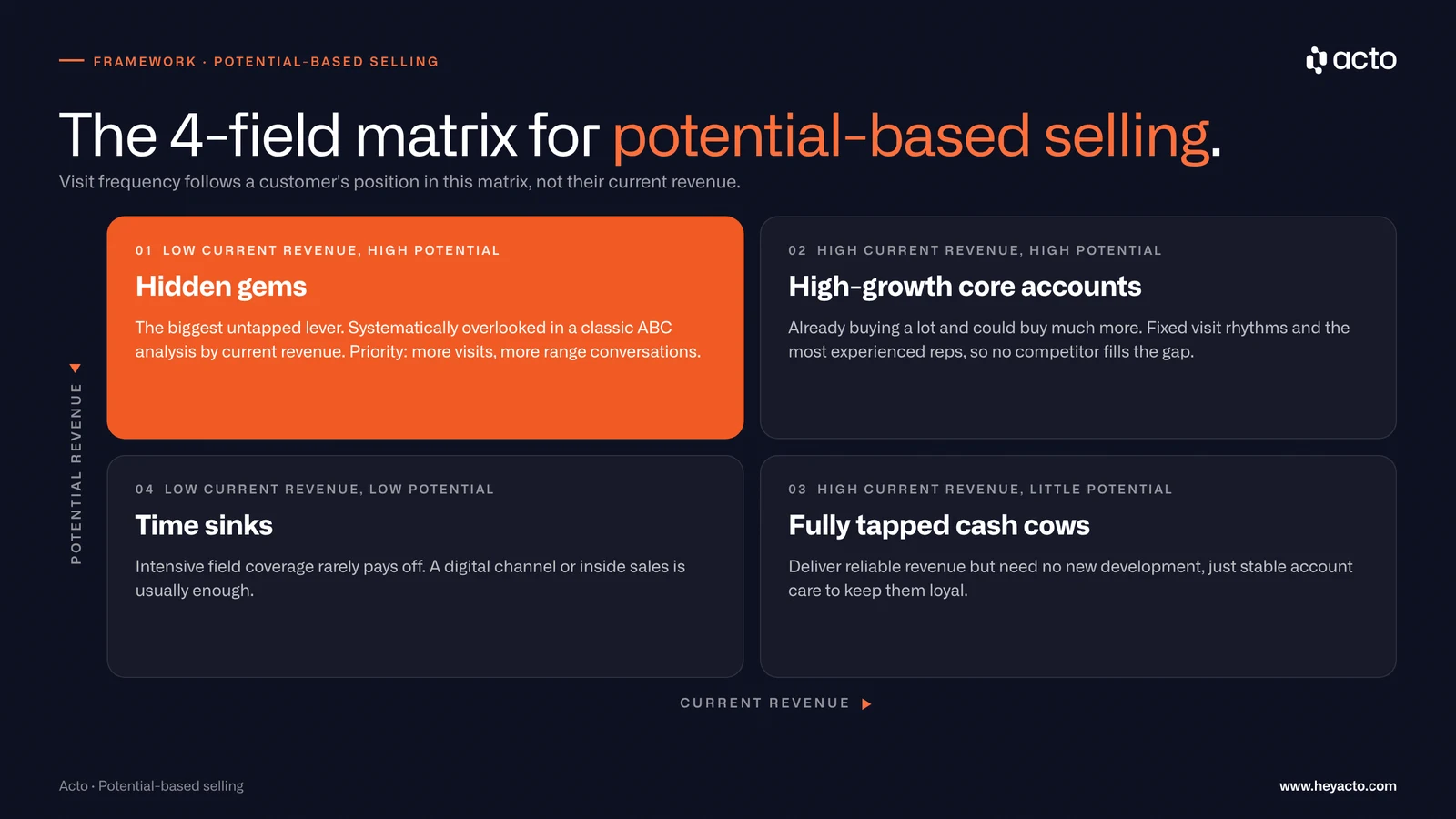
The central tool in potential-based selling is a simple four-field matrix. One axis shows current revenue, the other the estimated revenue potential. A customer's position in the matrix tells you directly how to cover them, independent of where they happen to rank in a revenue list.
The four fields look like this:
Field 1: Fully tapped cash cows
High current revenue, little additional potential. These customers deliver reliable revenue. They need stable account care to stay loyal, and little in the way of new development.
Field 2: Hidden gems
Low current revenue, high potential. This is where the biggest untapped lever sits, and these are exactly the customers a pure ABC analysis by current revenue systematically overlooks.
Field 3: High-growth core accounts
High current revenue, high potential. These customers already buy a lot and could buy considerably more. They get fixed visit rhythms, regular range reviews and your most experienced reps, so that no competitor moves into the gap.
Field 4: Time sinks
Low current revenue, low potential. Intensive field coverage rarely pays off here. A digital channel or inside sales is usually enough.
To place a customer in one of the four fields, quantitative characteristics count most, such as purchase volume, order frequency and product combinations, alongside qualitative ones such as industry, company size and number of employees. These same factors can be condensed by hand into a first potential estimate. For the detailed calculation logic, see our article on share of wallet in B2B sales, which works through the four-field matrix of current revenue and potential step by step. To find the specific product gaps per customer, a white space analysis is the natural next step.
Worked example: one wholesale customer, end to end
Take a fictional but typical case. A customer has been ordering spare parts from you regularly for years, with current revenue of 500,000 euros a year. Your rep knows their industry, knows how many machines they run and which product groups those machines typically need. From this rough derivation you arrive at an estimated total demand of 5 million euros. Your share of wallet with this customer is therefore around 10 percent.
Steered by current revenue, this customer is a solid B-customer. In the potential matrix they land among the hidden gems, with a clear consequence: more visits, more range conversations, possibly key account coverage, even though current revenue alone would not justify it. A sales director from our customer conversations described exactly this gap with a concrete example: "If the customer does 500,000 when they could do 5 million, we are only getting 10 percent of the potential." (translated from German)
Why rigid visit intervals no longer make sense
Cadence models look like strategy, yet they are a frequency rule. A-customers every two weeks, B-customers monthly, C-customers quarterly is the standard in many sales organisations. The model sets visit frequency by yesterday's ABC rating and ignores tomorrow's potential.
With large, heterogeneous customer portfolios in wholesale, this mistake gets expensive. A sales manager at a mid-sized wholesaler with several business units describes a related symptom in his organisation (translated from German): "You have to click through 5 to 7 different systems just to understand one customer, and the rep often doesn't know what the customer already buys from other departments." With that much fragmentation, a fixed visit interval loses any connection to a customer's real potential, let alone to what they already buy from other business units.
Sascha Niederhagen explains why the potential-focused approach works precisely because it scales (translated from German):
"That is what makes this potential-focused approach so attractive. I can make it scalable, adapt it to countries, adapt it to segments and industries. So I don't have to assume the same potential everywhere." (Sascha Niederhagen, EVP WIKA, in German)
The side-by-side comparison shows what changes:
| Criterion | Cadence model (interval) | Potential score model |
|---|---|---|
| Visit trigger | Fixed interval (e.g. every 4 weeks) | Position in the current revenue vs. potential matrix |
| Basis for prioritisation | Past revenue (ABC class) | Estimated future revenue |
| Response to market changes | None, the interval stays the same | Score is adjusted continuously |
| Biggest risk | Hidden gems are overlooked | Requires ongoing data maintenance |
Route planning still has its place once the visit list is set. More on that in our article on route planning in field sales. For the question of which metrics to steer by, read our post on field sales KPIs in wholesale: why visit frequency on its own is the wrong metric.
Spotting hidden upsell potential and churn risk
In a wholesale portfolio with hundreds of customers and thousands of items, a large share of the cross-selling potential stays invisible to the individual rep. Nobody can keep in their head which of 300 customers does not yet buy which of 5,000 product groups.
A sales director at a regional building materials distributor describes how the focus in his organisation is shifting (translated from German): "It's less about winning new customers and more about reactivating inactive customers and growing existing relationships. The focus is clearly on tapping the potential of existing customers." This matches the view of Patrick Heinemann, wholesale expert at Roland Berger, in a study of 890 German wholesale companies (translated from German):
"Where personal customer relationships, a broad range or the financing function of wholesale used to be the deciding factors for success, today comprehensive analysis of customer data, as the basis for combining online and offline sales channels effectively, is also decisive." (Patrick Heinemann, Roland Berger, 2016, in German)
The same study, summarised in English in "The digital transformation of wholesale", found that 54 percent of the wholesalers surveyed saw digital platforms as the greatest threat to their business model. One more reason not to lose revenue to competitors through overlooked potential in your existing customer base.
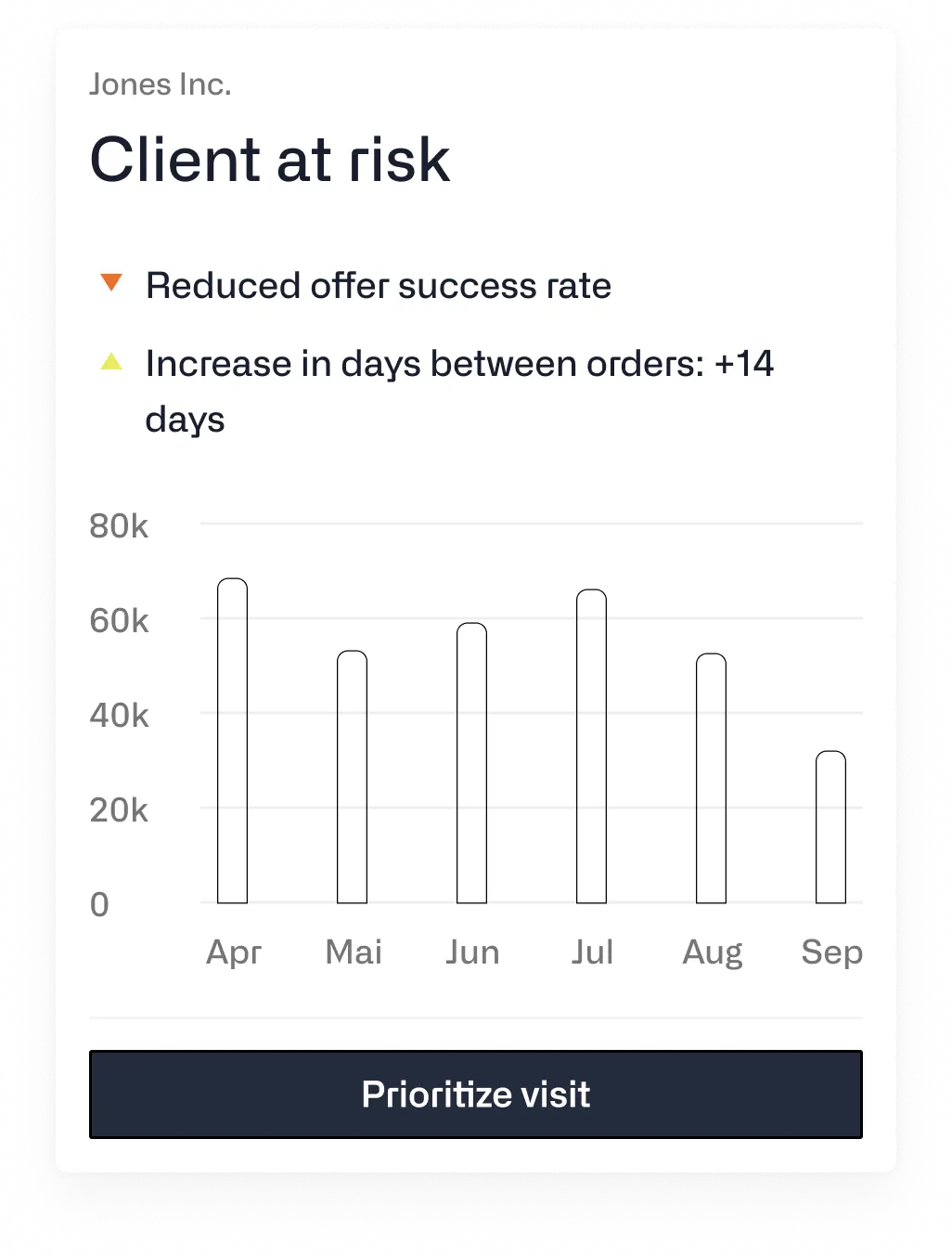
A good starting point for prioritisation is also to watch which customers change their usual ordering rhythm. Shrinking basket sizes or missing reorders are often the earliest warning sign of churn, long before a customer formally leaves. You will find details on both topics in our articles on upselling in wholesale, cross-selling in B2B and preventing customer churn.
Not for you: when potential-based selling does not work (yet)
Potential-based selling is no end in itself. With a portfolio of fewer than about 50 customers, the sales manager can usually keep the overview in their head, and a formal matrix adds little.
Without any data foundation in a CRM or ERP, the basis for any kind of scoring is missing, whether manual or software-based. A sales director from our customer conversations describes this problem openly (translated from German):
"We don't have a CRM tool where we could at least store potential, and I'm not even talking about potential data, just running classic ABC analyses, and that is maintained only rudimentarily." (Sales director, mid-sized B2B wholesaler, anonymised)
In that case, the first step is data hygiene, and the matrix comes later. Pure commodity business without range breadth also gets little from the potential axis: without room for cross-selling, the matrix shows hardly any variance between customers.
How to introduce potential-based selling in 5 steps
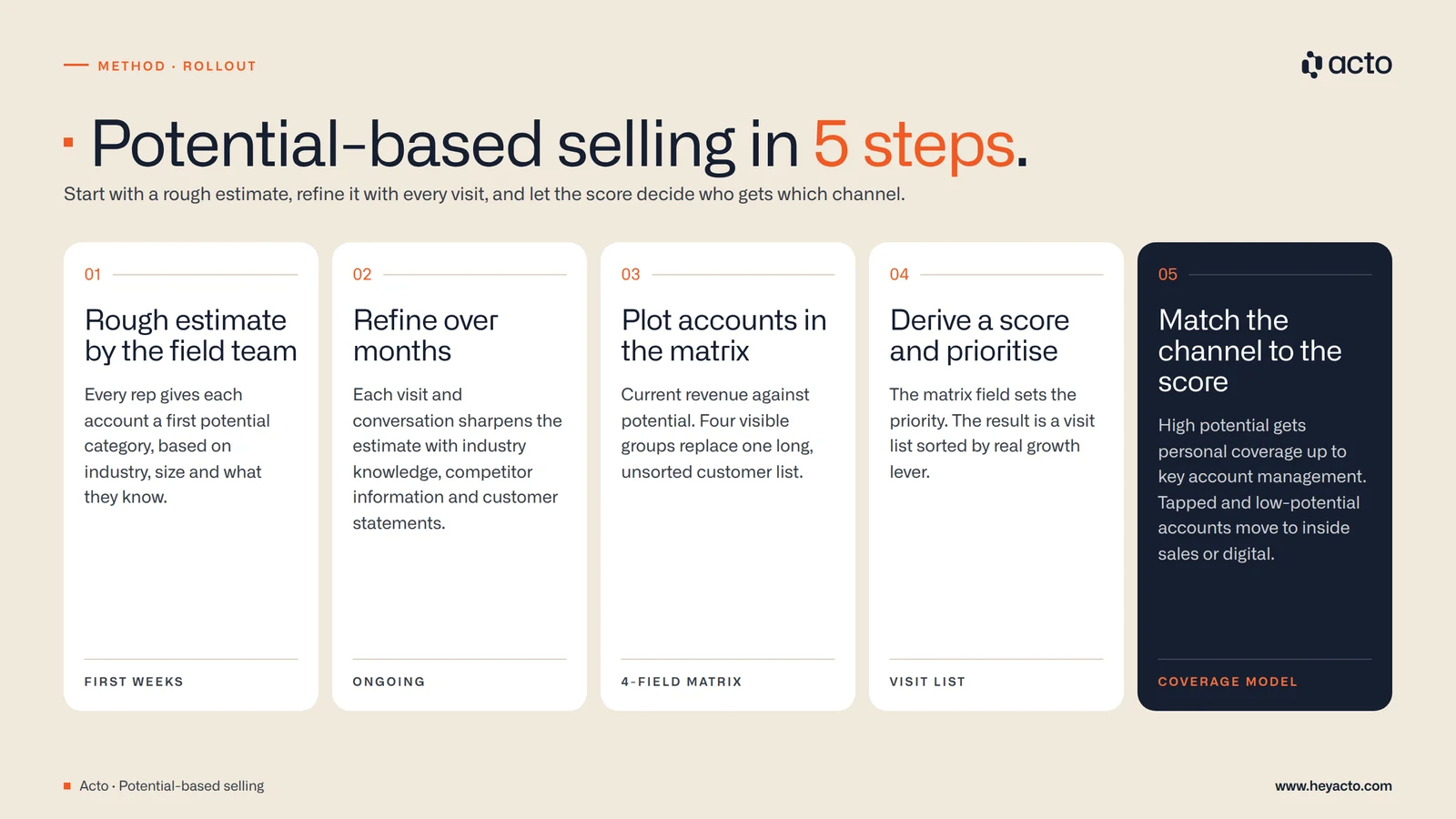
Step 1: Start with a rough potential estimate by the field team. Sascha Niederhagen explicitly advises against waiting for a flawless model (translated from German):
"Just start somewhere, even with a ballpark figure, and if it's wrong at the beginning, so be it, we'll correct it over the months and years." (Sascha Niederhagen, EVP, WIKA, Revenue Signals podcast, in German)
After just a few weeks, every customer has a first, rough potential category instead of none at all.
Step 2: Refine the potential over months. With every visit and every conversation, the first estimate gets more precise, backed by industry knowledge, information on competitors and what customers say. According to Niederhagen, continuous maintenance gives you relatively good transparency about market potential after a few months.
Step 3: Plot current revenue and potential in the matrix. Every customer gets a position in one of the four fields. Visible categories replace a long, unsorted customer list.
Step 4: Derive a score and prioritise customers. Priority comes from the field a customer sits in, not from the alphabetical customer master. The result is a visit list sorted by real growth lever, which is also the starting point for a next best action per account.
Step 5: Derive the coverage channel from the score. High-potential customers get personal coverage up to key account management. Fully tapped customers and those with little potential are served more efficiently through inside sales or digital channels. André Buck of Berner adds that the customer has a say in this, too (translated from German):
"I would perhaps add one thing: you also have to look at what the customer actually wants. … A customer with little potential, maybe also little current revenue, you perhaps can't cover the same way as the key account." (André Buck, Berner, Revenue Signals podcast, in German)
Listen to the full episode: Omnichannel, pricing and moving from information broker to value architect (in German).
How to structure coverage across the different groups is covered in more detail in our article on account management in B2B.
Common mistakes when switching to potential-based selling
The most common mistake is turning the potential model into a science before a first estimate even exists. Niederhagen warns explicitly against this: "You mustn't turn it into a science." (Revenue Signals, 11:51, in German) Whether a customer has 5, 6 or 7 million euros of potential makes no difference to prioritisation at first. Knowing that the potential is large enough to invest time there is what counts.
The second mistake: applying the same yardsticks to every country, segment and industry. High potential in Central Europe looks different from high potential in other markets, and a model without that differentiation produces the wrong priorities.
The third mistake: estimating potential once and never touching it again. Without regular updates, the potential model quickly turns back into a snapshot, which is exactly the problem it was meant to solve.
How to put potential-based selling into practice with Acto
You can build the current revenue vs. potential matrix by hand as long as the portfolio stays manageable. With hundreds of customers per rep and thousands of products, manual upkeep quickly becomes a bottleneck, because ordering rhythms and baskets change constantly, often faster than a spreadsheet can be updated.
Acto analyses ERP and CRM data continuously and compares buying behaviour over one, three and six months and quarter on quarter, so changes become visible early instead of in the annual report.
- Prioritised customer lists by current revenue and estimated potential, derived directly from existing ERP data
- Early warning signals when the ordering rhythm shifts, before a customer formally churns
- Concrete product suggestions for cross-selling and upselling per customer, based on similar customer profiles
.png)
In controlled A/B tests, Böllhoff achieved +8.6 percent revenue and Schäfer Shop +11.2 percent revenue with Acto. At Plate, revenue grew by 10 percent and the time between orders fell by 35 percent.
Want to see what this looks like for your customer portfolio? Book a consultation.
FAQ: potential-based selling
How do you calculate a customer's revenue potential?
A rough first estimate is enough: the customer's estimated total demand based on industry, company size and known benchmarks, minus the share you already serve. This estimate is refined continuously through visits and conversations. It does not need to be exact at the start.
What is the difference between customer value and customer potential?
Customer value looks back at revenue and contribution margin already achieved. Customer potential looks ahead at what a customer could theoretically still buy. A customer can have low value and high potential at the same time.
Do I now have to visit every low-revenue customer more often?
No. Only customers in the "hidden gems" field of the matrix, meaning low current revenue combined with high estimated potential, deserve more attention. Customers with low revenue and low potential belong in a more efficient channel rather than a personal field visit.
How do I spot impending customer churn early?
Watch for changes in the usual ordering rhythm and for shrinking basket sizes, rather than waiting for orders to stop. More on this in our article on preventing customer churn.
Is potential-based selling worth it for a small field sales team?
With very small portfolios of well under 50 customers, a personal overview is often enough, and a formal matrix adds little. From a few hundred customers per rep, systematic prioritisation quickly becomes indispensable.