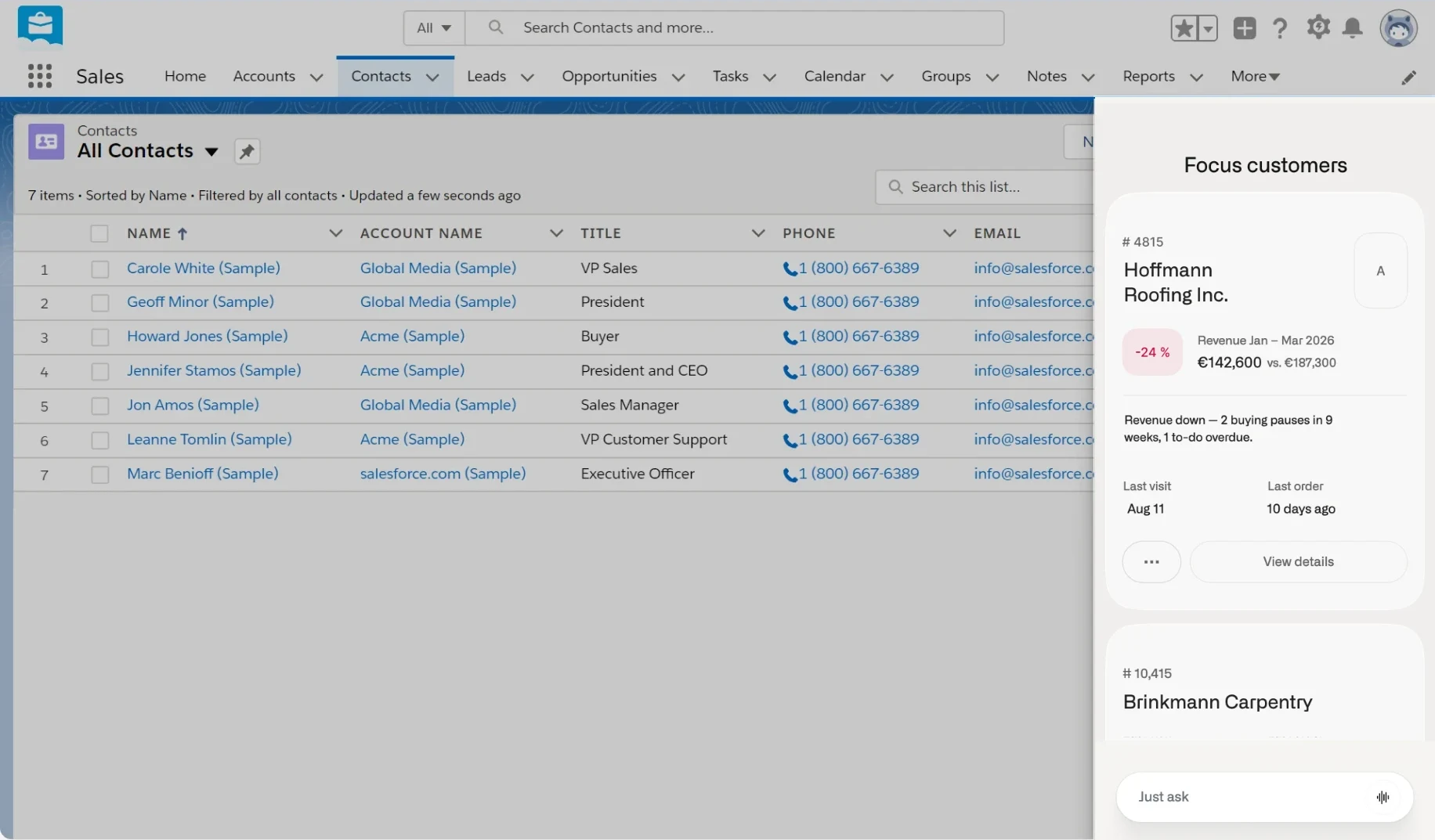
Acto analyzes the order data from your ERP every night. By morning, the sidebar in Salesforce shows whose revenue is dropping, who’s missing a product line, and who’s worth a call today.



Salesforce knows meetings and opportunities. Nobody there sees that a customer has been ordering less for eight weeks.
Reps log visit reports and get nothing back that helps them at the next meeting.
Because there’s no shared list of who needs attention today. Every rep goes with their gut.
Salesforce knows meetings and opportunities. Nobody there sees that a customer has been ordering less for eight weeks.
Reps log visit reports and get nothing back that helps them at the next meeting.
Because there’s no shared list of who needs attention today. Every rep goes with their gut.
“Focus customers” shows whose revenue is dropping, with the reason why, last visit, and last order.
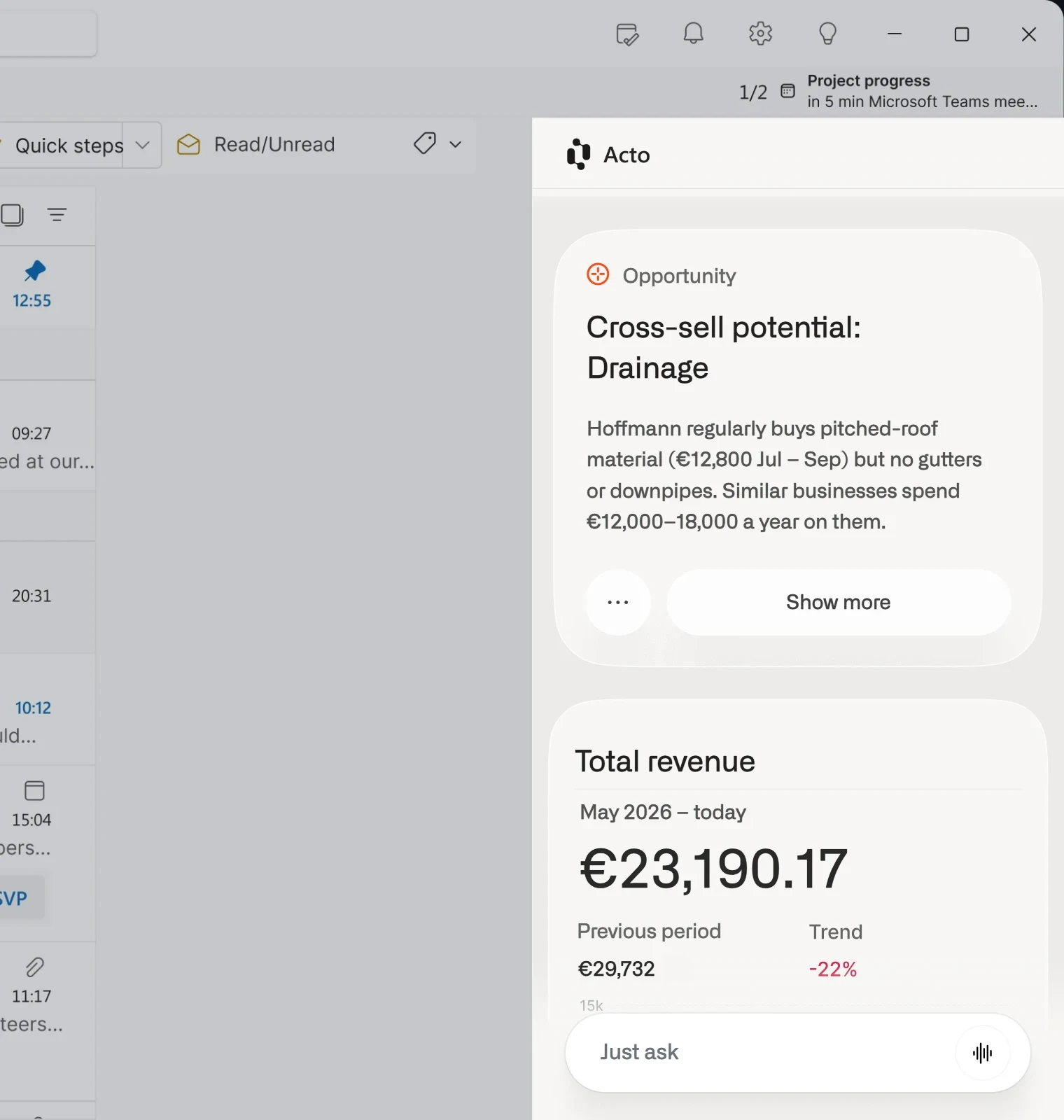
Before the meeting, revenue trend, open quotes, and the key points from the last conversation are ready.
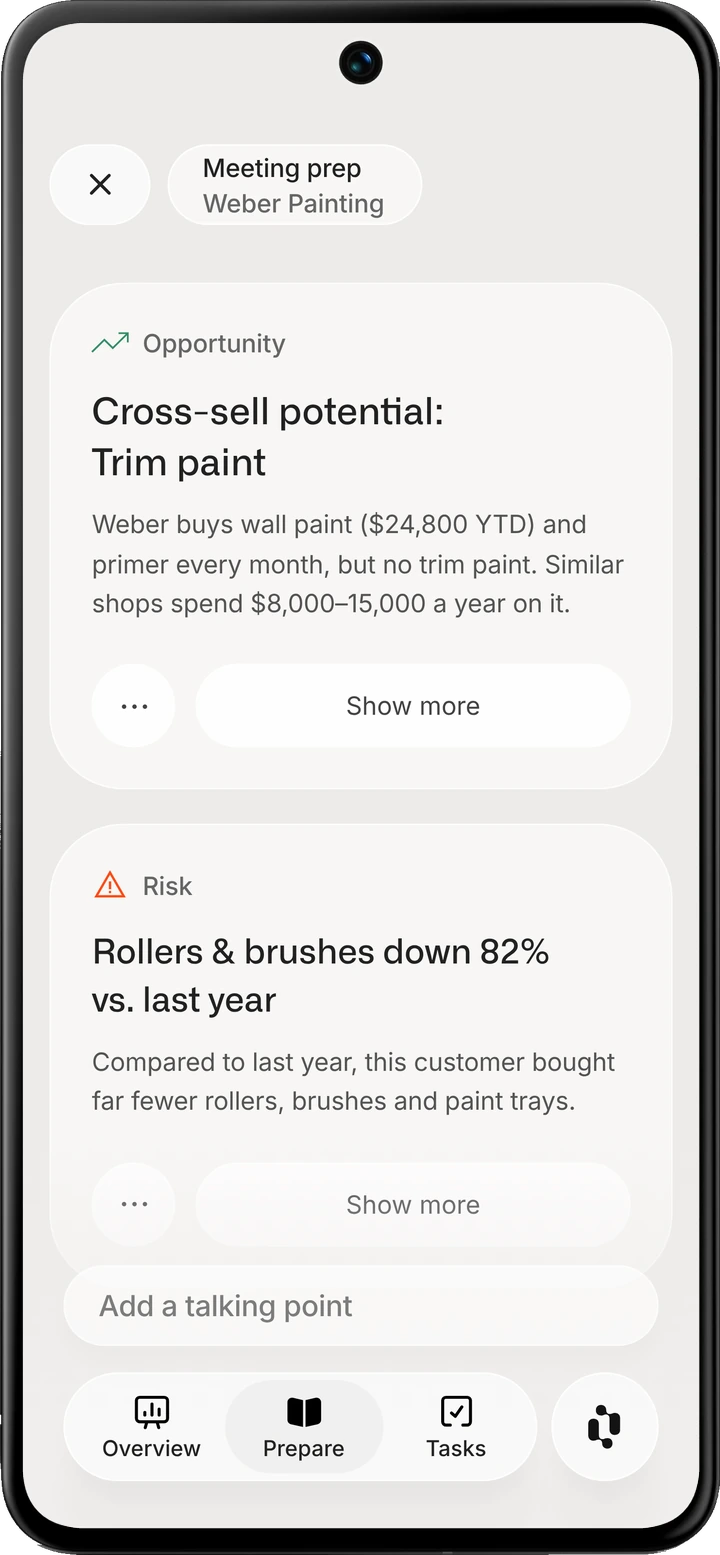
On the road, reps open the same customer in the app, with a call plan, risks, and cross-sell potential.
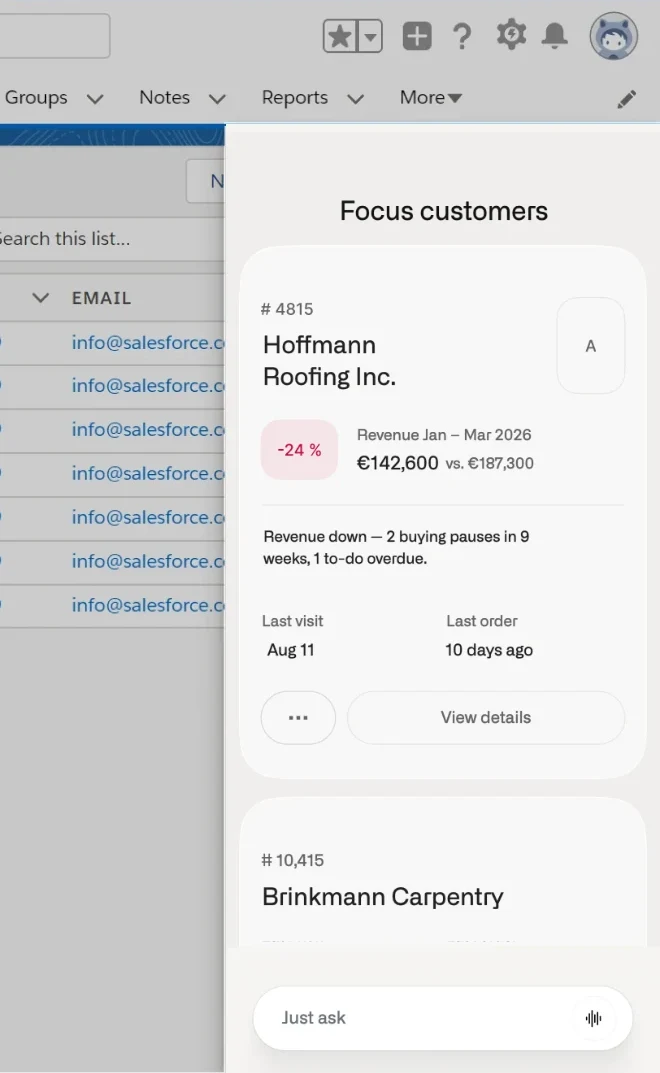
“Focus customers” shows whose revenue is dropping, with the reason why, last visit, and last order.
Before the meeting, revenue trend, open quotes, and the key points from the last conversation are ready.
On the road, reps open the same customer in the app, with a call plan, risks, and cross-sell potential.
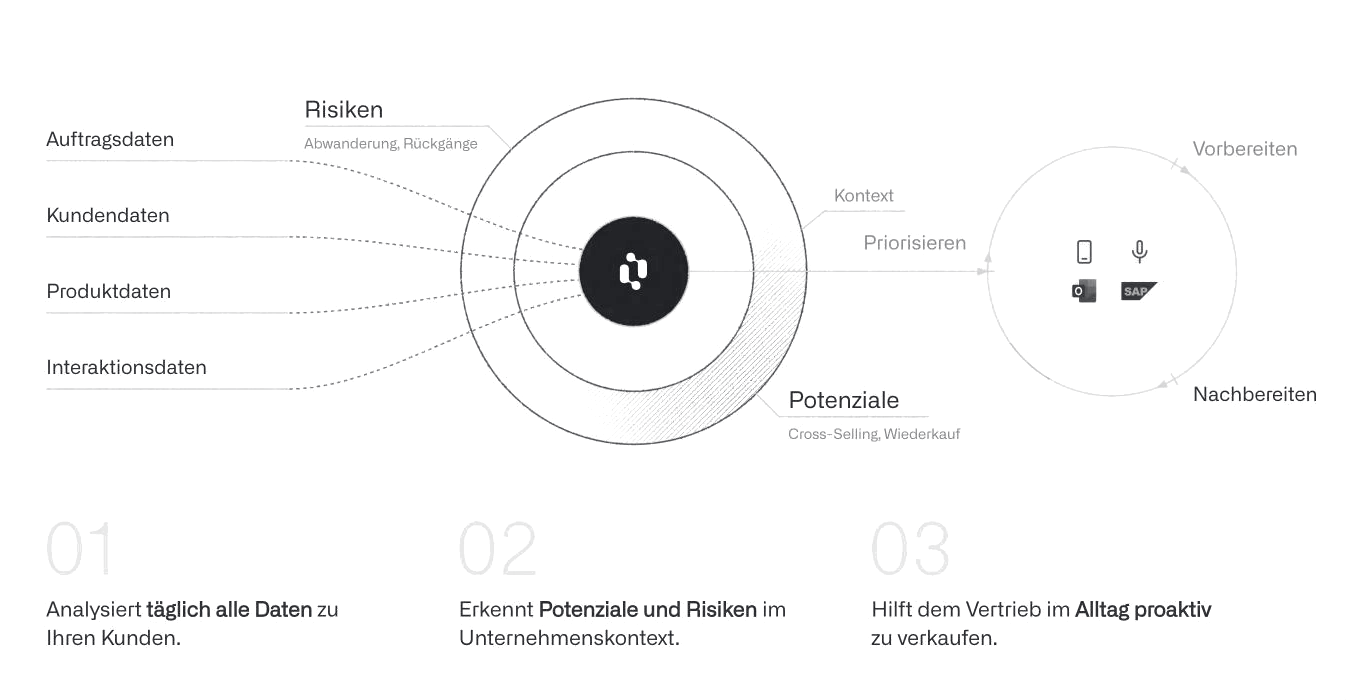
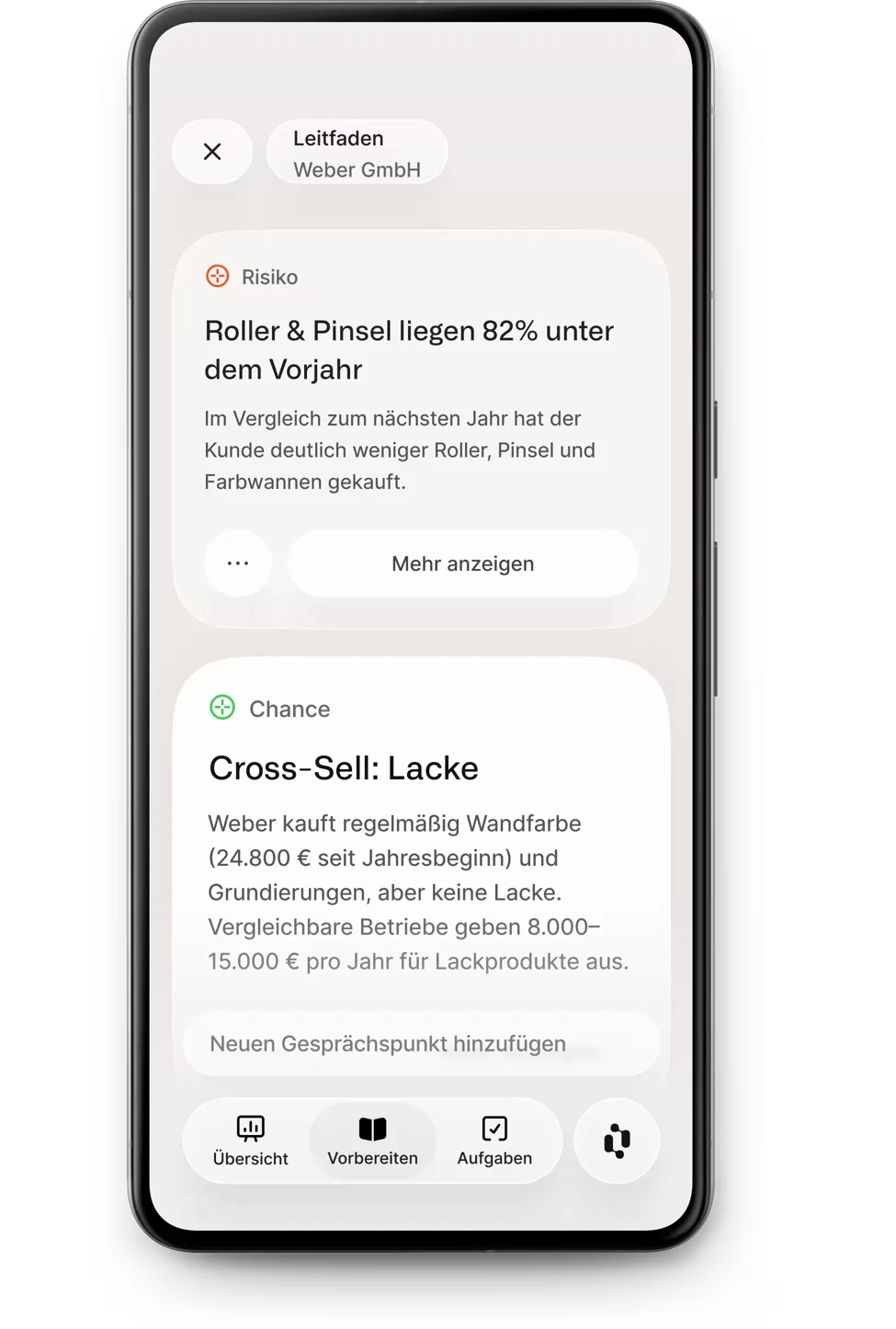
Every night, your system exports orders, customers, products, and pricing. Acto runs the analysis, scores every account, and writes the results to the sidebar. No live access required.
Every customer is measured against their own history. Only what’s worth a call or a visit reaches your reps.
Kraus & Meier is ordering less often than usual, and their quote win rate has been dropping since July.
Bauer buys hand tools regularly but never striking tools. Similar shops also buy long-life grease.
Blatter usually orders every 32 days. Similar customers regularly buy pliers.
The order is missing 5 of the 8 quoted product groups. Worth a follow-up on the rest.


“Acto’s AI analysis and automation save our sales team up to 8 hours every week. The result: more productivity, less time digging through data, and more time with the right customers.”
 ↗ 8,6%
 ↗ 10,0%
Call plan before the meeting, dictated report after.
As a sidebar next to the account record, and in Outlook if you want.
Before going live, Acto learns your rules. That’s how you get recommendations that fit your business instead of generic alerts.
One customer orders every week, another only when a project comes up. Acto learns when silence is normal and when it’s a red flag.
Seasonal business and incentive programs can shift entire weeks. Acto separates the usual from the unusual.
Acto learns your industry jargon and in-house terms instead of guessing. So the insights sound like they came from a colleague.
Priority accounts and new products: who your reps should see first.
Fewer orders mean risk, bigger baskets mean opportunity. You set the threshold for when it’s worth stepping in.
You decide which categories go together and which ones you want to push. Acto only suggests what fits.
Acto doesn’t read live from Salesforce. Order and customer data arrive via a nightly export from your ERP, whether that’s SAP, Microsoft Dynamics, or something else. Salesforce just gets the sidebar with the results.
Requirements · business logic · SFTP access
Tenant setup · daily export · data audit
Checks on sample customers · sidebar in your system · feedback
Training · sales team goes live · first results shortly after
Data arrives via export or SFTP. No live access, and Acto does the heavy lifting.
Stored in Frankfurt, language models hosted in the EU. Prediction models train only on your data.
Acto doesn’t read live from Salesforce. Order and customer data arrive via a nightly export from your ERP, whether that’s SAP, Microsoft Dynamics, or something else. Salesforce just gets the sidebar with the results.
Export, file share, or SFTP. No live access, so your ERP doesn’t slow down.
One time, to set up the export. After that it runs on its own, every night.
Stored in Frankfurt, language models hosted in the EU. Prediction models train only on your data.
Yes. Acto adds a sidebar right inside Salesforce that shows which customers are ordering less, who’s missing a product line, and which customers are worth a call today. It runs on the order data from your ERP, analyzed every night.
Einstein and Agentforce are Salesforce’s AI features. They work with what’s in Salesforce: contacts, opportunities, emails, and activities. In distribution, the data that matters most lives in the ERP: which customer buys which products, in what quantities, and when they last ordered. Acto analyzes exactly that order history, for every customer, every night. Your reps get specific insights, like churn risk, missing product lines, or open quotes, without anyone having to ask.
Yes. Acto doesn’t replace any Salesforce feature. Salesforce gets the sidebar, and everything else stays as it is.
Yes. The analysis runs on order data from the ERP and doesn’t depend on well-kept CRM records. And because the sidebar shows something useful for the next meeting, reps get one more reason to open Salesforce.
From your ERP, via a daily export, SFTP, or an exchange server. That can be SAP, Microsoft Dynamics, proALPHA, or another system. Acto doesn’t need live access.
No. Salesforce just gets the sidebar. Nothing in the CRM itself gets rebuilt.
In the office, in the sidebar in Salesforce, and in Outlook if you want. On the road, in the Acto app, with a call plan before the meeting and a dictated report after.
About six weeks. Your IT team spends roughly two to three days on it, mostly setting up the export.
Stored in Frankfurt, with language models hosted in the EU. Prediction models train only on your data.
In 30 minutes, we’ll look at your system and your sales team, then show you real examples from your industry of what Acto would flag.
Book a call
