Churn Early Warning System for Wholesale: Build It Yourself or Buy Software?
Summary
- A churn early warning system for wholesale checks every customer's order rhythm, quantities and product categories every night. The signal goes to the person who calls or visits that customer.
- There are five ways to get there: Excel or ERP reporting, a BI build with Power BI or Microsoft Fabric, a data science build with Python, a CRM extension such as Salesforce, or specialist software.
- Building it yourself wins if you have a data team with spare capacity, a lot of special-case logic or a small customer base. Specialist software wins when each field sales rep looks after hundreds of customers and nobody has time to build and maintain a system.
- Disclosure: we offer one of the options compared here, Acto, the sales AI for wholesale.
| Option | Best if … |
|---|---|
| Excel or ERP reporting | you want to test this week which signals matter for your business |
| BI build (Power BI, Fabric) | a BI team is available and sales management distributes the list and follows up itself |
| Data science build (Python) | a data team is permanently available and you need special-case logic |
| CRM extension (e.g. Salesforce) | your field sales team lives in the CRM and an integration project is already on the cards |
| Specialist software (e.g. Acto) | you want to monitor hundreds of customers per rep without running a project of your own |
Why do you miss silent churn across hundreds of customers?
You miss silent churn because it starts in the order lines and never triggers a cancellation. When each field sales rep covers hundreds of customers, nobody can spot by hand that one customer's gap between orders is growing or that a product category has disappeared.
Churn means customers leaving. Depending on how well they are looked after, a wholesaler loses 4 to 17% of its customers a year (in German), according to our churn benchmark. Customers rarely leave with a bang: they order more quietly and shift product categories to the competition.
For us, a customer has churned once they go without ordering for longer than their own threshold. That threshold comes from their order history: their longest previous pause after which they did order again, plus the mean and standard deviation of their gaps between orders. It differs from customer to customer and is not one fixed period for everyone.
"The thing is, of course some things slip through, like a customer breaking off or an item no longer being bought. […] It's still interesting to know why the item is no longer being bought."
– Sales director at a mid-sized building materials wholesaler, from an initial conversation
A decline is therefore only visible if someone compares each customer's order rhythm with their own normal. That puts two requirements on any system, whether built or bought:
- Complete checks: Order rhythm, quantities and product categories are checked for every customer every night. That includes B and C customers, the middle and lowest-revenue classes of a revenue-based ABC analysis, who tend to slip through in day-to-day work.
- Context: The signal comes with a reason. Otherwise the system produces false alarms and field sales stops reacting.
A special case shows how much context matters. Take an example customer, let's call him Siebert, who hasn't ordered anything for three weeks. Without context, that means churn risk, call immediately. With the visit report attached, it means: company holiday until 15 September, reminder on 16 September, no alarm.
We have put together how to recognise churn in detail in our 13 signals of customer churn in wholesale.

A customer goes quiet long before they leave, and only context separates risk from a holiday.
What criteria do we use to compare the five options?
We compare each option on effort, data needs, upkeep, time to first signal, and who in sales acts on the signal. The last column decides it, because a risk that is spotted but has no recipient won't keep a single customer.
The data for all five options sits in the ERP, in the order lines of recent years. The two requirements from above, complete checks and context, apply to every row.
| Option | Effort | Data needs | Upkeep | Time to first signal | Who acts on the signal |
|---|---|---|---|---|---|
| Excel or ERP reporting | Low to start, grows with every customer | ERP export of order lines | Every analysis redone by hand | Immediately, for a first run | Whoever creates and passes on the list |
| BI build (Power BI, Fabric) | Medium: data model, metrics, reports | Order lines, customer and item master data | Ongoing by BI team or service provider | Depends on free BI capacity | Whoever opens the report |
| Data science build (Python, LightGBM) | High: features, model, operations, interface | Multi-year order history per customer and item | Retraining when range or customers change | Longest of the five options | Only whoever gets an interface for it |
| CRM extension (e.g. Salesforce) | Medium to high: ERP connection and modelling | ERP order data has to get into the CRM | By CRM administration or partner | Depends on the integration project | Field sales directly in the CRM |
| Specialist software (Acto, our product) | 2 to 3 days of IT effort | Nightly ERP export: orders, customers, items | At the vendor, sales feedback is fed back in | 4 to 6 weeks to go-live | Field and inside sales in Outlook, CRM or app |
How we assessed this: The cells for the four build-it-yourself and platform options are our own assessment, based on conversations with wholesale sales leaders and supplemented by the vendors' publicly documented features (as of October 2026). We have not tested the third-party products ourselves. The Acto figures come from our website.
Which routes lead to a churn early warning system?
You build four of them yourself or on an existing platform. The fifth is specialist software, which we present at the end.
Manual Excel or ERP reporting
The strength of this route is that you can start today. An ERP export of the order lines, a pivot table and the gaps between orders per customer: a first run needs nothing more.
The limit is the number of customers. Every customer and every product category costs time, and that time recurs with every analysis. Action only happens if the person who builds the list also distributes it.
As a permanent solution, this route is an enormous manual effort, and the lists are often out of date before anyone uses them. Plate experienced exactly that before the team switched to software:
"To decide which customers we should prioritise, we relied on Excel lists we'd built ourselves. They weren't just cumbersome, they were often out of date by the time we used them. We also often only came across the insights once revenue had already collapsed."
– Marco Bender, Head of Inside Sales, Plate
Best if you want to check whether order gaps and product categories are meaningful for your customers at all, before you invest money or IT time.

A manual test shows which signals matter for you, but it doesn't scale to hundreds of customers.
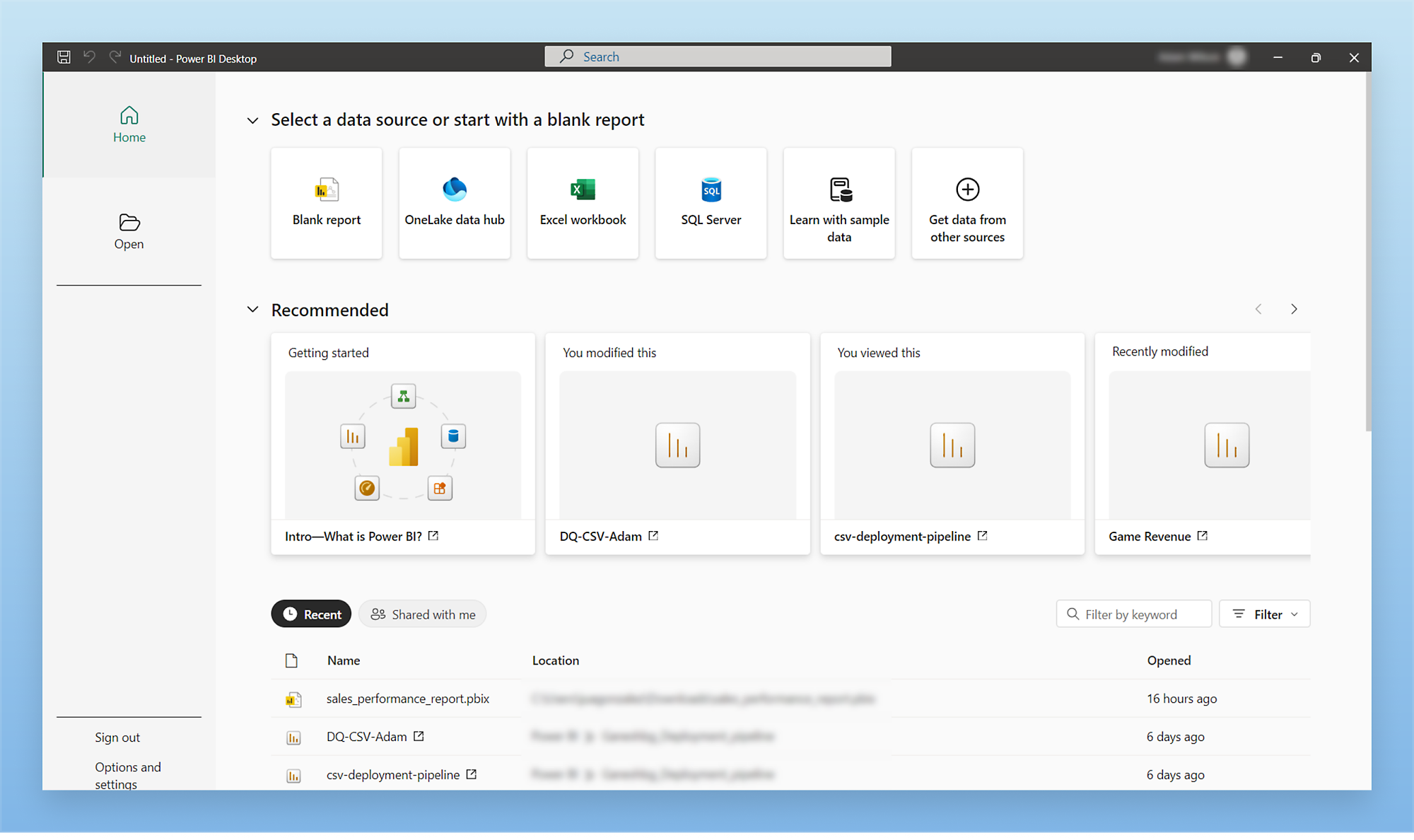
BI build with Power BI or Microsoft Fabric
Power BI is flexible and pulls data from hundreds of sources such as Dynamics 365, Salesforce and Excel. The data stays in-house, and if you already use Power BI for management KPIs, you're building on existing knowledge.
The limit is usage. On average, only about a quarter of employees actively work with BI tools, according to a 2022 survey of 214 companies by BARC and Eckerson Group. A churn report that people have to open actively just sits there.
"We have a report on churned customers, but it all gets managed half-heartedly, because you have to actively click into the report. […] Of course it's all reactive."
– from an initial conversation, paint wholesaler
A field sales rep sells. If you want them to work with data, you have to take the data work off their hands and give them ready-made recommendations. Between traffic jams and back-to-back appointments, nobody pores over reports.
What they need are answers to three questions:
- Who do I visit today?
- What do I offer?
- Where is it urgent?
Best if a BI team is available and sales management hands the list to the team itself every week.
Data science build with Python and LightGBM
A custom model is tailor-made. You decide the features, such as order gap per item or basket size, and keep full control of the logic. If you like, you can go as far as survival analysis.
The question is who builds and runs it. Before you start, clarify whether the talent is in the team and what maintenance and training cost. If the range or customer base changes, the model has to be retrained. And the result is initially a table of probabilities: it only reaches field sales once someone builds an interface on top.
Best if a data team is permanently available, the person won't move on within a year, and your business needs special-case logic that no off-the-shelf solution covers.

In a data science build, the model is just one of four components that someone has to run permanently.
Extending a CRM platform, e.g. Salesforce
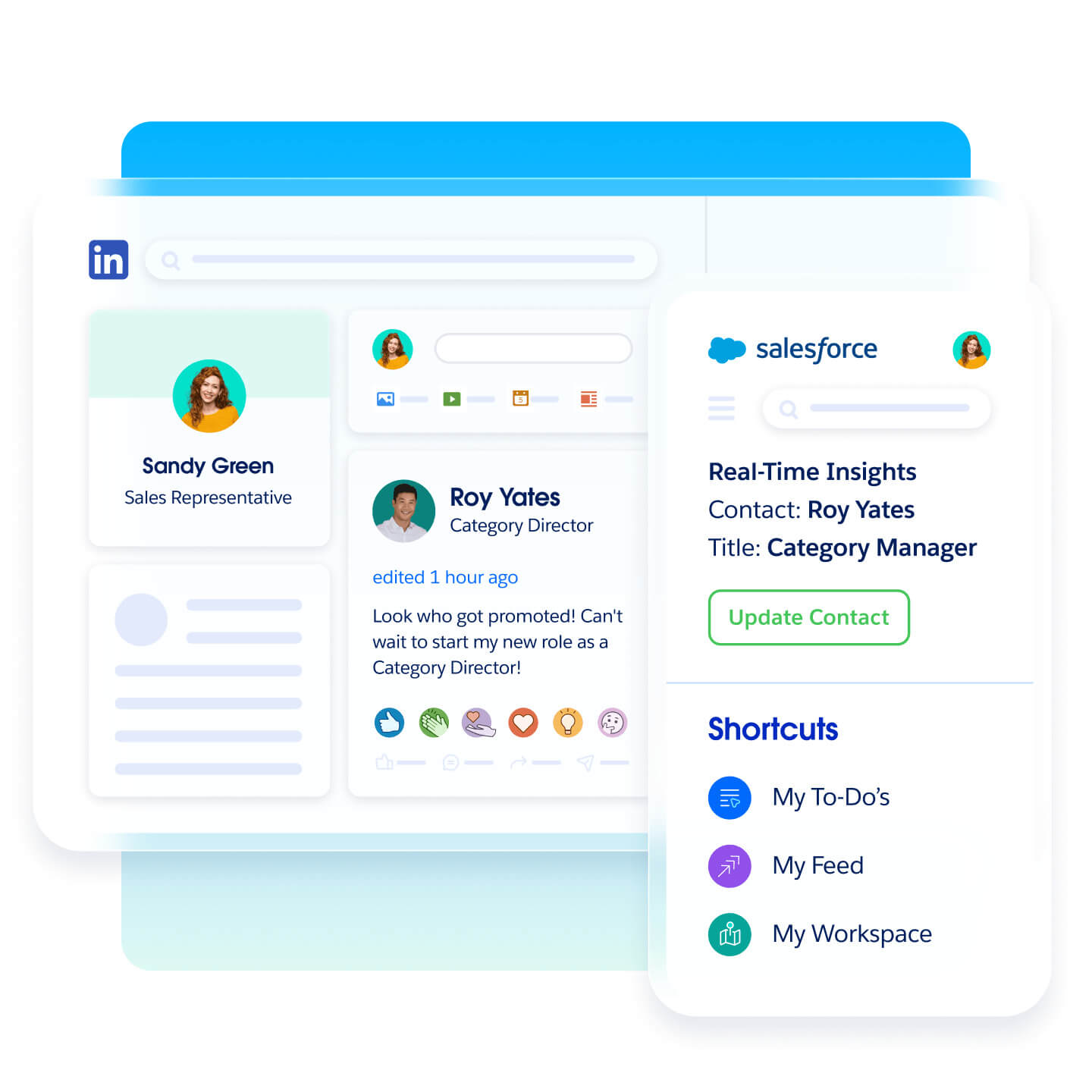
The strength of a CRM extension is that the signal appears where field sales already documents its work. Salesforce Sales Cloud offers an account overview with metrics, opportunities, and pipeline and forecast charts.
The limit comes from its origins. CRMs are built for new-customer pipelines, and a CRM only contains what someone has entered. Order rhythm per customer and item sits in the ERP and has to be connected and modelled. Sales Cloud has no ready-made order rhythm analysis per customer and product (as of October 2026). More on why CRMs reach their limits in wholesale.
Best if your field sales team works in the CRM and an ERP integration project is already planned.
Which option should you choose for your customer count and IT capacity?
The choice depends on two things: how many active customers you want to monitor, and how much IT and data capacity you have free on a permanent basis. The more customers and the less capacity, the more buying makes sense.
| Starting point | Obvious option |
|---|---|
| Small customer base, you first want to understand which signals matter | Excel or ERP reporting as a test |
| BI team in place, sales management distributes lists itself | BI build |
| In-house data team, a lot of special-case logic in the business | Data science build |
| Field sales works in the CRM, ERP connection is already planned | CRM extension |
| Hundreds of customers per rep, no spare capacity for building and upkeep | Specialist software |
As a rule of thumb, our customers start using Acto from around 1,500 active customer numbers. Below that, a well-maintained in-house build is often enough.
Specialist software for wholesale is not for you if:
- Your ERP can't provide order history at line-item level.
- Your business is mostly project work with no repeat orders.
- You are a manufacturer selling mostly through wholesale or to end consumers.
What goes wrong in practice when comparing?
Often the system detects the risk and nobody acts on it. In a survey of wholesalers by BGA and Roland Berger, only 22% said that sales is involved in digital customer retention.
These are the mistakes we keep seeing in conversations with sales leaders:
- Signal with no recipient: The list is created at head office and never reaches field sales. It belongs where they work: on the smartphone, in Outlook or in the CRM.
- Missing context: Without a visit report, every pause in ordering becomes an alarm, as with Siebert. After a few false alarms, the team ignores the real ones too.
- Fixed cycle instead of signal: A rigid visit interval per customer doesn't reflect the reorder intervals of thousands of items. If you build the early warning system and still plan visits on a fixed cycle, you're wasting it.
- Upkeep not planned for: The in-house build is budgeted as a project. Retraining, bug fixing and new product categories are ongoing work.
- Perfect data as a precondition: If you insist on cleaning up master data first, you never start. A good system brings structure to the data itself and makes upkeep routine.
What happens after the signal, in the conversation with the customer, is covered in our 12 measures against customer churn.
Acto: specialist software for wholesale's existing-customer logic
Acto, the sales AI for wholesale, reads the ERP order data every night and shows field sales each morning which customers carry a churn risk or revenue potential. It writes back only to the CRM, never to the ERP. As AI software for field sales, Acto delivers prioritised signals with reasons; CRM and BI functions are not part of it. In an A/B test against a control group, Schäfer Shop increased revenue by 11.2%.
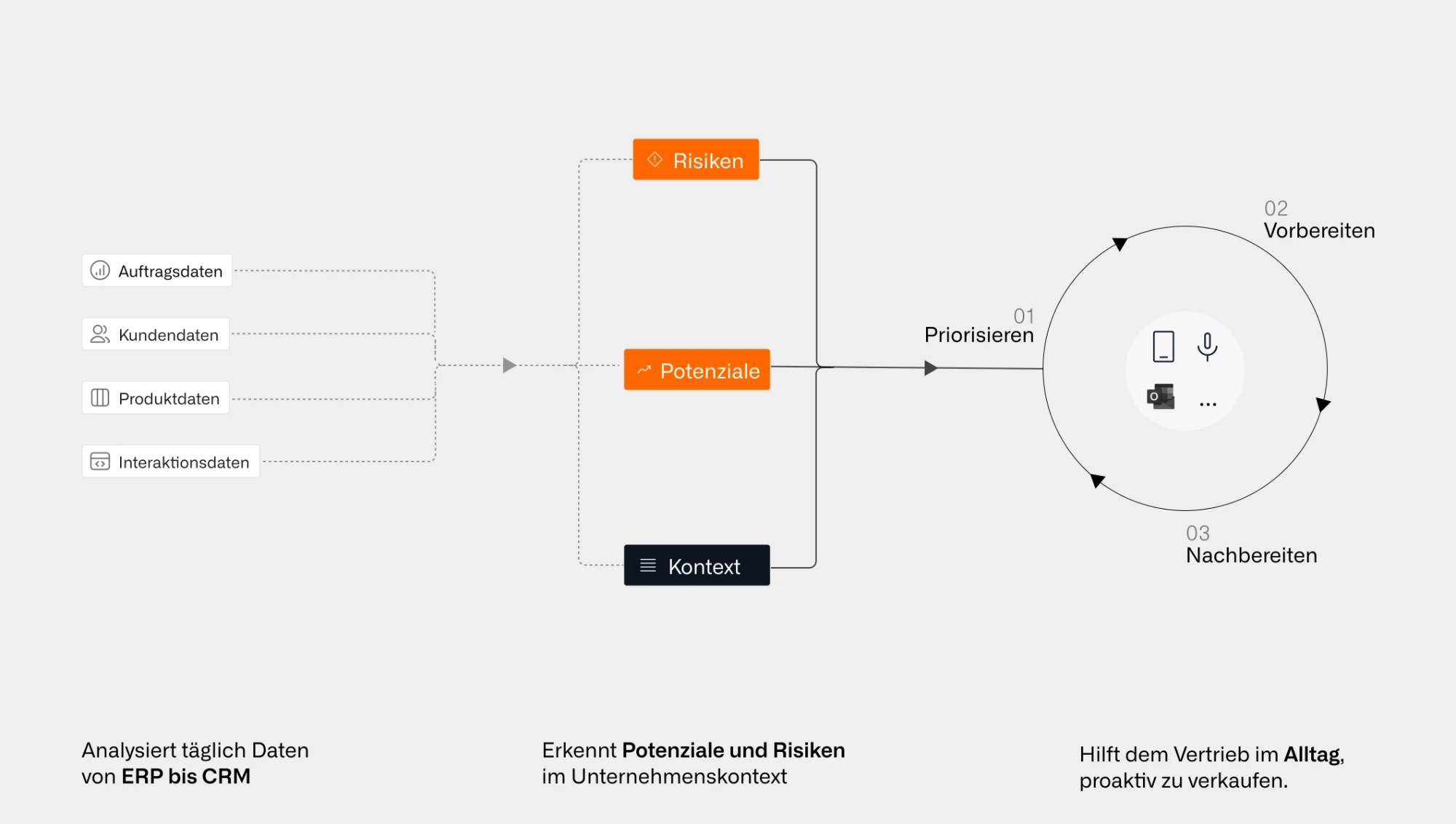
Order, customer, product and interaction data become risks and opportunities that sales uses in the app, in Outlook and by voice.
- Built for wholesale: The models understand wholesalers' ranges, reorders and seasonal patterns right down to the division, from building materials to foodservice.
- Existing-customer logic in detail: Order rhythm per customer and product, range penetration, silent customers, substitutes, margin decline, open quotes and contact frequency, every night for every existing customer. At Plate, the time between orders fell by 35%.
- Simple in daily use: The signal appears with a reason and talking points in Outlook, as a sidebar in the CRM or in the app. A visit is prepared in about two minutes.
Acto works with existing customers. Lead generation and cold calling are not part of it. Getting started usually runs through a pilot phase with KPIs agreed jointly.
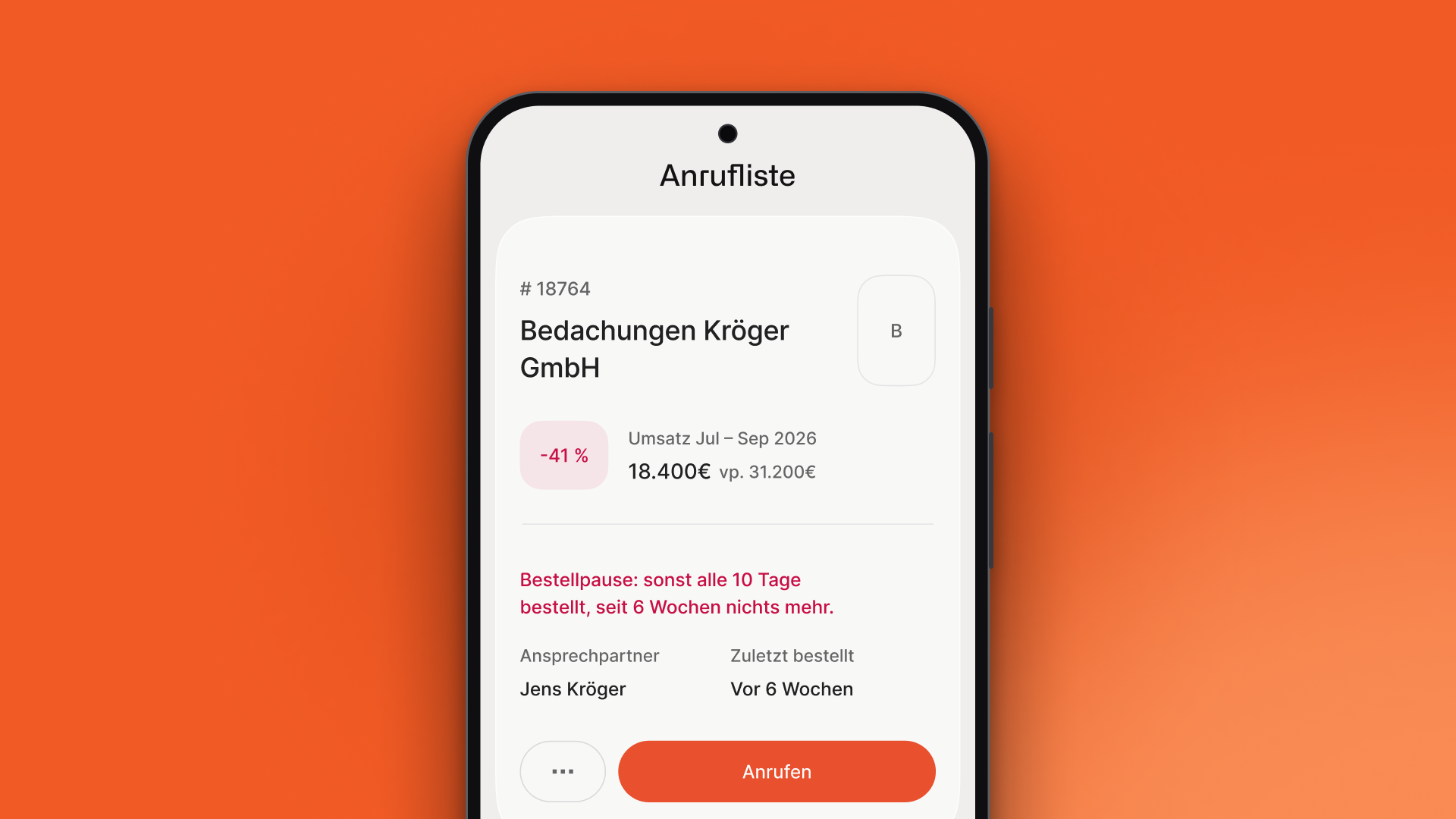
Signal for an example customer (demo data): usually orders every 10 days, nothing for 6 weeks, with revenue comparison and call button.
How do you check your starting point with your own numbers?
Four questions show which route fits your business. Answer them with numbers:
- How many active customer numbers does each of your field sales reps look after?
- Who sees it today when a customer drops a product category, and after how many weeks?
- Who will maintain a self-built model in a year, once the range and customers have changed?
- How many weeks can you wait for the first signal?
In a conversation, we'll run your ERP data through to show which of your customers are going quiet right now and who should act on it.
FAQ
Is the churn rate enough as an early warning signal in wholesale?
The churn rate isn't enough as an early warning signal, because it only counts losses after the fact. It is calculated as the customers lost in a period divided by the customers at the start. According to the B2BEST Barometer from IFH Köln, 49% of the wholesalers and manufacturers surveyed have defined churn rate as a KPI. Churn management, meaning detecting churn and acting on it, also needs the order gap and basket per customer.
Do we need clean data before software can find anything?
Clean master data is not a prerequisite. Acto needs a nightly ERP export with order lines, customer and item data, delivered by export, SFTP or database access via an exchange server so that the live ERP stays untouched. Acto brings structure to the data itself and automates activity logging.
How much trust does a churn probability deserve?
A percentage on its own deserves little trust. A signal needs a reason that field sales can check, such as "product category roof windows not ordered for four months". In Acto, AI agents check every signal for relevance, and feedback such as "not relevant, because …" feeds into the next nightly run.
Does churn prediction software replace our CRM or our BI?
In larger sales organisations, Acto complements the CRM and does not replace BI. Smaller sales organisations use Acto as a lean alternative to a CRM, while larger ones embed Acto as a sidebar in Dynamics 365, SAP Sales Cloud or Salesforce. Power BI remains responsible for management KPIs.