Why a CRM Isn't Always Best for Wholesale Distributors
Summary
- A classic CRM is rarely the best choice for sales work at wholesale distributors. It was built for new-customer pipelines, but wholesale revenue comes from the existing customer base.
- According to our study “Wholesale Sales 2026” (in German), a field sales rep in wholesale manages 247 customers on average (median 175, data from 106 companies, 2024 to 2026). In 49% of the analyzed conversations, the CRM is barely used or not used at all in field sales.
- Smaller sales organizations get by without a classic CRM, using a lean decision layer. Larger ones keep their CRM as a master data layer and put the actual work in a layer above it. Before any CRM project comes one question: What role should our CRM play in five years?
Last updated: October 2026
| Approach | Fits |
|---|---|
| Lean, without a classic CRM | smaller sales organizations that want to work lean and with focus |
| Existing CRM, decision layer as a sidebar | larger companies whose CRM also supports marketing and new business |
| ERP-centric | large corporations with a strong ERP organization |
Monday morning, half past seven. A field sales rep in sanitary wholesale is sitting in the car before the first appointment. The CRM shows three visit reports and a phone number for this installer. That the business hasn't ordered any pre-wall elements for weeks isn't there. A classic CRM is rarely the best choice for wholesale distributors because it was built for a different sales logic. The actual work belongs in a layer above it, and some companies don't need the CRM underneath at all.
Do I really need a CRM as a wholesaler?
As a repository for contacts and contact history: yes. As a tool the field sales team uses to run its day: no. The question before the next project is therefore “What role should our CRM play in five years?” and not “Which CRM should we buy?”.
Curiosity is rarely what drives the search for a CRM for wholesale. Usually a project has stalled. The system is rolled out, training is done and it's paid for, and still it becomes a digital phone book with a documentation obligation.
In our recorded conversations with more than 200 wholesale organizations over the last 18 months, we then hear the same diagnosis: more training, more discipline, maybe a different vendor. That falls short. Salesforce, Dynamics 365 or SAP Sales Cloud are good tools for industries that live off new customers, and that is exactly what they were built for.
What were ERP and CRM originally built for?
The ERP emerged in the 1980s as the source of truth for transactions, prices, inventory and terms. The CRM came in the 1990s from industries that live off new-customer acquisition: software, telecommunications, insurance.
The ERP was never meant for sales decisions. That is precisely what makes it the most stable layer in the company. Every order line shows who bought which item at what price and when. Anyone investing in S/4HANA or Dynamics right now is investing in the foundation, and that is the right call.
The CRM follows the logic of a pipeline: leads come in at the top, closed deals come out at the bottom, and qualification happens in between. For a software salesperson with, say, 200 open leads, that is exactly the right tool. Wholesale adopted this concept even though it has a different problem.
Why does CRM usage in field sales fall short of expectations?
Because the tool's logic doesn't fit the work. A field sales rep in wholesale doesn't manage a pipeline; they look after a portfolio of existing customers with thousands of items. For this work, a CRM gives nothing back.
The job is to work the portfolio: closing assortment gaps, prompting reorders, spotting churn early. Economically, this is the core of the business. According to a piece by Gallo in the Harvard Business Review (2014), depending on the industry, acquiring a customer costs five to 25 times as much as retaining an existing one.
In our study, we analyzed recorded sales conversations with wholesalers from 2024 to 2026, counting only statements made by the interviewees (not representative). In 49% of the conversations, the CRM is barely used or not used at all in field sales (in German), and well used in only 8% (base: 182 of 355 conversations). Customer visits are planned by gut feeling or experience in 47% of the conversations, and with the CRM in 8% (base: 186 conversations).

A CRM sorts leads into a funnel, but field sales in wholesale has to read a portfolio of existing customers.
Field sales is not to blame. Field sales reps are pragmatic. A tool that only demands input and gives no benefit back feels like a surveillance camera and is treated like one.
I put it on LinkedIn this way: the real profit lies in the existing customer base, and there a CRM helps at most with documentation. That is nothing against CRMs; we use one ourselves and are happy with it. Wholesale simply works differently from selling software or insurance.
Acceptance is a usefulness problem. Every tool for field sales must therefore pass one test: Does the rep use it on Tuesday at half past seven in the car, without anyone forcing them to?
What happens when the CRM doesn't hold up?
Field sales builds its own substitutes: Excel lists for focus customers, OneNote, custom reports from BI. Knowledge about a customer is spread across several tools and several heads.
“Do I look in the CRM, do I look in the [merchandise management system], do I have some Excel lists, do I start googling? I can really drive myself crazy.”
– Sales interviewee, customer conversation
CRM upkeep happens in the evening or on Friday.
“And when I walk out of the appointment, that's when the fun really starts, because of course I still have to update my contact reports in the CRM.”
– Interviewee, B2B mail-order retailer for business equipment, customer conversation
By then, the detail that the owner mentioned a second branch five months ago is forgotten. According to IFH Köln, around 60 percent of the surveyed B2B companies had problems keeping their customer data up to date (survey year not stated there).
The bill comes due at retirement. The longest-serving field sales rep knows when to call which customer and when better not to. That knowledge was never in the system, so it leaves with them.
What remains of the CRM when you look at its five functions one by one?
“CRM” is a bundle of five functions: documenting activities, tasks and follow-ups, reporting, contact master data, and pipeline management. The first three move up a layer; the last two stay.
Group A: Which functions move up a layer?
In future, documentation emerges as a by-product of the work: by voice after the appointment, from Outlook and the calendar. We describe what this looks like in practice under Voice-to-CRM. Follow-ups are derived from signals, for example an unusually long pause in ordering. Reporting belongs in a data layer of its own, not in the tool the field sales team types into.
Group B: What stays?
The contacts stay. A wholesale customer has an owner, a buyer, a workshop manager and accounting, and the ERP knows only a few of them. Pipeline management remains a peripheral topic: important for a new brand or a new line of business, not for the bulk of sales work. The existing-customer business doesn't need lead scoring and marketing automation.
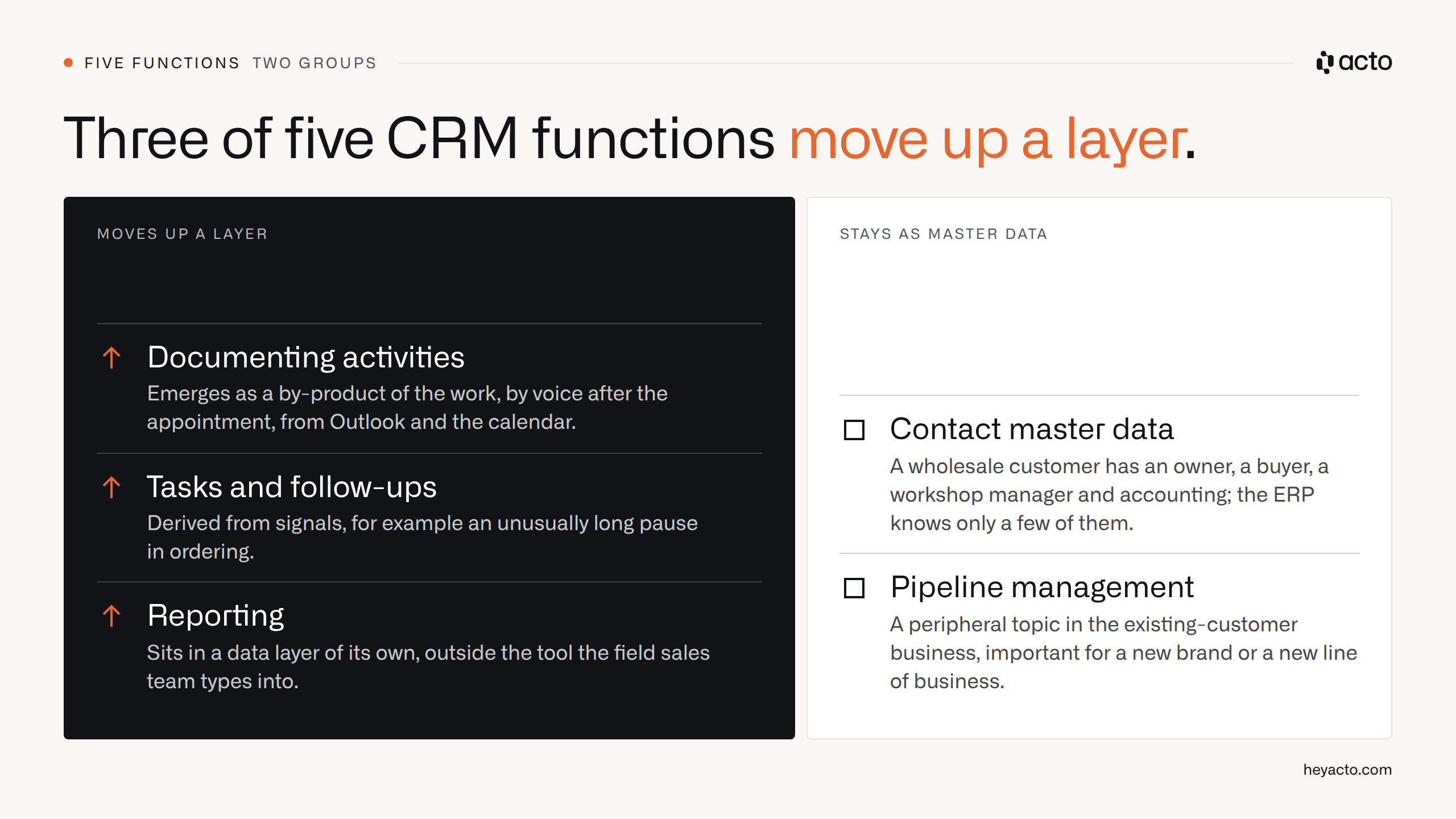
In future, three of the five CRM functions will happen automatically; only master data and new business stay in the CRM.
Does every wholesaler need a CRM at all?
No. Which approach fits depends mainly on the size of the sales organization and on what else the CRM is needed for. In none of the approaches does value creation happen in the master data layer. It is infrastructure.
| Approach | Advantage | What to watch for | Fits |
|---|---|---|---|
| Lean, without a classic CRM | One system fewer, no upkeep effort for field sales, the work runs directly in the decision layer | Contacts and GDPR evidence still need a fixed place | Smaller sales organizations that want to work lean and with focus |
| Existing CRM, decision layer as a sidebar | The investment stays usable, the CRM continues to support marketing and new business | CRM licensing and basic upkeep remain | Larger companies whose CRM has other tasks as well |
| ERP-centric | One source of truth for everything | Cumbersome in mid-sized companies, sales logic bloats the ERP | Large corporations with a big ERP team |
What matters is that the decision is made deliberately and that a classic CRM project isn't simply launched again by reflex.
What is missing between ERP, CRM and people?
What is missing is a knowledge and decision layer that tells field sales what to do today. A dashboard delivers 50 reports. A salesperson needs answers in the morning to questions like: Whom do I visit today, and what do I offer there? The layer consists of context, assistants and an interface in everyday work; more under Decision Intelligence.
Context: How does the data come together?
It brings together ERP transactions, CRM master data, Outlook and Teams activities, recorded conversations and shop data. The buying signals have been sitting in the ERP for years. A wholesaler described to us a customer who buys thousands of cartons but not a single closure. Something like that only becomes visible when someone compares the order intervals and product groups per customer against comparable customers. This includes feedback from day-to-day work: Was the recommended product placed?
Assistants: Who says what matters today?
Specialized assistants detect risks and potential, prioritize visits, prepare conversations, record them and suggest follow-up activities. They suggest, the human decides. Sales tools from software sales can't be transferred one to one, because assortments, customer cohorts and seasonal effects work differently in wholesale.
Interface: Why not a new app?
Sales software is bought in the office and used in the car, or not at all. Five minutes before an appointment, nobody needs 20 metrics. The layer appears where field sales already is: as a voice assistant in the car, a briefing in Outlook, an entry in Teams. A pretty interface without intelligence behind it is a new CRM.

Value creation happens in the third layer, which most wholesalers lack today.
Why now?
One thing above all has changed since the last CRM wave: data entry is no longer an obstacle.
The biggest obstacle of the last 20 years was input discipline. A short voice memo in the car now replaces filling in fields. At Würth, 3,500 field sales employees use the assistant Pico for information and administrative tasks. ERP vendors are building in assistants as well, but ERPs are designed to be transactional and roll out too slowly. And economic pressure leaves no time to wait for that.
The pressure is real. The BGA expects only 0.7% real revenue growth in wholesale for 2026 (1.2% nominal), and the number of insolvency filings in wholesale has almost doubled since 2022: from 632 to 1,241 in 2025 (Destatis, 2025 figures provisional, analyzed in our study “Wholesale Sales 2026” (in German)). Departing knowledge holders are hard to replace: according to the Federal Employment Agency, it takes a median of 85 days to fill a position for wholesale and foreign trade merchants, and in 2024 it was 93.
A purely illustrative example calculation shows why the existing customer base is the lever. Assumptions: €200 million in revenue, 25% gross margin, 3% EBIT (that is, €6 million). If 5% more revenue is achieved at the same margin and without additional costs, that is €10 million more revenue and €2.5 million more gross profit, arithmetically around 42% more operating profit. This calculation is not a promise. It only shows how strongly a few percent in the existing base can flow through.

Five percent more revenue in the existing base flows through disproportionately to profit at the same margin.
What can go wrong with this approach?
We see these mistakes again and again.
First, tool is stacked on tool. A new layer that simply gets added alongside CRM, BI and Excel lists aggravates the problem.
Second, adoption is treated as a compliance problem. Anyone who says “they have to use it now” has lost before the rollout begins.
Third, management and incentives stay unchanged. If you pay only on revenue, you get revenue instead of margin, no matter how good the recommendations are.
Not for you: When a classic CRM remains the right answer
Anyone who mostly does commercial project or new-customer business needs a CRM as a working tool. An interviewee from building services explained to us why he can't do without one: he looks after many planners who never generate revenue themselves, and project business is becoming more international.
“In building services too, especially in the public sector, more and more tenders have to be published Europe-wide, so we can't get around a CRM at all.”
– Interviewee, manufacturer of fittings for building services, customer conversation
There, the pipeline is the business.
The approach is likewise unsuitable when transaction data is missing, for example for manufacturers that sell through wholesale.
“If I were to say now, hey, from the data I have I'm even trying to map percentage changes in revenue up and down, and I can't say at all whether he may have ordered the products through wholesale for 3 months, 6 months or not, that later also leads to wrong conclusions.”
– Interviewee, manufacturer of dental materials, customer conversation
The same applies to poor ERP data quality: without clean order data there are no usable signals.
What decisions are coming up in the next 12 to 24 months?
Keep the ERP transactional, define the CRM's role deliberately, and start small.
1. The ERP stays transactional
Sales logic doesn't belong in the ERP. There it builds up complexity for years that makes every later change harder.
2. The fundamental question before the CRM project
Anyone who first defines what role the CRM should play ends up with a leaner system. The budget then works in the layer above, which can be built in parallel to the CRM modernization.
3. Start small
For example with one site, 15 to 25 field sales reps and a success criterion that can be measured after twelve weeks. The first step costs nothing: ask five field sales reps, for example, when they last looked in the CRM before a visit.
How does Acto build the knowledge and decision layer for wholesale?
Acto is built for direct sales and wholesale, down to the sub-sector: technical trade, food service, office supplies or HVAC. Smaller sales organizations that want to work lean use Acto instead of a CRM. Larger companies embed it as a sidebar in their CRM and also use it in Outlook. Transparency: Acto is our own product. Acto reads the orders from the ERP and tells field sales where the revenue is today. Implementation usually takes four to six weeks with two to three days of IT effort, depending on data quality, system landscape and number of sites.
- ERP data is used directly, for example from SAP S/4HANA or Dynamics 365 Business Central, and CRM data feeds in as well.
- Acto runs as a sidebar in Outlook, in the CRM Salesforce, in Dynamics 365 and in SAP Sales Cloud.
- After the appointment, field sales speaks into the phone, and the visit report and follow-up tasks are created in the CRM.
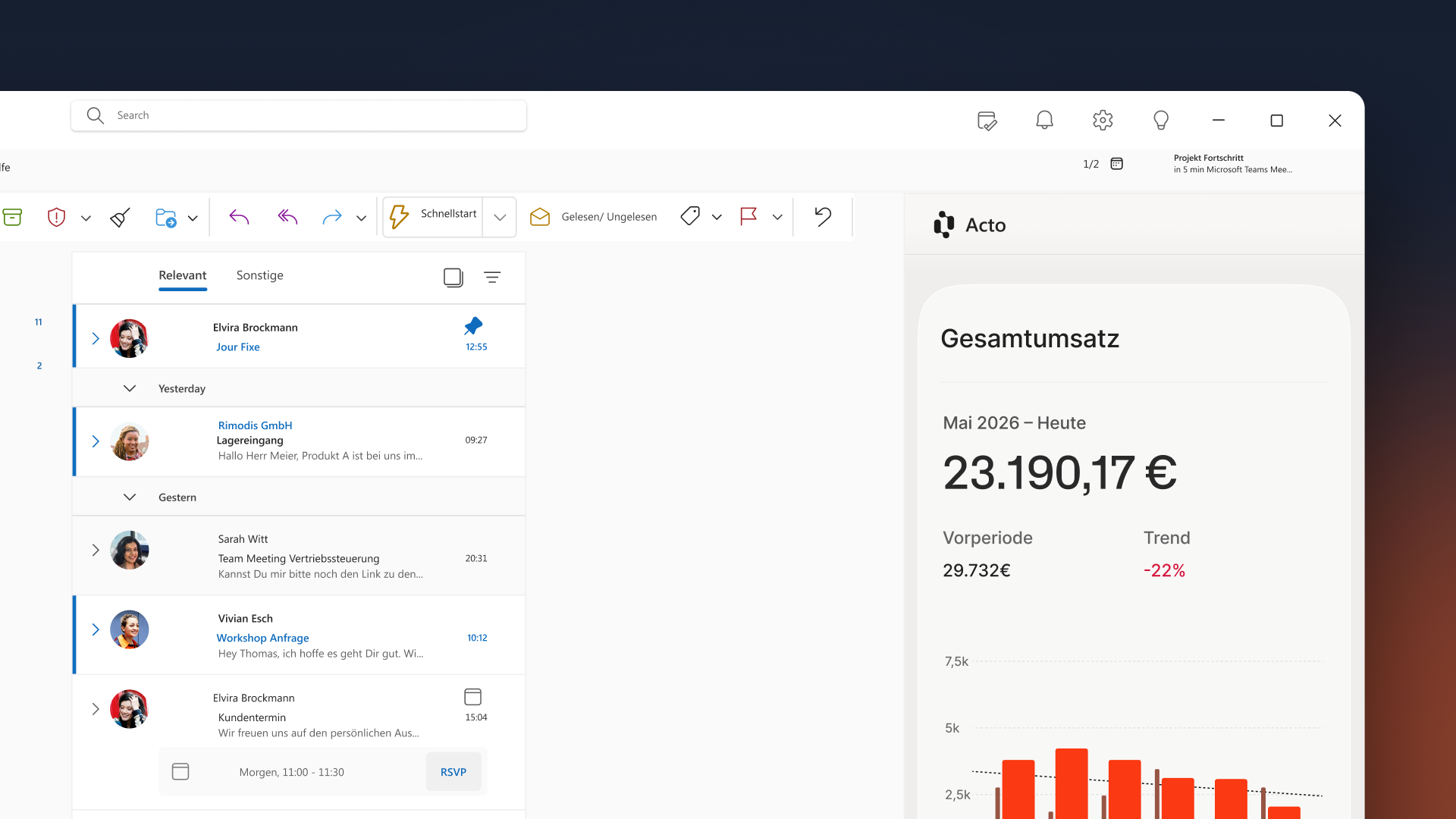
Revenue trend and customer signals appear directly in Outlook, without opening another program.
At Plate, revenue among the users in the pilot team rose by 10%, and the time between orders fell by 35%. At the office supplies retailer Schäfer Shop, sales marked 92% of the suggested signals as helpful. Usefulness creates acceptance. You can find more on the principle under existing customer management.
Closing picture: What remains when the field sales rep leaves with 240 customers in their head?
A field sales rep retires after 28 years, 240 customers in their head.
In world 1, the successor diligently maintains a modern CRM. He starts from zero anyway, because the knowledge was never in the CRM.
In world 2, a voice assistant tells the successor in the morning that customer X has been ordering less for three weeks. And that at the last visit, the handover to the owner's son was hinted at, because the predecessor once mentioned it and the system kept it.
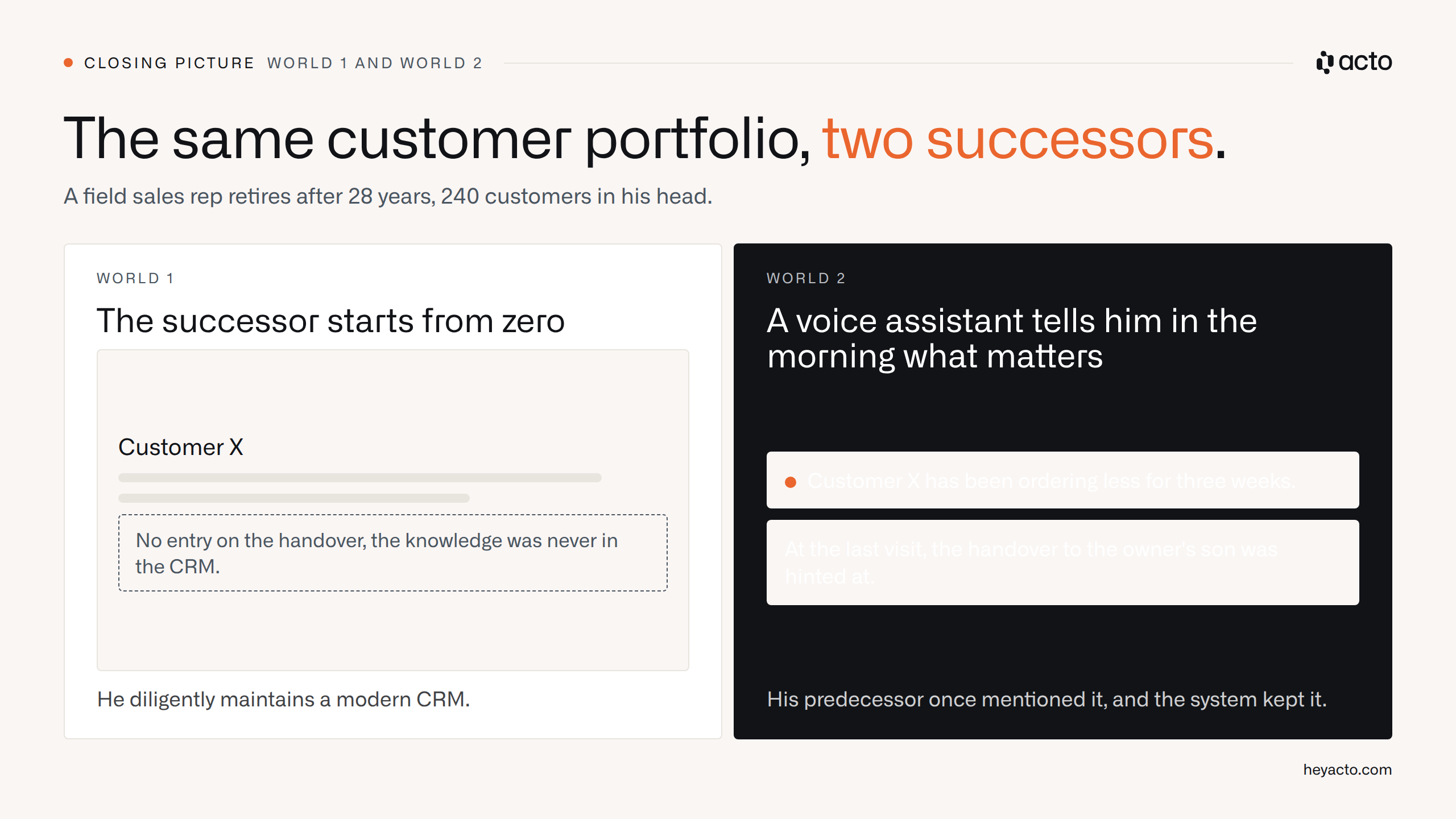
The same customer portfolio, two successors: the difference lies in the layer above the CRM.
In which world does your successor work?
FAQ: Frequently asked questions about CRM in wholesale
Are SAP and CRM the same thing?
No. SAP S/4HANA is an ERP for orders, prices and inventory; SAP Sales Cloud is SAP's CRM. Salesforce is a CRM, Microsoft Dynamics 365 offers both. For sales in wholesale, the ERP supplies the more valuable data.
What are the three types of CRM?
A distinction is made between operational, analytical and collaborative CRM. CRM stands for customer relationship management. Operational CRM manages contacts and activities, analytical CRM evaluates data, collaborative CRM connects departments. In wholesale, the analytical work moves into a decision layer of its own.
Is an industry-specific CRM solution the better choice for wholesale?
An industry-specific solution knows price lists and discount tiers better. But the pipeline logic stays the same. Clarify the role of the CRM first, then the vendor.
What do I do if my field sales team simply doesn't maintain the CRM?
Stop enforcing upkeep. Ask what field sales gets back from the system. If nothing comes back, refusal is a reasonable reaction, and the solution lies in voice instead of forms and recommendations instead of reports.
Whether the layer above the CRM fits your company, we are happy to clarify in a conversation.