Field Sales Rep Costs 2026: Calculating Annual Cost and Cost per Visit
Summary
- A field sales rep in wholesale costs, by calculation, around €98,000 a year (range €76,000 to €129,000). That is the finding of the Acto study „Vertrieb im Großhandel 2026“, our own calculation based on the BA Entgeltatlas (Federal Employment Agency salary atlas), 2026 social security contributions and 2026 ADAC car costs. Commissions and management costs are not included.
- At around 1,000 visits a year, each visit costs just under €100.
- According to our analysis, a field sales rep in wholesale serves an average of 247 customers (median 175, figures from 106 companies, 2024 to 2026). By calculation, that means seeing each customer about four times a year.
- The biggest lever is where those visits take place. For this, Acto analyzes ERP and CRM data and shows field sales teams in wholesale and manufacturing which customers currently have a need or a churn risk.
Last updated: October 2026
What counts toward the cost of a field sales rep?
The cost of a field sales rep is their full cost: everything the employer bears for them in a year. That includes gross salary, the employer's share of social security, company car, expenses, and IT and equipment, plus commissions and a proportionate share of management costs.
Definition: The full annual cost is the sum of all employer costs for a field sales rep. The cost per visit is this full cost divided by the number of customer visits in the year.
Five terms are often used interchangeably but mean different things:
- Salary is only one item of the full cost, albeit the largest.
- Field sales compensation comprises fixed pay and variable components, but neither vehicle nor expenses.
- Sales costs cover the entire sales organization, including inside sales and management.
- A commercial agent is self-employed and does not appear as a personnel cost.
- The cost per visit refers to the appointment, not to the order.
How do you calculate the cost per year and per visit?
You calculate in two steps. First: full cost = gross salary + employer contributions + vehicle + expenses + IT + commissions + management costs + other attributable costs. Second: cost per visit = full cost ÷ (field days × visits per day).
The formula has two adjustable levers. The numerator is the cost, which can hardly be moved without paying people less. The denominator is the visits, and what a visit brings in depends on them too.
The model calculation for wholesale
The study uses the median gross salary from the Federal Employment Agency's Entgeltatlas (KldB 61123, as of 31 December 2025: €5,344 a month). Added to this are 21% employer contributions based on the 2026 social security values and vehicle costs based on the 2026 ADAC car costs. The denominator comes from roughly six visits a day from our conversations (median of 42 responses) and the 176 field days assumed in the model calculation.
| Item | Assumption | Amount per year (by calculation) |
|---|---|---|
| Gross salary | 12 × €5,344 | €64,128 |
| Employer contributions | 21% | €13,467 |
| Vehicle | Assumption based on 2026 ADAC car costs | €12,000 |
| Expenses | Study assumption | €6,000 |
| IT and equipment | Study assumption | €2,500 |
| **Full cost** | Total | **around €98,000** |
| Visits per year | 6 × 176 days | around 1,000 |
| **Cost per visit** | Full cost ÷ visits | **just under €100** |
If you pay commission, add it on top. The range of €76,000 to €129,000 depends mainly on the salary level.
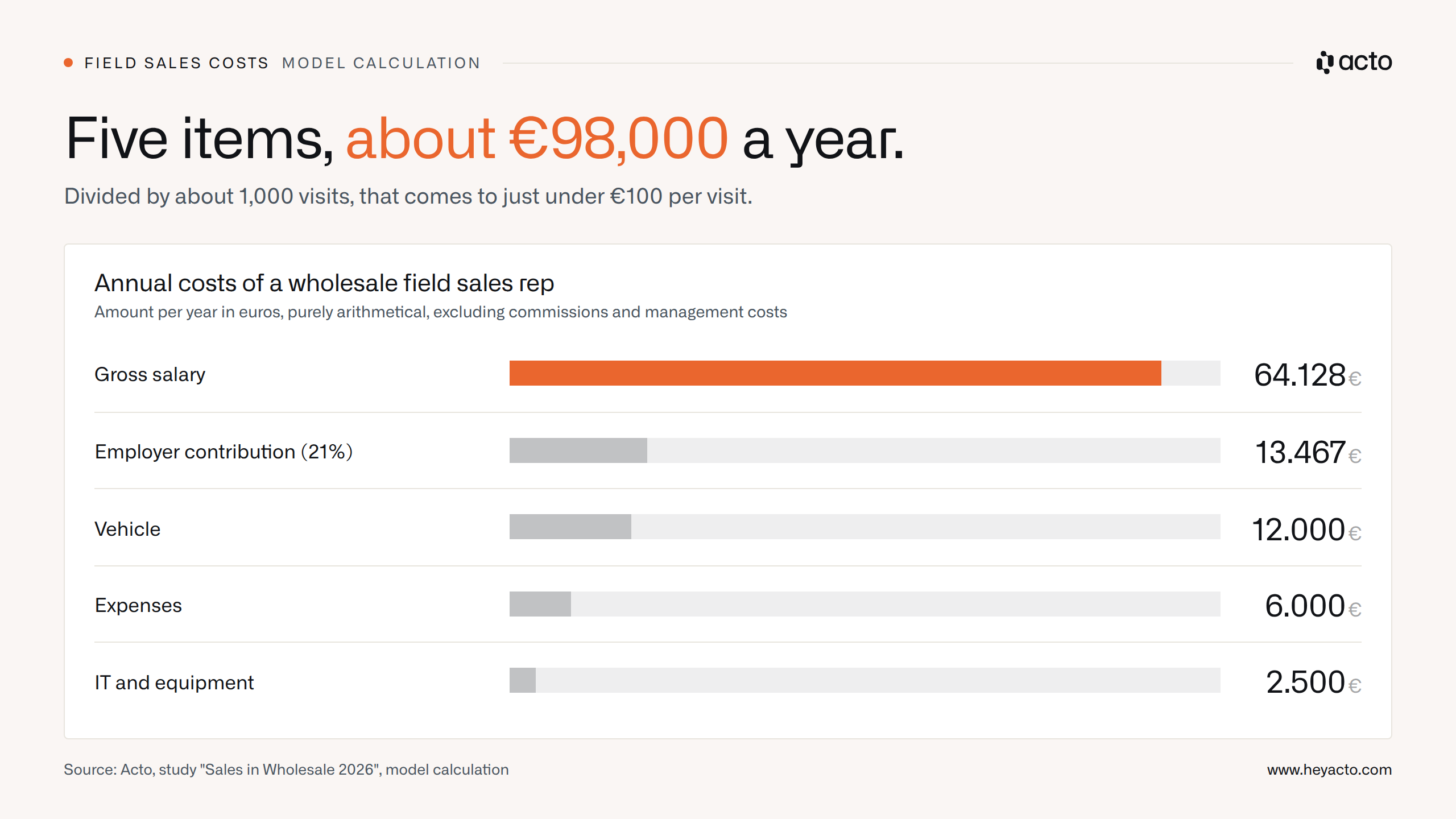
Salary and employer contributions make up the bulk; the price of a visit only emerges from the number of appointments.
Field sales as a cost factor: Which blocks weigh heaviest?
Salary with employer contributions weighs heaviest. Vehicle, expenses and IT together come to €20,500 in the model calculation.
On salary, sources diverge. The median target salary in field sales is €56,000 gross at Experteer, while for field service in skilled trades Stepstone cites €48,800. The BA median is higher. Reliable figures for your own industry are provided by paid compensation studies for sales and marketing.
The company car is the second-largest block. Often more expensive than the car itself is the time spent in it, because every hour of driving is an hour missing at the customer.
Meal allowance and mileage allowance
For domestic business trips in 2026, €14 for absences of more than eight hours and €28 for a full 24 hours continue to apply. For trips abroad, there are country-specific flat rates in the Federal Ministry of Finance's payroll tax handbook. The mileage allowance applies only to trips in a private car. Both are tax parameters. What your company actually pays is set out in the travel expense policy.
Is your field sales team expensive or market standard?
Around €98,000 is a calculated benchmark for wholesale. Whether your field sales team is expensive, however, is decided only by what the roughly 1,000 visits a year deliver.
According to our study, a field sales rep serves an average of 247 customers, with a median of 175. By calculation, they see each customer about four times a year, or just under six times at the median. For example: someone who visits their 30 most important customers monthly uses up 360 visits for that. For the remaining 145 customers, a good 600 are left.
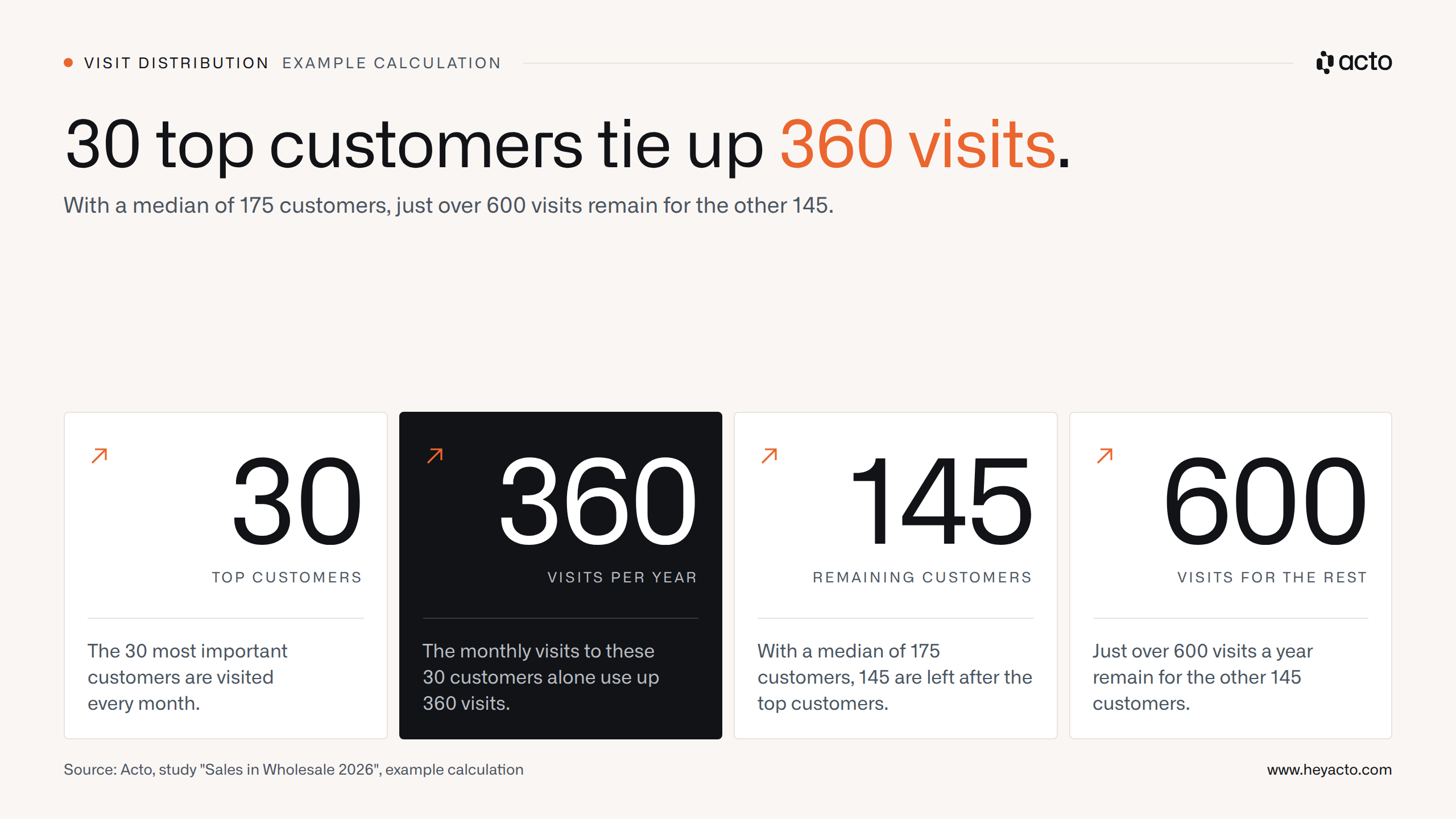
If you visit your key customers often, you have hardly any visits left for the rest of the customer list.
In one of our conversations, an interviewee calculated around 600 customers per field sales rep, at six visits a day. There is never enough time for all of them. The selection is then made in the rep's head, because the CRM rarely provides anything for it: in 49% of 182 analyzed conversations with wholesalers, the CRM is barely used or not used at all in field sales.
"We have so many customers to look after that it's simply difficult to really keep an eye on every customer. We're actually usually operating reactively at the moment."
(IT Director, €600 million food wholesaler, customer conversation)

At what revenue does a single visit pay off?
A visit pays for itself when the gross profit it triggers exceeds its cost. The break-even point per visit equals the visit cost divided by the gross margin.
Example (hypothetical): At just under €100 per visit and an assumed gross margin of 25%, a visit has to trigger around €400 in additional revenue. The margin is made up; use your own.
The second calculation is usually more convincing in controlling. Suppose 200 of the roughly 1,000 visits take place at customers with no reason to visit. By calculation, that is around €20,000 a year per field sales rep, with not a euro of revenue to set against it.
Field sales or commercial agent: What pays off?
A commercial agent costs mainly when they sell. By our model calculation, an employed field sales rep in wholesale costs around €98,000 a year excluding commissions and management costs, even in a weak quarter. In return, steering, customer knowledge and the relationship stay in-house.
| Criterion | Employed field sales | Commercial agent |
|---|---|---|
| Cost structure | mostly fixed | mostly variable via commission |
| Steering | visit planning and instruction | self-employed, via contract |
| Customer knowledge | stays in-house | stays with the agent |
| End of contract | notice periods | compensation claim under § 89b HGB |
| Fits when | existing business with many customers carries the revenue | new territory, uncertain volume |
At the end of the contract, the agent becomes more expensive again: the compensation claim can reach up to one average annual commission of the last five years. In the agent's favor, a permanent hire takes time. According to the Federal Employment Agency's Fachkräfteengpassanalyse 2025, filling a position in wholesale takes a median of 85 days.
How can you reduce the cost per visit?
More visits at the same cost lower the cost per visit; more yield per visit improves profitability. The second lever is bigger, and it starts with planning visits by signal rather than by date.
Rigid intervals of four, eight or twelve weeks follow the calendar. The field rep then stands in front of a customer who needs nothing while another quietly churns. Churn happens product group by product group, and total revenue looks healthy for a long time because the standard items keep selling. A signal looks like this: a customer otherwise buys a product group every 16 weeks and hasn't ordered anything for 25 weeks. Such deviations from the customer's own order frequency have long been sitting in the ERP, as we show in our article on churn risk.
If the search for signals stays manual, it eats up the time it is meant to save.
"Once a month we get a report listing all customers who are 15 days or more outside their regular ordering rhythm. Then the really laborious, cumbersome work starts. You can definitely count on a good hour per customer."
(Head of Sales, mid-sized manufacturing company, initial conversation)
Field sales reps are salespeople, not analysts. The data work should be outsourced; sales needs ready-made recommendations. Route planning reduces travel costs, but it doesn't tell you which customer is due this week. A white-spot analysis by potential answers that. Less admin work through automation also gives visit capacity back. Preparation pays off too: in one in four conversations with wholesalers, field sales barely prepares visits, if at all.
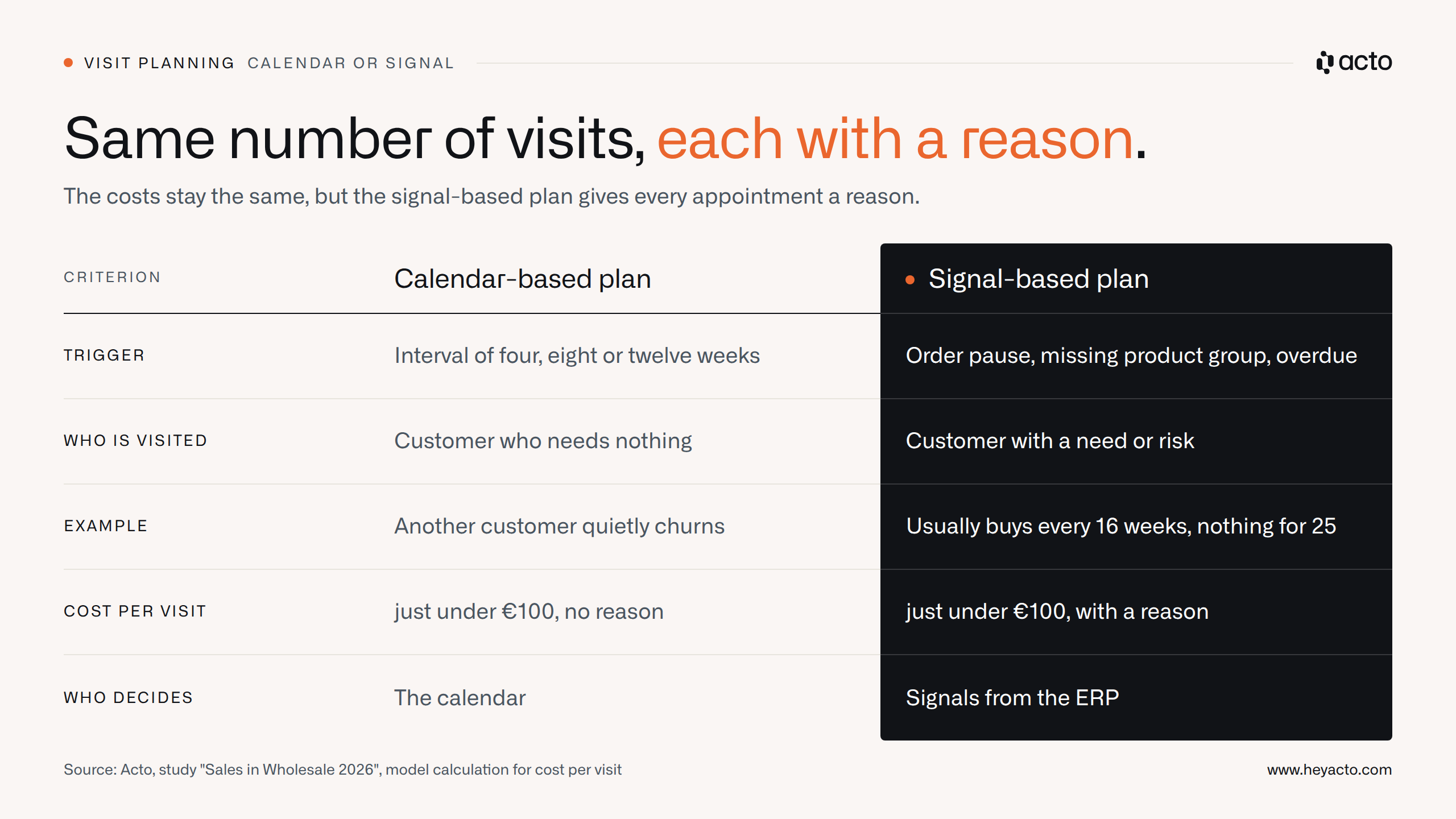
Same number of visits, same cost, but on the right every appointment has a reason.
Checklist: What must a solution be able to do?
- Analyze signals from ERP and CRM daily, per customer and product group.
- Deliver ready-made recommendations instead of reports you have to analyze yourself.
- Appear where field sales works: Outlook, CRM, smartphone.
- Allow follow-up by voice.
- Work with the data quality you already have.
You should continuously measure cost per visit, visits per day and the share of customers beyond their usual order cycle. More on this in our field sales KPIs.
Not for you: When this calculation and the signal approach don't fit
The model calculation does not replace a full-cost calculation from your accounting, because commissions and management costs are missing. Visit prioritization achieves little if a field sales rep serves only a handful of key accounts whom they already follow closely. It also helps little in pure new-customer business, because the signals come from order history. And no software lowers salary or company car costs. It changes what the paid time is used for.
How to implement visit prioritization with Acto
Acto is the provider of the software described here. Acto analyzes the order data from your ERP and presents field sales every morning with the customers where a visit is worthwhile. Schäfer Shop increased revenue by 11.2% with Acto, and sales marks 92% of signals as relevant. Plate increased revenue by 10.0% and saves 1.5 hours a day.
- Prioritize customer visits by order gaps, revenue decline and missing product groups.
- Prepare conversations with the customer's open opportunities and risks.
- Follow up visits by voice instead of typing visit reports on a laptop.
⚠️ [Screenshot fehlt: 02-kunden-im-fokus-1, no URL in the library]
Frequently asked questions (FAQ)
What does a field sales rep cost per year?
In wholesale, by calculation around €98,000, with a range of €76,000 to €129,000. This includes salary, employer contributions, vehicle, expenses and IT, but no commissions or management costs.
What is field sales compensation including commission?
There is no reliable flat figure, because commission models vary widely from company to company. Stepstone cites a median salary of €48,800 gross a year for field service in skilled trades, Experteer a median target salary of €56,000 gross a year for field sales. You add the variable compensation from your own model.
How high is the meal allowance?
Domestically, €14 for absences of more than eight hours and €28 for a full 24 hours. For abroad, country-specific flat rates from the Federal Ministry of Finance apply.
Is a commercial agent cheaper than an employed field sales rep?
In a new territory with uncertain volume, often yes, because almost only commission is incurred. In existing business with many customers, you lose steering and customer knowledge. At the end of the contract, the compensation claim under § 89b HGB is added.
We're missing a field sales rep. Shouldn't we just hire?
First calculate how many of your visits per field sales rep had a reason; our model calculation assumes around 1,000 visits. If a noticeable share goes to customers with no need, use better prioritization to steer existing capacity to customers with a need before you commit around €98,000 a year to a new hire.
We are happy to work out with you, using your own figures, how many of your visits have a reason.