Inside Sales in Wholesale: Tasks, Role and How It Can Evolve

Summary
- In wholesale, inside sales handles quotes and orders, advises customers by phone, logs complaints, maintains customer data and coordinates with field sales.
- Almost two in three sales roles advertised by distributors are inside sales positions (65% of 253 ads on the job board of Germany's Federal Employment Agency, calendar week 42/2026, from our "Sales in Wholesale 2026" report (in German)). Inside sales is also the team in most frequent contact with regular customers.
- Seven to eight in ten job ads mention advising customers or selling. Only about one in ten explicitly asks for "active selling", and in practice, managers describe their inside sales team as order-takers.
- For inside sales, active selling means following up on quotes, calling dormant customers and raising gaps in what they buy. To do that, the team needs ready-made prompts from its own order data every morning.
"Does your inside sales team help field sales sell?"
"No. Barely, really. Mostly just order-taking."
We hear that a lot. This time, the reason came with it. The customer calls and reads out their items. The rep types along, with no time to think. And then: "Thanks, bye."
Yet that's exactly the moment for a question. "Have you thought about this? Don't you need that too?" That's how the manager we spoke to pictures his inside sales team. Today, nobody asks.
Inside sales has more customer contact than anyone else in the company. And it spends that contact on data entry, while the reasons to sell sit untouched in the order data. Only when those sales opportunities arrive ready-made, with a reason attached, does an order call become a sales conversation.
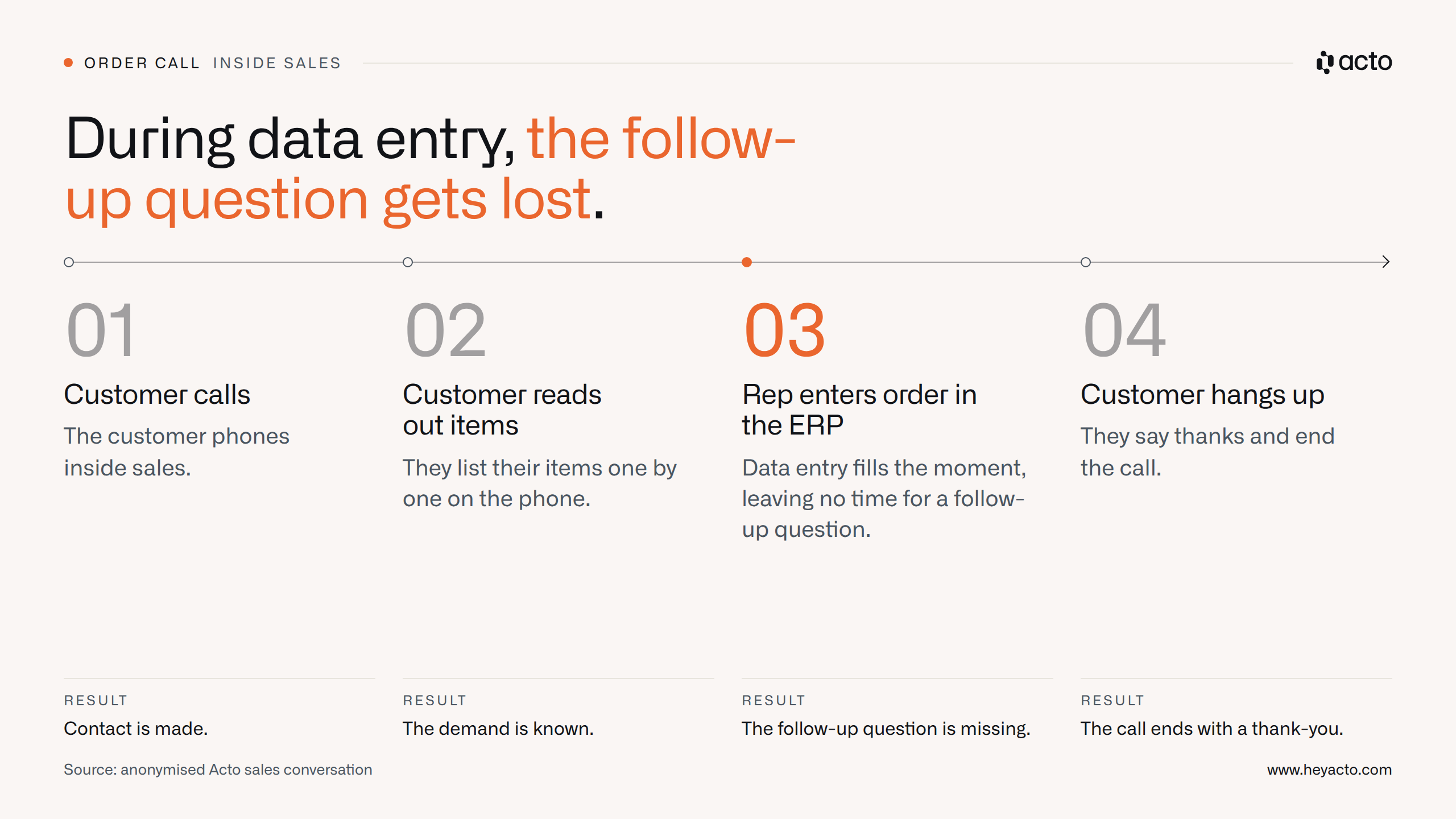
The sales opportunity sits right in the middle of the order call, but data entry takes up exactly that moment.
What does inside sales do in wholesale?
In wholesale, inside sales prepares quotes, enters and processes orders, advises customers by phone, handles complaints, maintains customer data and coordinates with field sales. In short, it's where everything comes together: customers, field sales, the warehouse and purchasing.
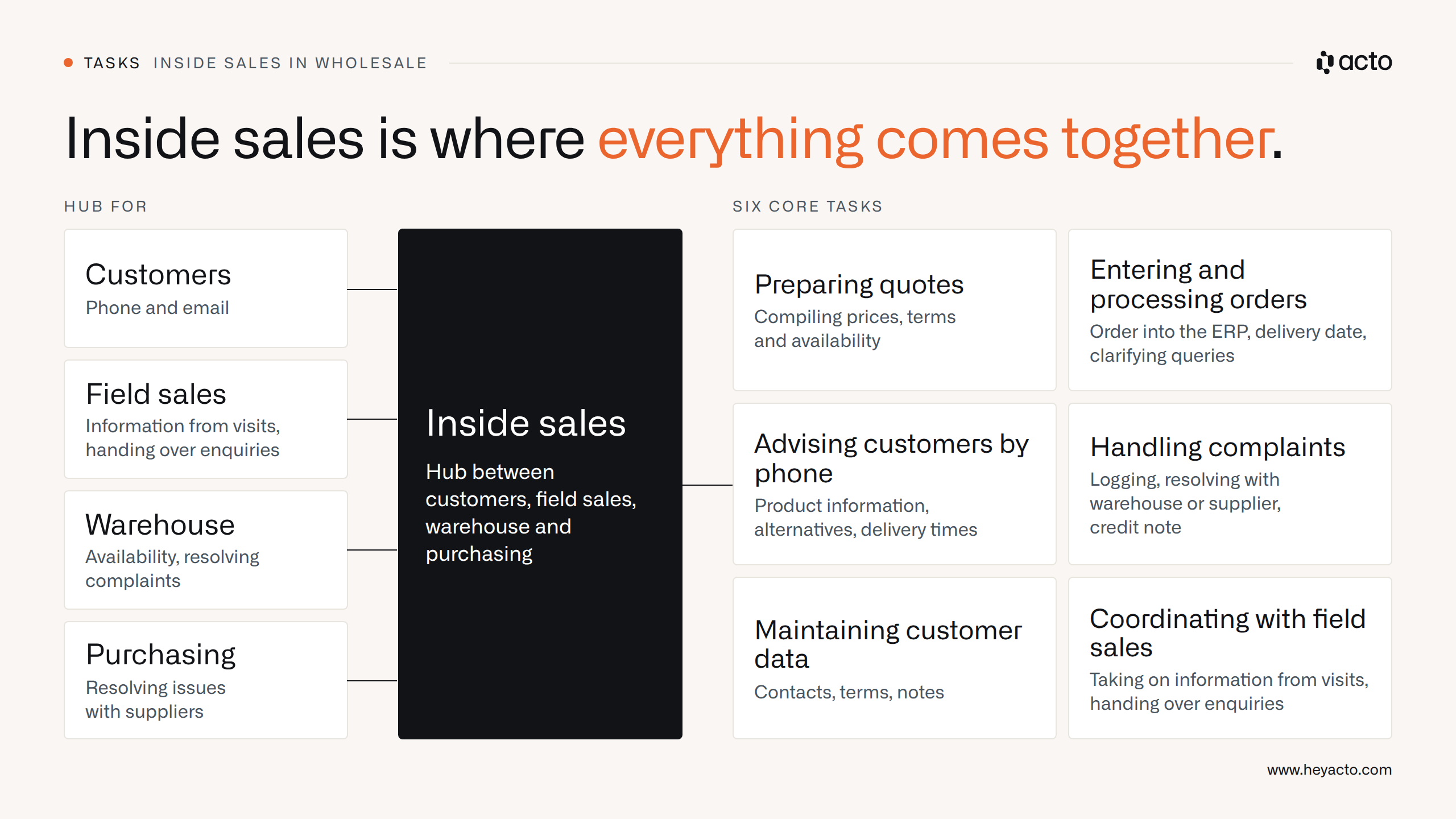
Inside sales connects customers, field sales, the warehouse and purchasing, and that's where its six core tasks come from.
Definition: Inside sales is the sales function in a company that handles customer enquiries, quotes and orders, looks after customers by phone and email, and supports field sales.
Here's what that looks like in wholesale:
| Task | What it involves | Wholesale example |
|---|---|---|
| Preparing quotes | Compiling prices, terms and availability | Quote for tile adhesive and waterproofing for a tiler's building project |
| Entering and processing orders | Order into the ERP, delivery date, clarifying queries | An auto repair shop orders brake discs and filters by phone |
| Phone advice | Product information, alternatives, delivery times | Which press fitting works when the usual item is out of stock |
| Complaints | Logging, resolving with warehouse or supplier, credit note | Wrong gutters delivered to a roofer |
| Maintaining customer data | Contacts, terms, notes | New buyer at a restaurant customer |
| Coordinating with field sales | Taking on information from visits, handing over enquiries | Field sales reports a major project, inside sales prices it |
| Following up on quotes | Checking in on open quotes | Calling an electrician back two days after the quote |
Notice anything? Only the last row is real selling. And that's exactly the one that tends to get squeezed out day to day.
What skills does an inside sales administrator need?
An inside sales administrator needs product range knowledge, confidence on the phone, speed in the ERP and, above all, an understanding of the customer. That last one is a weak spot across sales as a whole. In a Mercuri International survey of B2B sales professionals worldwide, 88% rated customer understanding and analytical thinking as critical. Only 27% feel confident in it. In inside sales, the people are rarely the problem. What they lack is prepared knowledge about each individual customer.
How do inside sales, technical sales support and customer service differ?
Sales administration processes transactions, technical sales support answers product and application questions, inside sales sells actively, and customer service handles post-purchase issues.
- Inside sales administration: processes quotes, orders and complaints, usually at the customer's request
- Technical sales support: answers product and application questions, such as dimensions, standards or installation
- Inside sales (active): sells proactively by phone and email, with its own revenue targets and customer list
- Customer service: deals with issues after the purchase, such as delivery status or returns

How is wholesale sales split between inside and field sales?
No official statistics show how many inside and field sales reps work in wholesale. Job ads, however, offer a clear indication. In our "Sales in Wholesale 2026" report (in German), 65% of distributors' sales job ads are for inside sales and 35% for field sales (253 ads from 123 distributors on the job board of Germany's Federal Employment Agency, calendar week 42/2026). Counting each employer at most twice, inside sales accounts for 64%.
So most of the hiring happens on the inside. Experience, on the other hand, sits outside: 73% of field sales reps in wholesale have more than ten years of professional experience, compared with 43% in inside sales (sample of sales profiles, 177 in field sales and 90 in inside sales, as of calendar week 40/2026; older employees and inside sales staff are less represented in online profiles). What inside sales lacks as a result is knowledge of individual customers built up over years.
"The people we have have been here for 20 years, […] they've got it all in their heads."
– E-commerce and marketing, wholesale, in one of our conversations with distributors
| Characteristic | Inside sales | Field sales |
|---|---|---|
| Contact channel | Phone, email, incoming orders | On-site visits |
| Who gets in touch? | Usually the customer | Usually the rep, per visit schedule |
| Contact frequency with regular customers | Often daily or several times a week | Based on visit cycle |
| More than ten years of experience | 43% | 73% |
How inside and field sales divide customers between them is a topic in its own right.

Does inside sales in wholesale actually sell?
The job ad says selling. In practice, managers describe order-taking. Companies hire consultative salespeople, and then data entry fills the day.
We took a closer look. In November 2026, we analysed job ads for inside sales roles in wholesale: 55 ads from the DACH region, cross-checked against 64 ads on Indeed, one per employer. Not representative, but clear.
| Task in the ad | How often mentioned |
|---|---|
| Advising customers or selling | in seven to eight in ten ads |
| Handling quotes and orders | in more than two thirds |
| Complaints | in roughly one in three |
| "Active" or "proactive" in a sales activity | in a quarter to two fifths |
| Following up on quotes | in one in four to one in three |
| Winning new customers, prospecting | in one in five to one in ten |
| Explicitly "active selling" | in only about one in ten, at most one in seven |
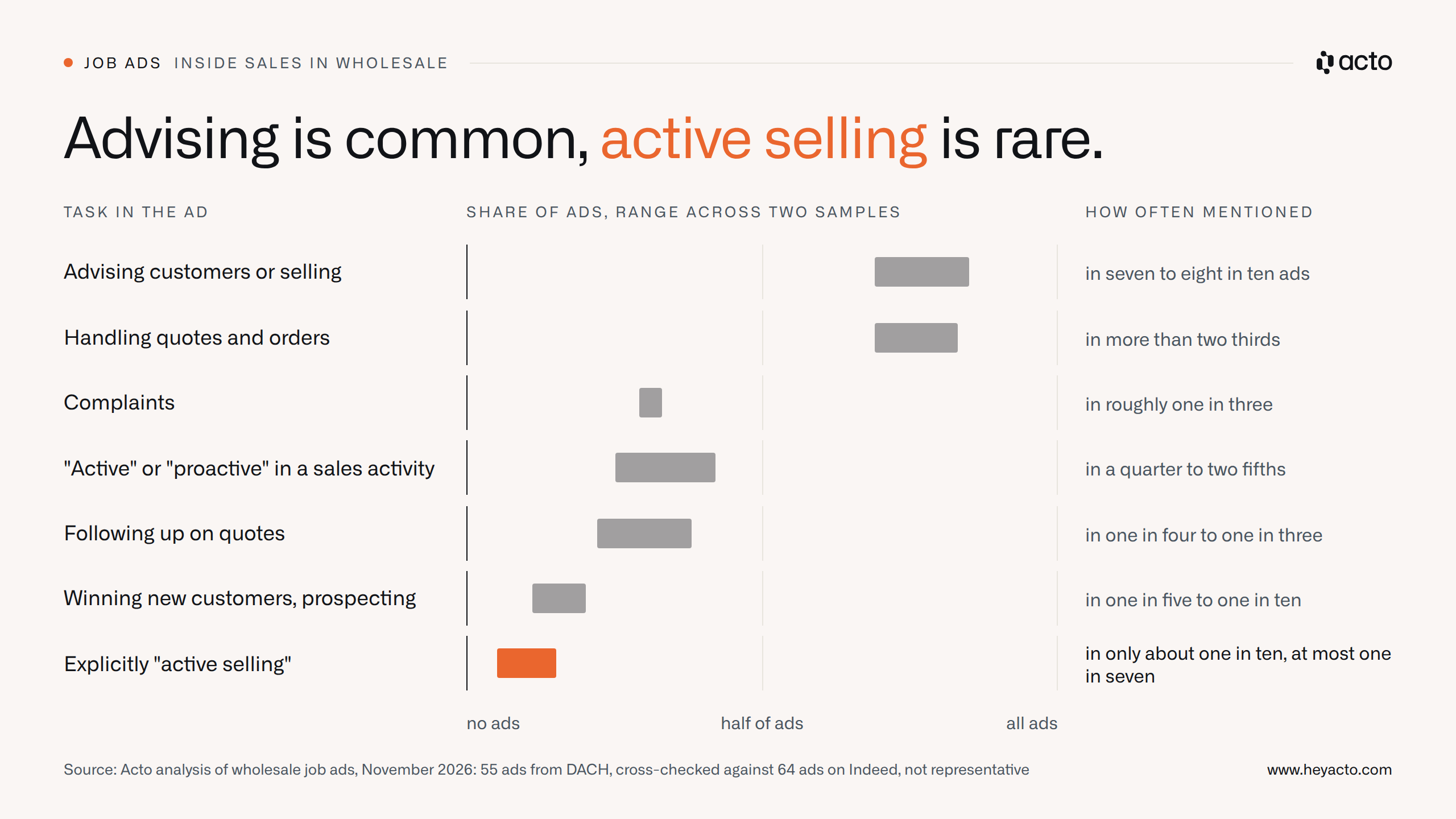
Advising and selling appear in most ads, but explicitly "active selling" in only about one in ten. Source: Acto analysis of wholesale job ads, November 2026, not representative
"Advising" sounds like sales, but it means little. The word covers answering a query just as much as a sales conversation. So the ads show the ideal. The reality we hear in our sales conversations: in at least 16 of them, managers describe their inside sales team as reactive, and in at least 9 they want to push it towards selling.
And the voices sound remarkably similar across sectors:
- Technical distribution: One sales manager essentially calls his inside sales team order-entry clerks and support staff.
- Foodservice wholesale: One head of sales describes their sales function right now as pure order-taking.
- Plumbing and HVAC wholesale: Management would very much like an active telesales team, but doesn't have one.
"We have 50 sales reps […] but in inside sales there are 400 of us dealing with customers every day […] that's where the leverage is."
– Executive assistant to the board, building materials and roofing trade cooperative, sales conversation
50 outside, 400 inside. Where do you think the leverage is?
From the other side, it sounds more sober. A field sales rep in industrial wholesale estimated in a public comment that his inside sales team spends around 70% of its time on data entry, 20% on pricing and 10% on complaining. That's his personal estimate. And selling? He sees that as his job:
"Nah, that's what field sales is for ;)"
– Field sales rep in industrial wholesale, public online comment
A small survey of ours shows it can be done differently: of 36 distributors, 14 had firmly established a proactive inside sales team. So a selling inside sales team is achievable. Where it's missing, the ad says selling, and the day still revolves around data entry.
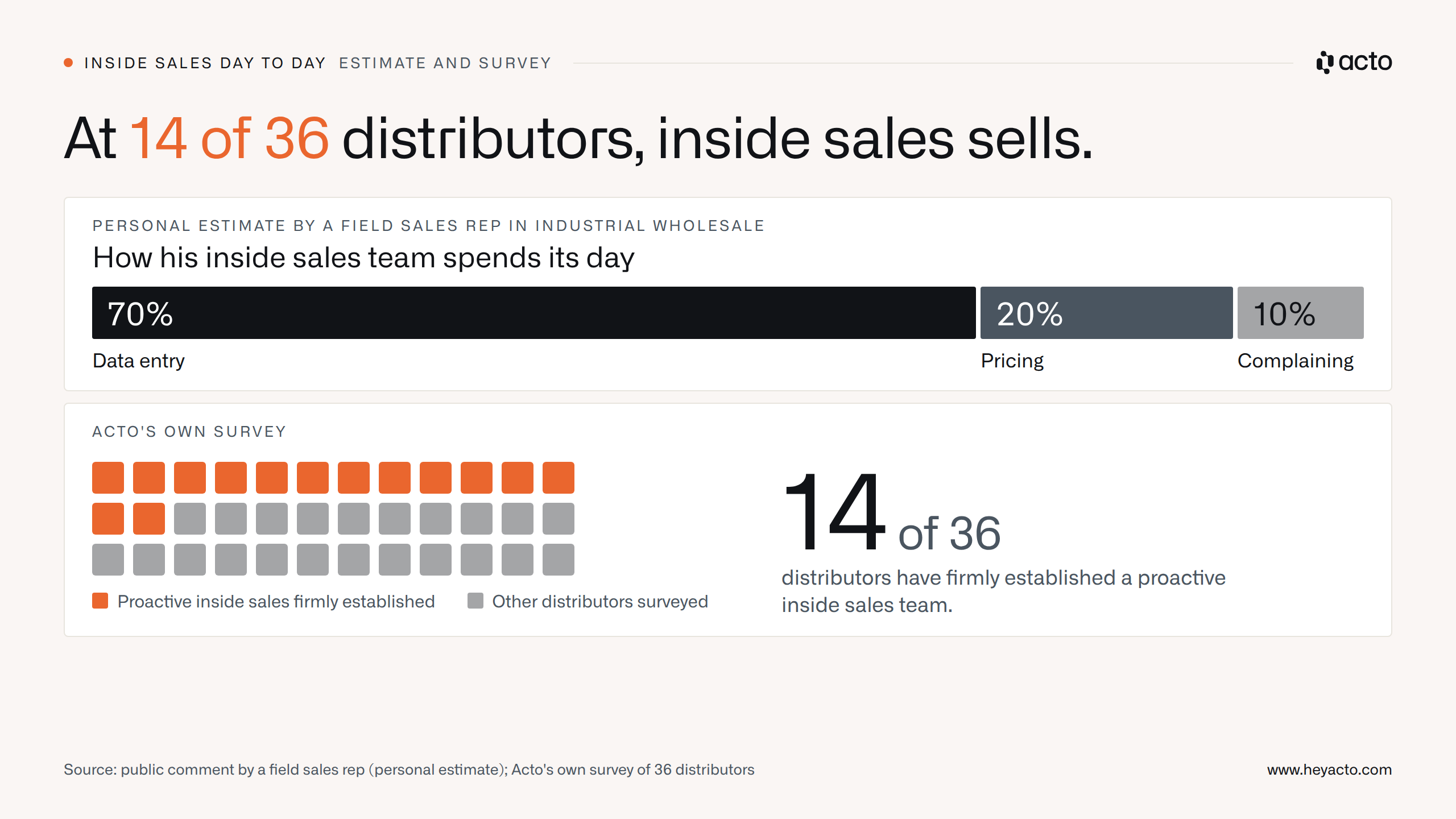
Data entry usually eats up the day, yet at 14 of 36 distributors, inside sales already sells actively.
Inside sales has the most frequent contact with regular customers of anyone in the company, and in practice it mostly takes orders. Selling only happens there when the reason is ready before the customer hangs up.
Why does inside sales stay stuck at order-taking?
Inside sales stays stuck at order-taking because data entry takes up the very moment the customer is on the phone, because customer knowledge lives in people's heads, and because buying signals sit in the ERP with nobody looking for them. The team itself is rarely the problem.
- Data entry eats the customer moment: While the customer is reading out item numbers, nobody thinks about the missing product category. That's exactly the scene from the start. And it repeats itself dozens of times a day.
- The knowledge sits with the veterans: Someone who's covered a territory for decades knows when a customer usually reorders heating pumps. The thing is, much of that is already in the order data: repurchase intervals, seasonal patterns, buying patterns of similar customers.
- The signals sit untouched in the ERP: Only around a quarter of employees actively use BI tools. And only 11% of our conversations with distributors even mentioned an early-warning list for customers who are buying less (in German) (19 of 177).
One head of sales is candid about how late they notice:
"We notice after five months when a customer stops buying certain product categories from us."
– Head of sales, building materials trade, in one of our conversations with distributors
Five months in which those products are bought elsewhere.
When I analysed around 50 conversations with sales leaders in wholesale, the same gap came up again and again. Power BI, dashboards and CRM are all there. And yet nobody looks at them day to day, because there's no time.
Salespeople aren't analysts, and nobody should expect them to do analysis. If you want an inside sales team that sells, you have to take the data work off its plate and deliver ready-made opportunities.
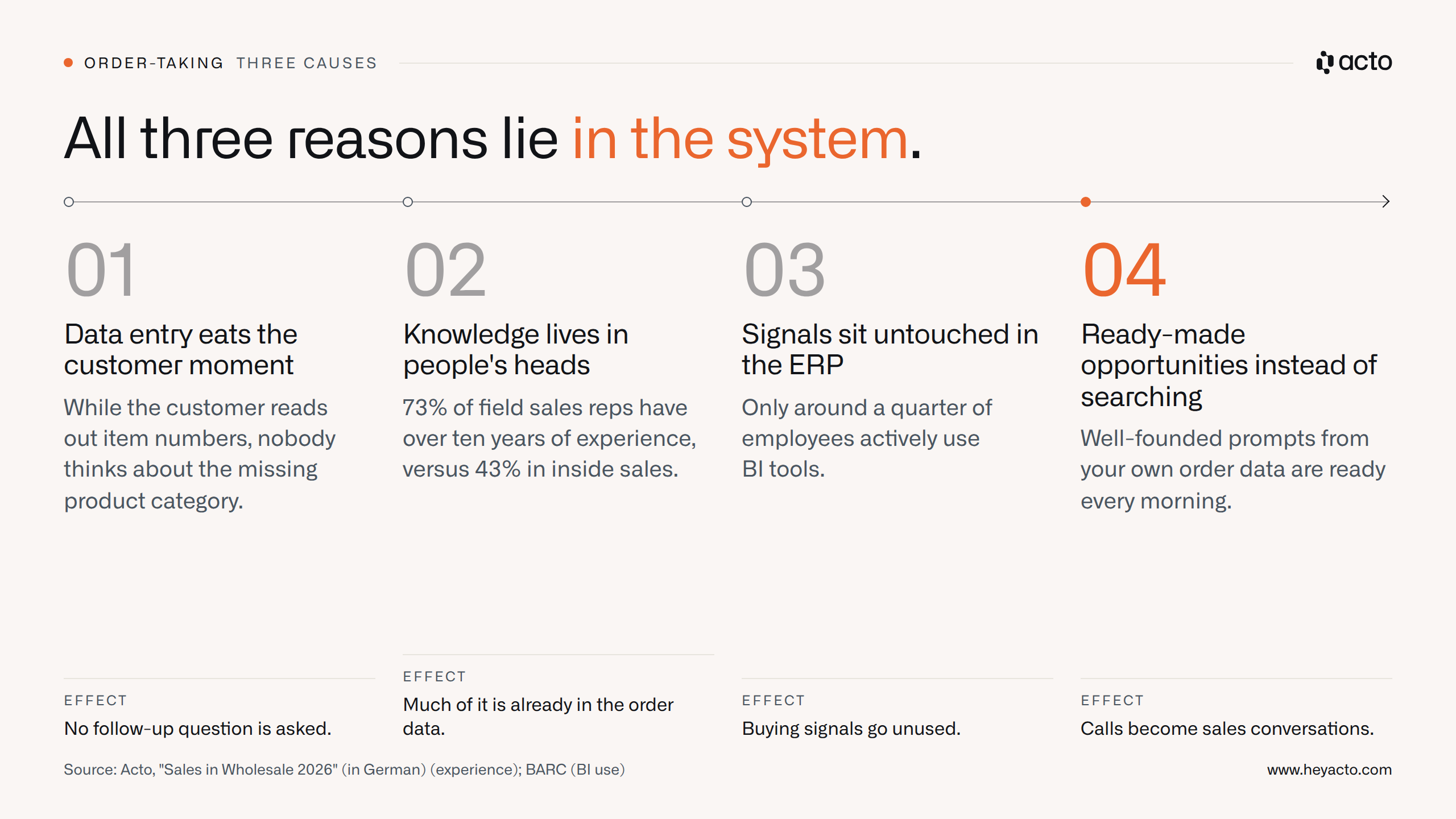
All three reasons lie in the system, none in the team.
What does active selling mean for inside sales?
For inside sales, active selling means turning calls and callbacks into targeted sales opportunities, especially with existing customers it already knows. Often, the right sentence in the right call is enough.
Four triggers lend themselves to this:
- Following up on quotes: calling about open quotes before the customer orders elsewhere
- Calling dormant customers: customers ordering less often than usual, before they shift product categories to the competition
- Due reorders: reminding customers about consumables whose usual interval has passed
- Range gaps: raising, during an incoming order, what similar customers also buy
Why focus on existing customers? Because the market is barely growing. The BGA (Germany's wholesale and foreign trade federation) expects just 0.7% real growth in wholesale for 2026. Additional revenue has to come from existing customers. At the same time, 4 to 17% of customers churn each year, depending on how they're looked after (in German), and rarely with a bang. Customers don't cancel. They order less and shift their business one product category at a time.
Then there's a classic: C customers, the lowest-revenue tier in an ABC analysis, stay C customers because that's how they're treated. These quiet, smaller customers are exactly the ones inside sales reaches better by phone than any field rep.
There is one pitfall, though: the call without context. Three weeks without an order could also mean a company holiday. Then the concerned call is more awkward than helpful.
Example: a morning with five prompts
What does this look like in practice? Picture Ms Yilmaz, inside sales at Haustechnik Brandt, a plumbing and HVAC distributor. She starts the day with five prompts, each with a reason, and calls in this order:
- Installateur Kessler: a €3,200 quote open for nine days. The customer had forgotten about it and orders: €3,200.
- Bäder Neumann: a second open quote. The customer pushes it to next week, a callback is agreed: €0 today.
- Heizungsbau Lorenz: usually orders press fittings every four weeks, but hasn't for six. Reorder: €850.
- Sanitär Ott: no fittings and fixtures for two months. A competitor was cheaper; Ms Yilmaz arranges a counter-offer: €0 today.
- Badstudio Fink: buys shower channels but no waterproofing, unlike similar customers. Sample order: €240.
Five calls, three orders totalling €4,290, one agreed callback and one counter-offer. And none of these customers would have called on their own.
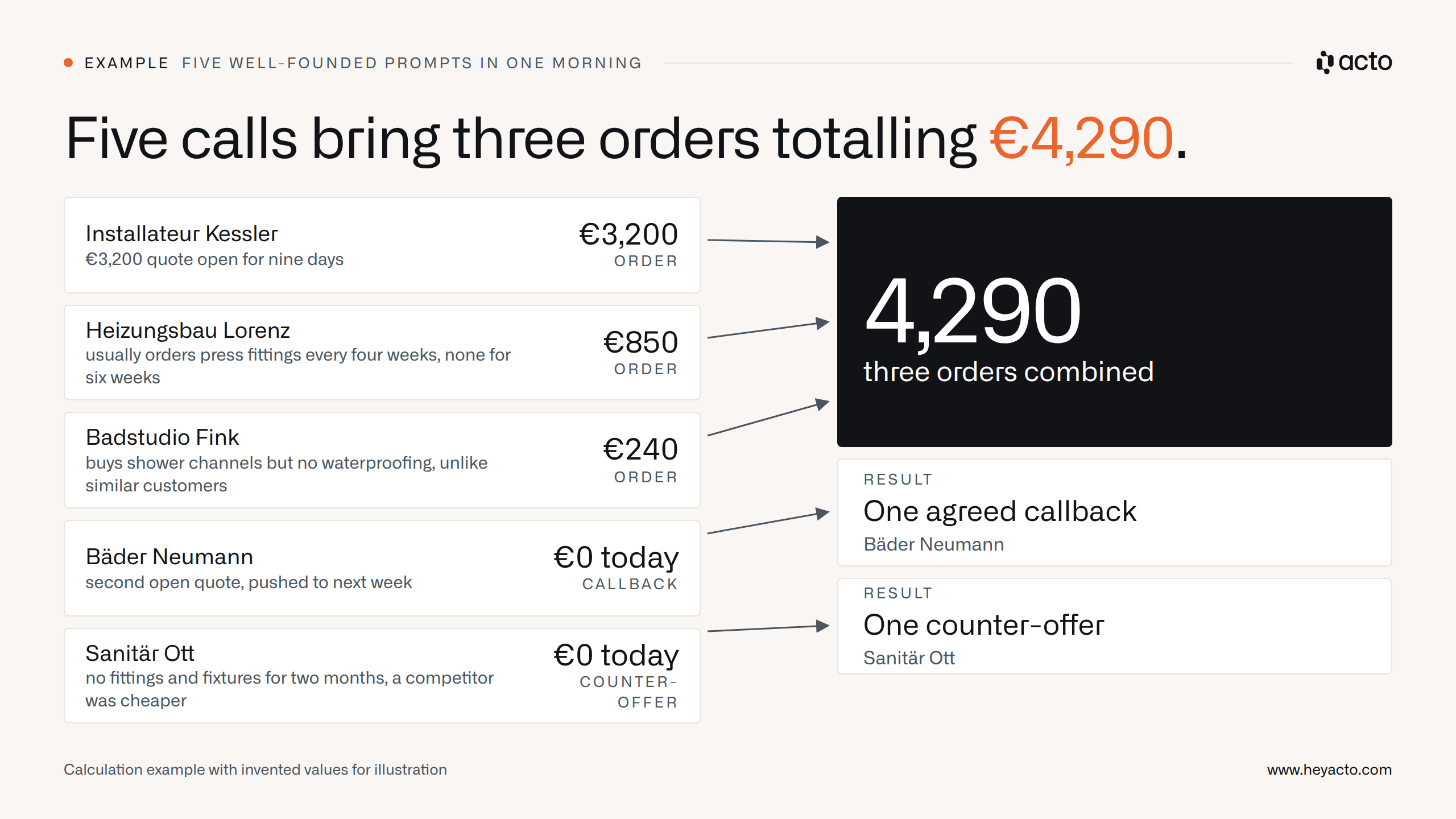
Five targeted calls to existing customers bring in revenue that would never have happened without a reason to call.
What prompts does inside sales need every morning?
Every morning, inside sales needs a short list of well-founded opportunities from its own order data: who to contact today, what to offer and where there's a fire to put out. What it doesn't need: another dashboard.
A useful solution provides:
- Overdue reorders: per customer and item, measured against the customer's own ordering rhythm
- Declining product categories: at order line level, because total revenue masks a drop in a single category
- Range gaps: compared with similar customers by sector, size and ordering behaviour
- Open quotes: with due dates and a note on which line items weren't ordered
- Context against false alarms: company holidays, seasonality, notes from visit reports
- Reason and next step: one sentence per prompt on why, and what to raise
- Display at the workstation: wherever inside sales works, including during order entry
One important point: when a customer counts as dormant should never be a fixed period for everyone. A customer who orders weekly stands out after three weeks. One who orders quarterly doesn't, not by a long way. The threshold comes from each customer's own history. Our article on recommender systems in B2B sales shows how such recommendations are built technically.
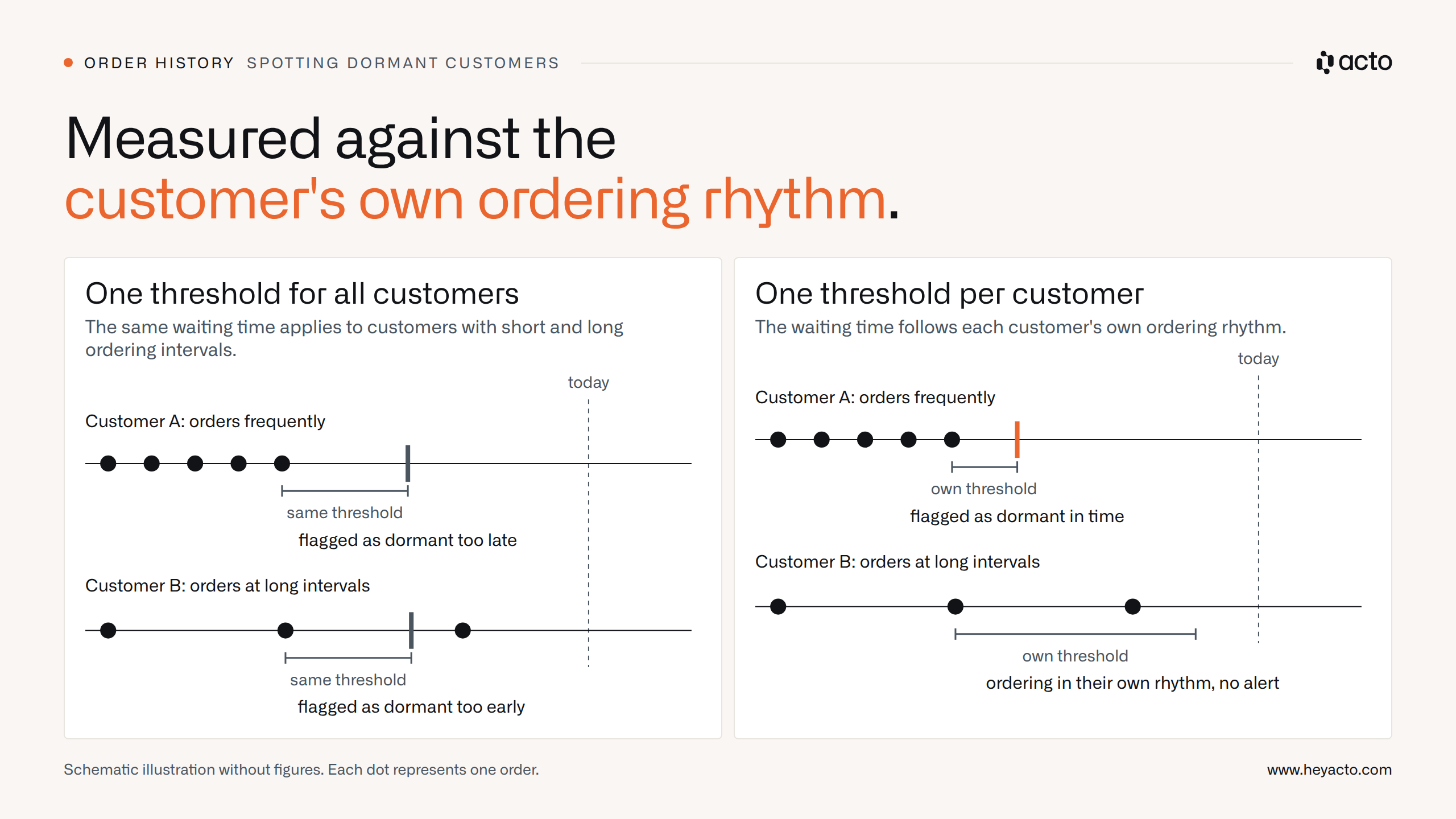
Only a comparison with their own ordering rhythm shows whether a customer is really going quiet.
Not for you: when a selling inside sales team adds little
To be honest, not every distributor needs this. A selling inside sales team adds little when the conditions for recurring sales opportunities aren't there:
- Few customers per rep: If every rep already knows their customers personally, prompts rarely surface anything new.
- Project business without reorders: Without an ordering rhythm, history produces no reorder signals.
- Manufacturers selling through wholesale: Without their own order data per end customer, the foundation is missing.
- No relief on data entry: If selling is simply piled on top, it stays a good intention.
And: prompts don't replace a good phone conversation or clean order data.
How Acto supports inside sales in wholesale
Acto is our sales AI for wholesale. Every night, it analyses ERP and CRM data using machine learning models and AI agents, and each morning shows inside and field sales which customer has a reason for contact today, why, and what to raise. The prompts appear in the Outlook sidebar, in the CRM or in the app. In other words, wherever inside sales already works, including while the customer is on the phone.
Remember the "Thanks, bye" from the start? That's exactly where Acto comes in. When a customer calls, the rep sees in the sidebar whether a quote is open, which product category similar customers also buy, or whether the customer is ordering less often than usual. The order call becomes an opportunity to advise and sell, based on data rather than gut feeling.
At Hitado, the customer estimates that new employees get up to speed six times faster, in one to two months instead of about a year before. At Schäfer Shop, inside and field sales also work with Acto. Our page on AI software for field sales shows what this looks like alongside the field team. Getting started involves a pilot phase with jointly agreed KPIs.
"All inside sales staff at Hitado use Acto every day as the central basis for their customer management. They receive 10 prioritised signals per day with the most relevant customers to contact that day."
– Ilka Greco, Head of Inside Sales, Hitado (Hitado case study)
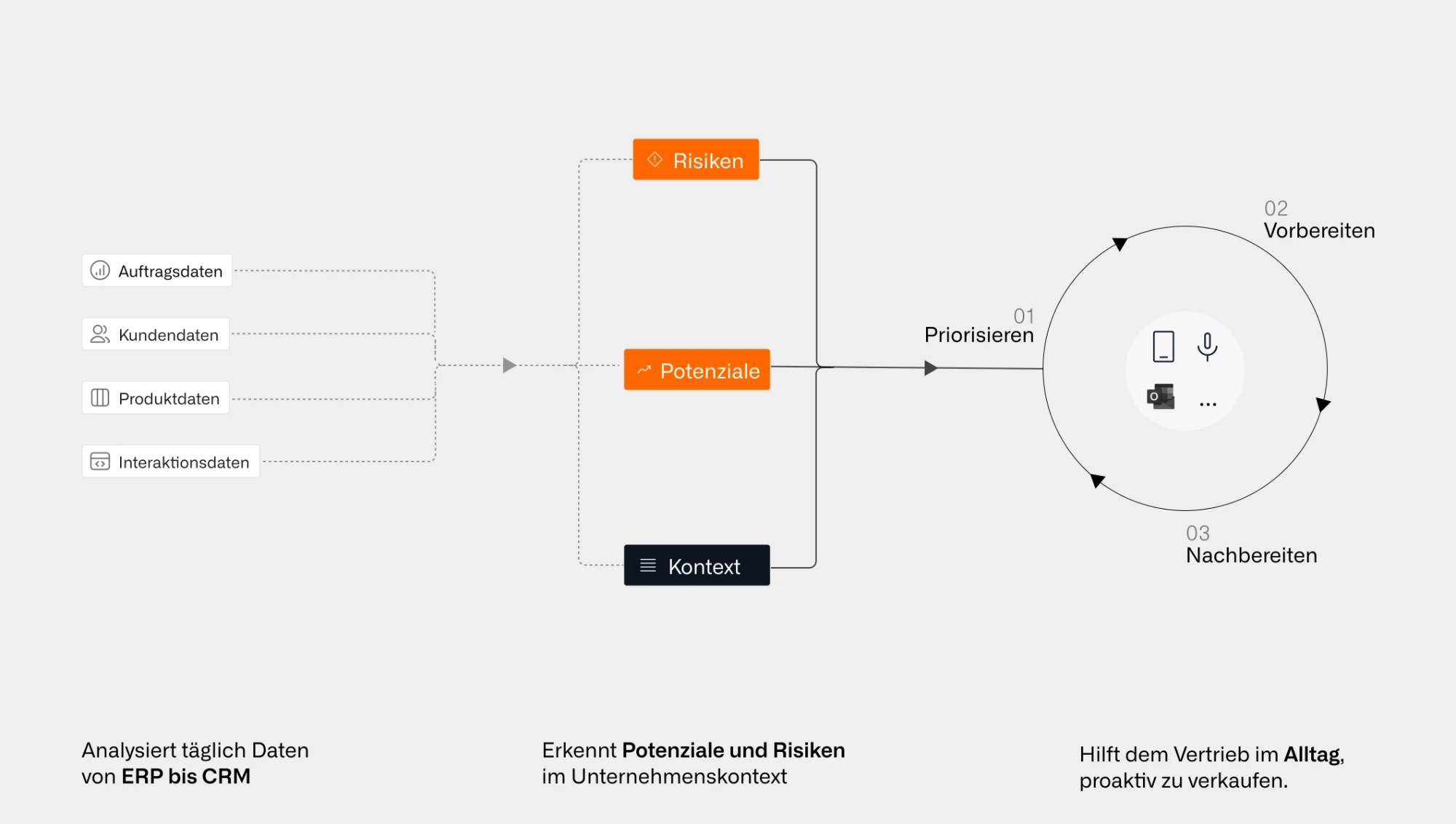
Order, customer, product and interaction data become risks and opportunities that sales receives in the app, in Outlook or by voice.
How much selling is hidden in your inside sales team?
Your inside sales team's sales potential lies in customer contacts without a sales opportunity, quotes without follow-up and order declines nobody notices. Three questions make it visible, answered with your own numbers:
- How many customer contacts does your inside sales team have in a day, and in how many of them did the rep have a concrete sales opportunity to hand?
- How many of last week's open quotes did anyone follow up on?
- How many customers are currently ordering less often than usual, and who in your company knows that today?
Write down the three answers this week. Before you talk about training or new hires.
If you want to know what your data holds: in a conversation, we'll show you which sales opportunities your own order data offers for your inside sales team's customer contacts.
Frequently asked questions about inside sales
Do I have to replace my inside sales team to get it selling?
No. Start, for example, with two or three reps who enjoy being on the phone, and give them a few well-founded opportunities per day. Once someone has seen a callback turn into an order, they'll pick up the phone on their own next time.
Will field sales feel sidelined if inside sales calls their customers?
Only if nobody has agreed beforehand who handles which opportunity. A simple rule helps: smaller existing customers and phone follow-ups go to inside sales, while major projects and pricing negotiations stay with field sales. How the two roles work together is a topic in its own right.
Does field sales still have a future in wholesale?
Yes, but not every vacancy needs a like-for-like replacement. In 36 of 355 of our conversations with distributors, retirement or succession came up (in German), almost always in their own field sales team. We think the right approach is to increase net selling time and hand part of existing-account management to inside sales.
Isn't our CRM enough to find these opportunities?
Usually not, because a CRM is built for new-business pipelines and the order history sits in the ERP. The CRM holds what someone entered. The ERP shows who's overdue and which product category is missing. That's why a CRM often falls short in wholesale when it comes to sales opportunities with existing customers.
Should inside sales also prospect for new customers?
Only once the existing base has been fully tapped. According to Harvard Business Review (2014), acquiring a new customer costs five to 25 times as much as retaining an existing one. For a distributor with hundreds of active customer accounts, the quicker revenue lies in a phone call with the dormant regular customer.