Wholesale and Field Sales Statistics 2026: Workload, Churn, Hiring and AI

Summary
- A wholesale field rep covers 247 customers on average and makes about 1,000 visits a year. Each visit costs just under €100.
- Wholesalers lose 4% to 17% of their customers a year, often gradually. Only 11% of the wholesalers we spoke to have an early-warning list.
- Replacements come slowly: 46% of wholesale field sales jobs stay open for more than 90 days, and a new rep needs 3 to 5 years to know the territory.
- Every figure comes with its source, year and sample. You're free to use them with attribution.
Most of the sales statistics out there describe software sales over Zoom. Wholesale field sales looks different: one rep, a car, a few hundred customers and an order history that already says who's slipping. This page collects the numbers for that world, from our own study of wholesale sales in Germany, Austria and Switzerland and from official statistics, each with its source, year and sample.
You're welcome to use every figure and chart on this page. Please cite "Acto, Wholesale Field Sales 2026" and link to this page.
Key wholesale and field sales statistics
- A wholesale field sales rep covers 247 customers on average (median 175, 106 companies).
- A field rep makes around 6 visits a day, about 1,000 a year, and costs around €98,000 a year including car, expenses and IT, so each visit costs just under €100.
- Wholesalers lose 4% to 17% of their customers every year (Acto benchmark, ERP order data).
- At 10% churn, two thirds of all new business only replaces lost revenue (worked example, 5% growth target).
- In 47% of our conversations, wholesalers plan field sales visits on gut feeling; in 8%, with the CRM.
- Only 11% of the wholesalers we spoke to have an early-warning list for customers who are buying less.
- 46% of wholesale field sales job ads have been open for more than 90 days, compared with 37% across all industries.
- A new field rep needs 3 to 5 years to know the territory like an experienced one, say 52% of sales leaders in our live poll (n = 52).
- 26% of people in sales occupations in Germany are 55 or older, up from 17% in 2015.
- 32% of German wholesalers used AI in 2025, up from 13% in 2023.
- The average seller spends only 40% of their time selling (Salesforce, 2026).
- Winning a new customer costs 5 to 25 times as much as keeping one (Harvard Business Review, 2014).
- 67% of B2B buyers prefer a rep-free experience, but 69% want to validate AI-generated insights with a sales rep (Gartner, 2026).
How many customers does a field sales rep cover in wholesale?
A field sales rep in wholesale covers 247 customers on average, with a median of 175. That's based on figures from 106 companies, collected in our sales conversations and a survey from 2024 to 2026. 64 of the 106 companies name 200 customers or fewer per rep, and nine name more than 500.
- At around six visits a day and 176 field days a year, a rep makes about 1,000 visits a year.
- That works out to about four contacts per customer per year, or just under six at the median of 175 customers.
- A field rep costs around €98,000 a year: salary, employer contributions, car, expenses and IT. The range is €76,000 to €129,000. (Acto's own calculation based on the German Federal Employment Agency's pay atlas, 2026 social security rates and ADAC car costs 2026; excluding commission and management costs.)
- So each visit costs just under €100. One wholesaler we spoke to puts its own cost at €150 to €200 per meeting.
With 247 customers, the list is too long to sort from memory. Which customers get the visits decides the revenue.
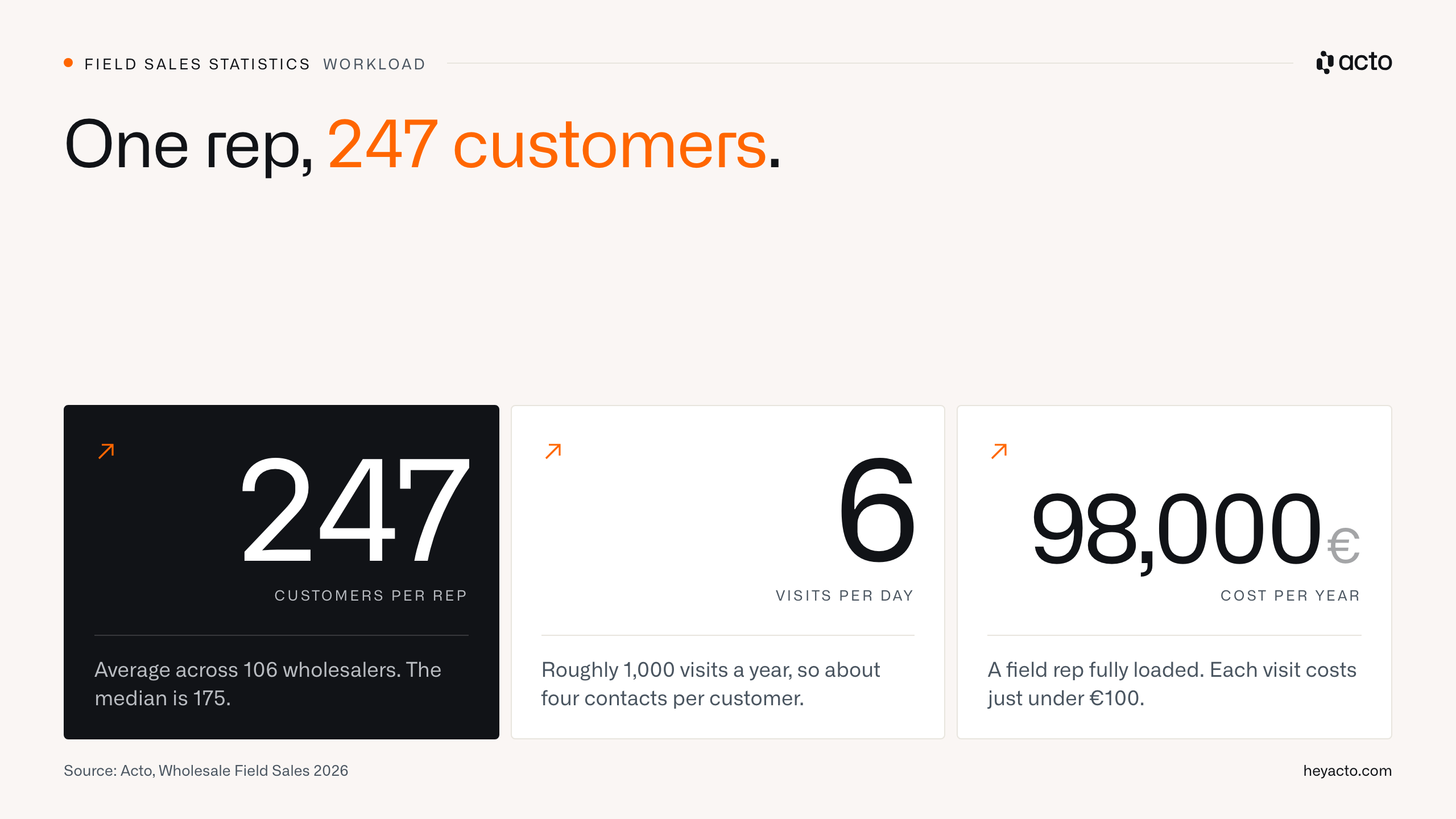
One field rep, 247 customers: workload and cost per visit in wholesale.
How many customers do wholesalers lose each year?
Wholesalers lose 4% to 17% of their customers each year. That's the range in Acto's internal benchmark, based on ERP order data from wholesalers. These customers rarely leave all at once. Often they first stop buying one product group, then order less often, then not at all.
- A customer counts as churned when the gap since their last order is longer than their longest previous pause plus the mean and standard deviation of their reorder intervals.
- Ten field reps (the median in our conversations) with 247 customers each cover about 2,470 customers. At 10% churn, 247 are lost every year, a full rep's territory.
- Wholesalers who estimate their churn put it at 5% to 8% of revenue per year.
- Only 11% of the wholesalers we spoke to have an early-warning list for customers who are buying less (19 of 177 conversations).
Churn decides how much new business you need just to stand still. Worked example for a wholesaler with €50 million in revenue and a 5% growth target, assuming lost customers had average revenue and the remaining customers buy as much as the year before:
| Annual churn | Revenue lost | New business needed for +5% | Share that only replaces losses |
|---|---|---|---|
| 4% | €2.0m | €4.5m | 44% |
| 10% | €5.0m | €7.5m | 67% |
| 17% | €8.5m | €11.0m | 77% |

At 10% churn, two thirds of new business only replaces lost revenue (worked example).
How do wholesalers plan field sales visits?
Wholesalers most often plan field sales visits on gut feeling and experience: 47% of conversations name it, 8% name the CRM. That comes from our analysis of 355 recorded sales conversations with wholesalers from 2024 to 2026 (n = 186 for this question, multiple answers possible).
- Gut feeling and experience: 47%
- ERP reports: 31%
- Fixed rotation: 29%
- Software or route planner: 17%
- Excel lists: 12%
- CRM: 8%
Experience is used six times as often as the CRM. In 49% of conversations, field reps hardly use the CRM or not at all (n = 182). In one in four, field reps barely prepare their visits or not at all (n = 183).
"Today they often just turn up unprepared. They don't know when the customer last bought or what they last bought."
– Sales project lead, C-parts wholesaler (translated from German)

How wholesalers plan field sales visits: gut feeling leads, the CRM comes last.
How much time do sales reps actually spend selling?
The average seller spends 40% of their time selling and 60% on other work, according to Salesforce's State of Sales report. The 7th edition surveyed 4,050 sales professionals in 22 countries, including 250 in Germany (Salesforce, February 2026).
- Sales professionals spend 16% of their time on preparation and planning (Salesforce State of Sales report, 2026).
- Sales teams use eight tools on average, and 42% of reps feel overwhelmed by too many tools (same report).
- 46% of sellers rarely get feedback on their sales conversations (Salesforce, 2026).
- Gen Z reps spend only 35% of their time selling and lose about two hours a week to manual data entry (Salesforce, 2026).
For wholesale field sales, that time is split again between driving, visiting and paperwork. With 247 customers per rep, every hour that goes to admin is a visit that doesn't happen.
What does keeping a customer save compared with winning a new one?
Winning a new customer costs five to 25 times as much as keeping an existing one, depending on the industry and the study (Harvard Business Review, Gallo, 2014).
- Raising customer retention by 5% raises profits by 25% to 95%, according to research by Frederick Reichheld of Bain & Company, cited in the same article.
- Both figures are older than most on this page. We include them because they're still the most cited, and show the year so you can judge them.
How hard is it to hire field sales reps in wholesale?
46% of open field sales positions at wholesalers have been advertised for more than 90 days, compared with 37% across all industries. That's from our job ad monitor: all 4,746 field sales positions on the German Federal Employment Agency's job board in week 44 of 2026, of which 311 were posted by 162 wholesalers. What's measured is the age of open ads, not the time to hire.
- 11% of wholesale field sales ads have been open for more than a year, compared with 8% across all industries.
- Only 8% of wholesale field sales ads mention a salary, compared with 19% across all industries.
- 65% of wholesalers' sales job ads are for inside sales, 35% for field sales (253 ads from 123 wholesalers, week 42/2026).

Wholesale field sales jobs stay open longer than the average across all industries.
How long does it take a new field rep to get up to speed?
A new field rep needs three to five years to know the territory as well as an experienced one, say 52% of sales leaders. That's from our live poll at the 2026 annual conference of the VTH, the German association of technical wholesale (n = 52).
- 1 to 2 years: 37%
- 3 to 5 years: 52%
- More than 5 years: 10%
- 6 to 12 months: 2%; nobody said under six months.
So after a rep leaves, a territory isn't fully covered for more than three years: a median of 85 days to fill a wholesale trade position (German Federal Employment Agency, 2025), then the ramp-up.

Most sales leaders expect a new field rep to need three to five years.
How old is the sales workforce?
26% of people in sales occupations in Germany are 55 or older, up from 17% in 2015. In ten years, the number of sales employees aged 55 and over has almost doubled, from 79,428 to 154,328 (German Federal Employment Agency, all industries, 31 December 2025).
- Among managers in purchasing and sales, 36% are 55 or older, up from 19% in 2015.
- In German wholesale overall, 26.7% of employees are 55 or older, up from 17.6% in 2015.
- 73% of wholesale field reps have more than ten years of experience, compared with 43% in inside sales (Acto sample of sales profiles, n = 177 for field sales).
- 54% of sales leaders expect at least a quarter of their field team to retire in the next ten years (Acto live poll, VTH 2026, n = 56).
- New apprenticeship contracts for wholesale and foreign trade management fell by 33% from 2015 to 2024, compared with 7% across all occupations (BIBB).
"The people we have have been here for 20 years. They have everything in their heads."
– E-commerce and marketing, wholesaler (translated from German)
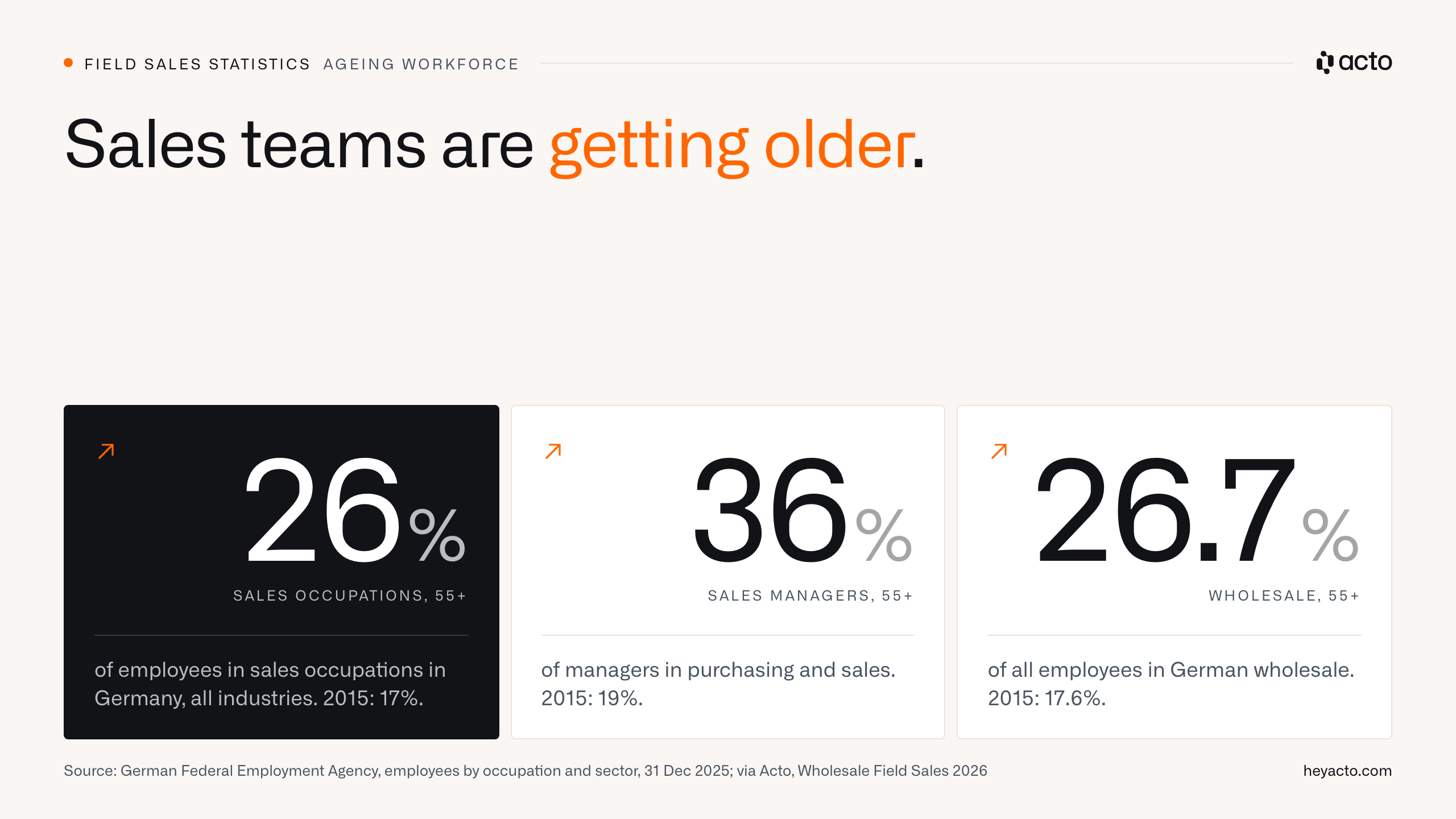
The share of sales employees aged 55 and over keeps rising.
Wholesale and manufacturing sales reps in the US
The US employs about 1.57 million wholesale and manufacturing sales representatives, with a median annual pay of $76,460 (US Bureau of Labor Statistics, Occupational Outlook Handbook, 2025).
- Employment in the occupation is projected to stay flat to 2035, but about 123,400 openings will still arise each year, mostly to replace reps who retire or leave (BLS).
- The median US wholesale and manufacturing sales rep is 44.2 years old, compared with 42.1 for all workers (BLS, Current Population Survey, 2025).
- About one in four of these reps is 55 or older: 292,000 of 1,145,000 (our calculation from the same BLS table).
- US wholesale trade employs about 6.08 million people (BLS, September 2026, preliminary).
- US merchant wholesalers sold $817.5 billion in August 2026, up 15.6% on a year earlier, not adjusted for price changes (US Census Bureau, Monthly Wholesale Trade).
How many wholesalers use AI?
32% of German wholesalers with ten or more employees used AI in 2025, up from 13% in 2023. That's above the EU average of 23% but behind Austria at 38% (Eurostat, isoc_eb_ain2, NACE G46).
- 15% of German wholesalers use AI in marketing and sales, compared with 10% across the EU (Eurostat, 2025).
- 23% of wholesale field sales job ads mention CRM, digital tools or AI, compared with 31% across all industries (Acto job ad monitor, week 44/2026).
- AI use in wholesale is growing faster than in the economy as a whole: 23.4% of EU wholesalers used AI in 2025, up from 14.1% a year earlier, compared with 20.0% of all EU companies (Eurostat).
- 13.8% of German wholesalers say they don't use AI because they lack the expertise (Eurostat, 2025).
- Among EU companies that use AI, marketing and sales is the most common use: 34.7% use it there (Eurostat, 2025).
- 57% of German companies with 20 or more employees use AI, a majority for the first time, up from 36% a year earlier (Bitkom, September 2026, n = 603).
- 11% of German companies already use AI agents, and 29% plan to (Bitkom, 2026).
- 87% of sales organizations use some form of AI, and 54% of sellers have used AI agents (Salesforce State of Sales, 2026).
- 51% of sales leaders who use AI say disconnected systems are slowing their AI projects (Salesforce, 2026).
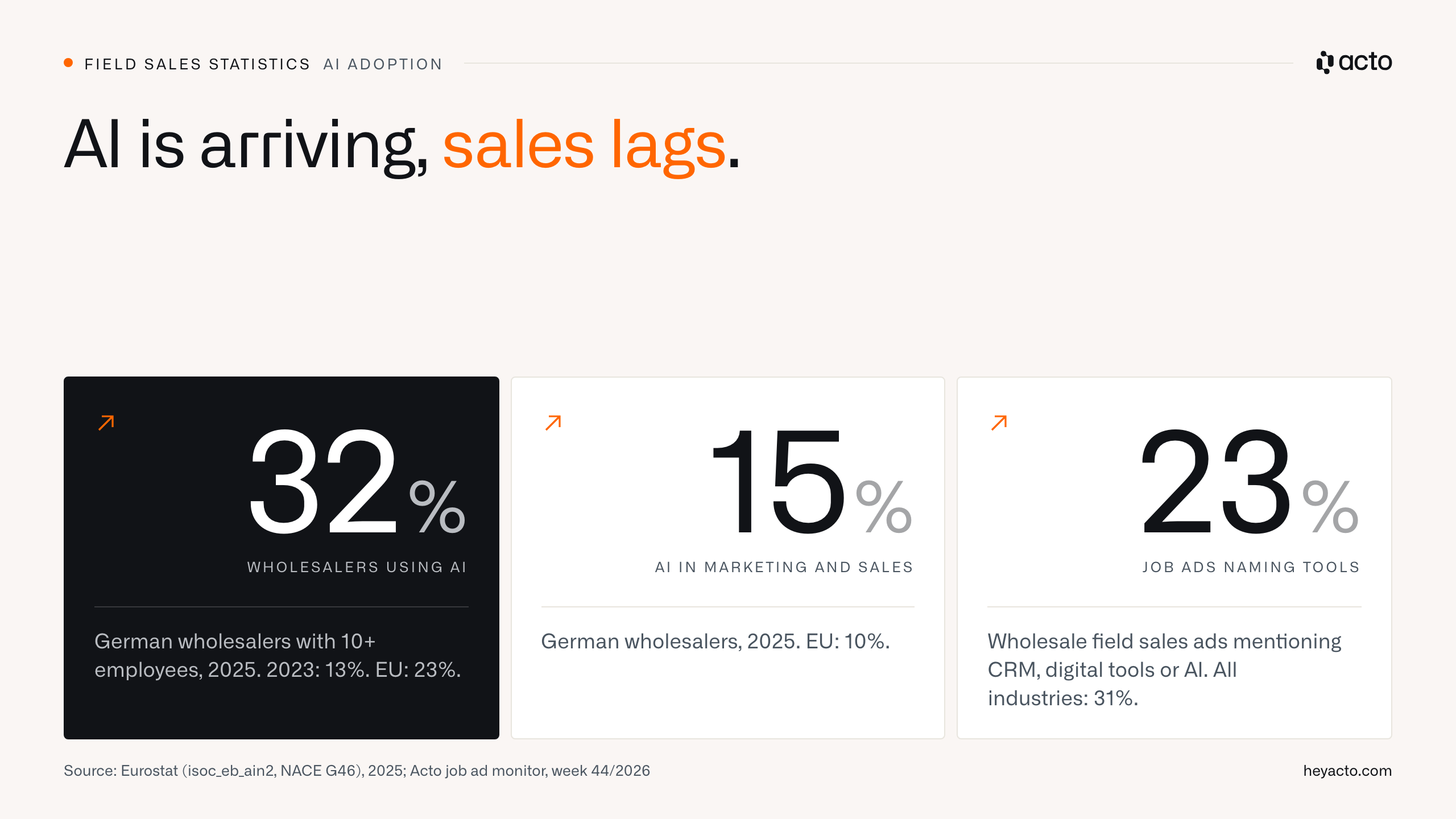
AI use in German wholesale has more than doubled since 2023, but sales lags behind.
How are B2B buyers changing?
67% of B2B buyers say they prefer a rep-free buying experience, but 69% still want to check what AI tells them with a sales rep. Both figures come from Gartner surveys of 646 and 645 B2B buyers (Gartner, March 2026; Gartner, May 2026).
- A year earlier, 61% of B2B buyers preferred a rep-free experience, and 73% actively avoided suppliers who send irrelevant outreach (Gartner, June 2025, 632 buyers).
- 45% of B2B buyers used AI during a recent purchase (Gartner, March 2026).
- 51% of buyers say they're more likely to get misleading information from generative AI, 49% from a sales rep (Gartner, May 2026).
- B2B buyers follow a "rule of thirds": at every stage, about a third want in-person contact, a third remote contact and a third digital self-service (McKinsey B2B Pulse, September 2024, nearly 4,000 decision makers in 13 countries).
- 41% prefer in-person contact when dealing with a new supplier, and 40% when buying something for the first time (McKinsey, 2024).
- B2B buyers use an average of ten channels in their buying journey, up from five in 2016, and more than half would switch suppliers after a poor experience across channels (McKinsey, 2024).
- In-person sales now bring in 17% of B2B sellers' revenue, down five percentage points, while e-commerce has become the top channel for companies that offer it (McKinsey, 2024).
- 57% of sales professionals say customers take longer to decide than they used to, and 69% say measurable ROI matters more than a year ago (Salesforce State of Sales, 2026).
For field sales, that means fewer routine visits and more visits that have to count: the rep shows up where the buyer needs reassurance, with a reason and a number.
How is the German wholesale market doing?
German wholesale turned over €1.29 trillion in 2024 across 128,937 companies, but it has barely grown in real terms since 2023. (Destatis, structural statistics in trade, WZ 2008 division 46.)
- Real turnover index: 98.6 in 2025 (2021 = 100, Destatis, provisional).
- Insolvency filings by wholesalers rose from 632 in 2022 to 1,241 in 2025 (Destatis). In the first half of 2026 there were 744, 20% more than a year earlier.
- Wholesale of wood, building materials, paints and sanitary equipment was 27.3% below 2021 in real terms in 2025; IT and communications wholesale grew the most (+11.1%).
- Around 3,100 large companies account for three quarters of wholesale turnover; the roughly 91,000 micro-companies together account for less than 3%.
How big is wholesale in Europe?
EU wholesale turned over €6.31 trillion in 2024 across about 1.58 million companies with 9.72 million people employed (Eurostat, structural business statistics, NACE G46).
- EU wholesale turnover fell 4.4% from €6.60 trillion in 2022 to €6.31 trillion in 2024 (our calculation from Eurostat).
- Germany accounts for about a fifth of that: €1.29 trillion, with 1.90 million people employed in wholesale (Eurostat, 2024).
- German wholesale turnover grew only 1.2% in nominal terms and 0.7% in real terms in 2025 (BGA, Trends & Analysen Großhandel 1/2026).
- Employment in German wholesale fell to 1.985 million in October 2025, from 2.019 million two years earlier (BGA, based on Destatis).
- 27% of German wholesalers planned to cut staff in the first half of 2026; 11% planned to hire (BGA business survey, winter 2025/26).
- Germany also has 38,264 commercial agencies, independent sales agents selling on behalf of manufacturers, with 102,154 people (Eurostat, 2024).
Fewer people and flat revenue mean each rep's customer list tends to get longer.
What these numbers mean for wholesale sales teams
Put the numbers together and the picture is clear. One rep covers 247 customers with about 1,000 visits a year, often plans them on gut feeling, loses 4% to 17% of customers a year without a warning list, and takes three to five years to replace. The order history that shows who's slipping is already in the ERP.
- Plan visits with data. Revenue drops, open quotes and assortment gaps give an order that can be explained and handed over to a successor.
- Measure churn and catch it early. A running analysis of buying behavior flags customers who order less, before they're gone.
- Keep customer knowledge in the system. What a rep knows after 20 years in the territory should be there when they retire.
Acto is the sales AI for wholesale distributors and manufacturers with their own field sales teams. Every night it reads ERP and CRM data and shows field sales in the morning which customers need attention and why. More on the topics behind these numbers: AI in sales, detecting customer churn in wholesale and field sales apps.
Methodology
The figures above combine official statistics with Acto's own research. Acto's own data covers Germany and the DACH region. Third-party figures come from the publishers named next to each number.
- Official statistics: Destatis (structural statistics, turnover index, insolvencies), German Federal Employment Agency (employees by occupation and age, vacancy times, pay atlas), Eurostat (AI use), BIBB (apprenticeships).
- Job ad monitor: all 4,746 field sales positions on the German Federal Employment Agency's job board in week 44/2026, deduplicated; 311 from 162 wholesalers, excluding staffing agencies and identifiable manufacturers. What's measured is the age of open ads.
- Conversation analysis: 577 recorded sales conversations from 2024 to 2026, 355 of them with wholesalers. Only statements by the wholesalers were analyzed.
- Sales profiles: a sample of more than 3,000 profiles from wholesale companies in DACH (week 40/2026), roles assigned by job title.
- Live poll: VTH annual conference 2026, n = 52 and 56.
- Acto benchmark: ERP order data from wholesalers, the basis of the churn rate.
Conversations, profiles and the poll are samples and aren't representative of wholesale as a whole.
How to cite these statistics
You can use every figure and chart on this page for free. Please name the source and link to this page:
Source: Acto, Wholesale Field Sales 2026, heyacto.com/en/blog/wholesale-field-sales-statistics
Journalists and authors can get the full report and individual charts without filling in a form. For questions, quotes and interviews, contact Alexander Heinle at alexander@heyacto.com. The full report is available as a free PDF: Wholesale Field Sales 2026.
FAQ: wholesale and field sales statistics
How many customers should a field sales rep have?
There's no single right number, but in wholesale a field rep covers 247 customers on average and 175 at the median (Acto, 106 companies). At around 1,000 visits a year, that's about four contacts per customer. Most teams can't visit every customer equally, so the question is which customers get the visits.
What is a typical customer churn rate in wholesale?
In Acto's benchmark from ERP order data, wholesalers lose 4% to 17% of their customers per year. Some published benchmarks show much higher churn for wholesale. They come from surveys and may define churn differently, so check how a rate was measured before comparing it.
How much does a field sales visit cost?
In German wholesale, a field rep costs around €98,000 a year including car, expenses and IT and makes about 1,000 visits, so a visit costs just under €100 (Acto's own calculation). One wholesaler we spoke to puts its own cost at €150 to €200 per meeting.
How many sales reps use AI?
87% of sales organizations use some form of AI, according to Salesforce (2026). In German wholesale, 32.4% of companies used AI in 2025 and 15.4% used it in marketing and sales (Eurostat).
Can I use these statistics?
Yes. Please cite "Acto, Wholesale Field Sales 2026" and link to this page. For third-party figures, cite the original source we name next to each number.