AI in Sales: 10 Use Cases With Examples From Wholesale and Field Sales

Summary
- AI in sales analyzes sales data and takes routine work off your plate: from lead scoring and writing to forecasts and prioritizing existing customers. According to Bitkom, only 14 percent of German companies that use AI were using it in sales in 2026.
- Generative assistants like ChatGPT write text. Predictive AI works out from your data what happens next, and that’s what actually moves revenue.
- Every one of the ten use cases has to move one of two levers: revenue per visit or number of visits. If it moves neither, it’s not a priority.
- In wholesale, the biggest lever is your existing customers. The buying signals have been sitting in your ERP order history for years.
What is AI in sales, and how far along are companies?
AI in sales is software that analyzes sales data, writes text or takes over routine work, so reps get more time with customers and bring up the right topic when they’re there. That includes generative assistants like ChatGPT as well as models that use order and CRM data to predict which customer will buy next or is about to walk.
Sales is only just catching up on AI. According to a Bitkom survey of 603 German companies with 20+ employees, 57 percent of companies used AI in 2026, a majority for the first time. Of those, 14 percent use it in sales, up from 5 percent the year before; in customer contact, it’s 72 percent.
So if you’re starting now, you’re not late.
What are the use cases for AI in sales?
There are ten places AI fits in sales, from prioritizing existing customers to lead research to generative assistants for writing. The table shows which lever each one moves, what data it needs and how mature it is today.
The lever describes how a use case affects revenue: through revenue per visit (the right customers, the right topics) or through the number of visits (less admin, more time with customers).
The maturity ratings in the table are our assessment from working with wholesalers, not a study.
| Use case | Lever | Data | Maturity today (Acto’s assessment) | Good fit for |
|---|---|---|---|---|
| Prioritizing existing customers | Revenue per visit | ERP order history, CRM optional | production-ready | Wholesalers and manufacturers with field sales |
| Spotting churn early | Revenue per visit | Order rhythm, product groups, notes | production-ready with clean data | Repeat-order business |
| Cross-selling and upselling | Revenue per visit | Order history, assortment, similar customers | production-ready | Broad assortments |
| Revenue forecasts | indirect | Long, clean history | varies a lot by level | Customer and product-group level |
| Meeting prep | both | ERP, CRM contacts, visit reports | production-ready | Field sales with lots of meetings |
| Voice visit reports | Number of visits | Voice note, CRM | production-ready | Any field sales team |
| CRM upkeep and automation | Number of visits | CRM | partly production-ready | Teams required to keep a CRM |
| Lead research | Number of visits, if it cuts research time | External company data | production-ready with specialist tools | New-business sales |
| Building quotes | Number of visits | Prices, configuration | production-ready with specialist tools | Quote-driven business |
| Generative assistants | Number of visits | Your own texts and documents | production-ready for writing | Every role in sales |
Who’s already using AI in sales? Two examples
Coca-Cola: order suggestions for thousands of retailers. In Malaysia, Coca-Cola suggests to retailers in its ordering app Coke Buddy what to order and how much. The “Perfect Basket” feature works from past orders, order frequency, seasonal demand, the weather and the buying behavior of similar businesses. According to Coca-Cola, 83% of participating retailers took the suggestions when they ordered (PYMNTS, September 2026). In a pilot in three countries, managers got WhatsApp alerts about when to restock. Revenue there grew 7 to 8% compared with outlets without the algorithm, according to Coca-Cola CIO Neeraj Tolmare (Fortune, July 2025).
That’s the same logic that works in wholesale: your own customers’ order history shows what’s coming due.
Salesforce: an AI agent for inbound leads. In 2024, Salesforce introduced an AI agent for sales development that handles inbound prospects around the clock, answers questions, handles objections and books meetings for sales (Salesforce, August 2024). It works on new business and the number of visits, not on existing customers.
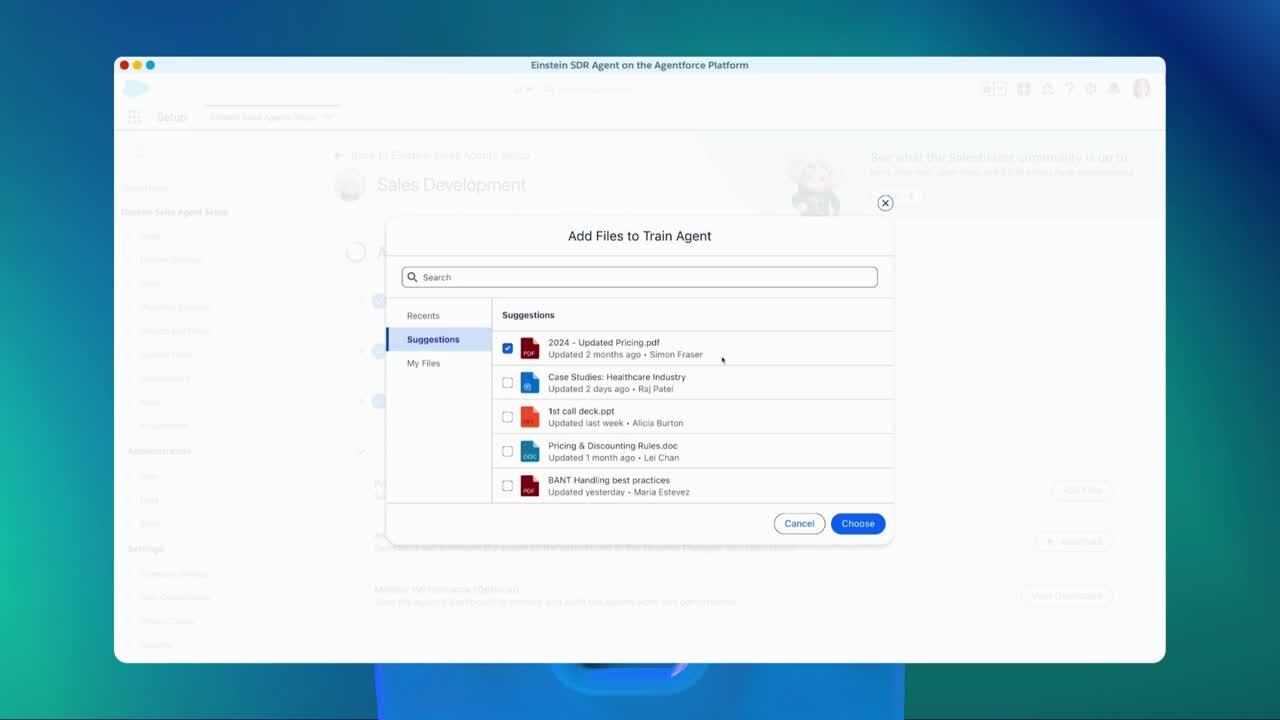
Setting up the SDR agent in Salesforce: the agent learns from price lists, case studies and talk tracks. Image: Salesforce.
What AI tools are there for sales?
AI tools for sales fall into six categories, depending on the data they work with. The examples are a neutral selection, as of November 2026.
| Category | What it’s for | Examples | Data |
|---|---|---|---|
| Generative assistants | Writing, summaries, talk tracks | ChatGPT, Microsoft Copilot, Google Gemini | whatever you type in |
| AI features in the CRM | Notes, lead scoring, pipeline forecasts | Salesforce Agentforce, HubSpot Breeze, Copilot in Dynamics 365 | CRM entries |
| Conversation intelligence | Analyzing phone and video calls | Gong, tl;dv | Recordings, only with consent |
| Sales intelligence | Finding companies and contacts for new business | Dealfront, Apollo, Cognism | External company data |
| Quote configuration (CPQ) | Building quotes with pricing logic | Salesforce Revenue Cloud, SAP CPQ | Prices and product rules |
| Existing-customer AI for field sales | Who’s overdue, what’s missing, who’s about to churn | Acto | ERP order history |
The last column is what matters: a tool can only analyze what’s in its data.
Are ChatGPT and Copilot enough for day-to-day sales?
For writing, summaries and talk tracks, yes, and you don’t need a new tool for it. But they know nothing about your customers: which customer is overdue isn’t in the chat window.
Generative assistants summarize a long customer email, turn bullet points into a follow-up email, translate a technical data sheet into a buyer’s language or list the typical objections to a product. That saves time, so it works on the second lever.
Four prompts that work for field sales right away. Don’t put customer data into personal accounts: use a tool your company has approved, or leave names out.
| Task | Prompt |
|---|---|
| Prep a visit | “Here are my notes from the last visit. Summarize what’s still open in five bullet points and suggest three questions for the next conversation.” |
| Follow up | “Turn these bullet points into a short, friendly email to a buyer at a contractor. No sales pitch, 120 words max.” |
| Practice objections | “I sell [product] to [customer type]. List the five most common objections and a short answer to each that doesn’t need a discount.” |
| Explain a data sheet | “Explain this technical data sheet so a buyer with no technical background gets in three sentences what makes the product better.” |
“Treat AI like a new inside sales hire. Hardworking, fast, never sick, but with no people skills and no accountability.”
– Dirk Kreuter, sales trainer (blog post “KI im Vertrieb: Chancen, Grenzen, Praxis”, translated from German)
Generative AI writes text from what you give it. Predictive AI works out from your order history what happens next. In wholesale, the revenue lever is the second one. For a tool comparison, see field sales apps.

Generative assistants write; your order data tells you who’s worth the visit.
How should wholesalers and manufacturers get started with AI in sales?
From here on, this is about sales in wholesale and at manufacturers with field sales teams.
A good place to start is a simple formula: field sales revenue equals number of visits times revenue per visit. Every AI project has to move one of those two factors. If it moves neither, it’s not a priority, no matter how easy it is to roll out.

An AI use case is only a priority if it moves one of these two levers.
Here’s how AI moves the two factors:
- Number of visits: AI takes over the stuff that eats time away from customers: writing reports, digging for data, prepping meetings. According to Salesforce’s State of Sales report 2026, sales reps spend only 40 percent of their time actually selling.
- Revenue per visit: AI shows which customer has something coming up and what topic the rep should bring.
Both aim at the same thing: more time for the face-to-face conversation, and a conversation that’s worth more because the rep shows up with a concrete reason to talk. André Buck of Berner describes where that takes the role:
“Anything that’s boring, we’re going to automate it, agentize it […]. We’ll go from being information brokers to, I think, more like value architects in [field sales]. Values, trust, […] human communication – that’s what’s going to move to the front.”
– André Buck, Berner (Revenue Signals, episode with André Buck, translated from German)
In wholesale, digital tools barely show up in job ads either. According to the Acto study “Wholesale Sales 2026”, our own analysis of 311 field sales openings at 162 wholesalers on the German Federal Employment Agency’s job board (week 44, 2026), 23% of wholesale field sales ads mention CRM, digital tools or AI. Across all industries, it’s 31%. More figures like this are collected in our wholesale and field sales statistics.
In sales, you can measure impact more precisely than almost anywhere else, because every order is in the ERP. McKinsey describes efficiency gains of 10 to 15 percent and more time with customers for B2B sales teams that equipped their people with automation and analytics. Our wholesale customers get more specific. Plate grew revenue among the pilot team’s users by 10% and cut the time between orders by 35%. Schäfer Shop grew revenue by 11.2%. At Böllhoff, Acto users in the pilot were 8.6% ahead of colleagues without Acto on revenue.
What that means for you: measure every AI project against a group that works without it. And don’t expect your field team to do analysis. Reps aren’t analysts. They need ready-made answers: who to drive to today, what to offer them and where things are on fire.

What does AI look like in day-to-day sales?
With existing customers, AI in sales isn’t a chat window your field team types questions into. It crunches the order history overnight and hands over a few alerts in the morning, each with a reason and a next step. Three made-up examples show what that looks like:
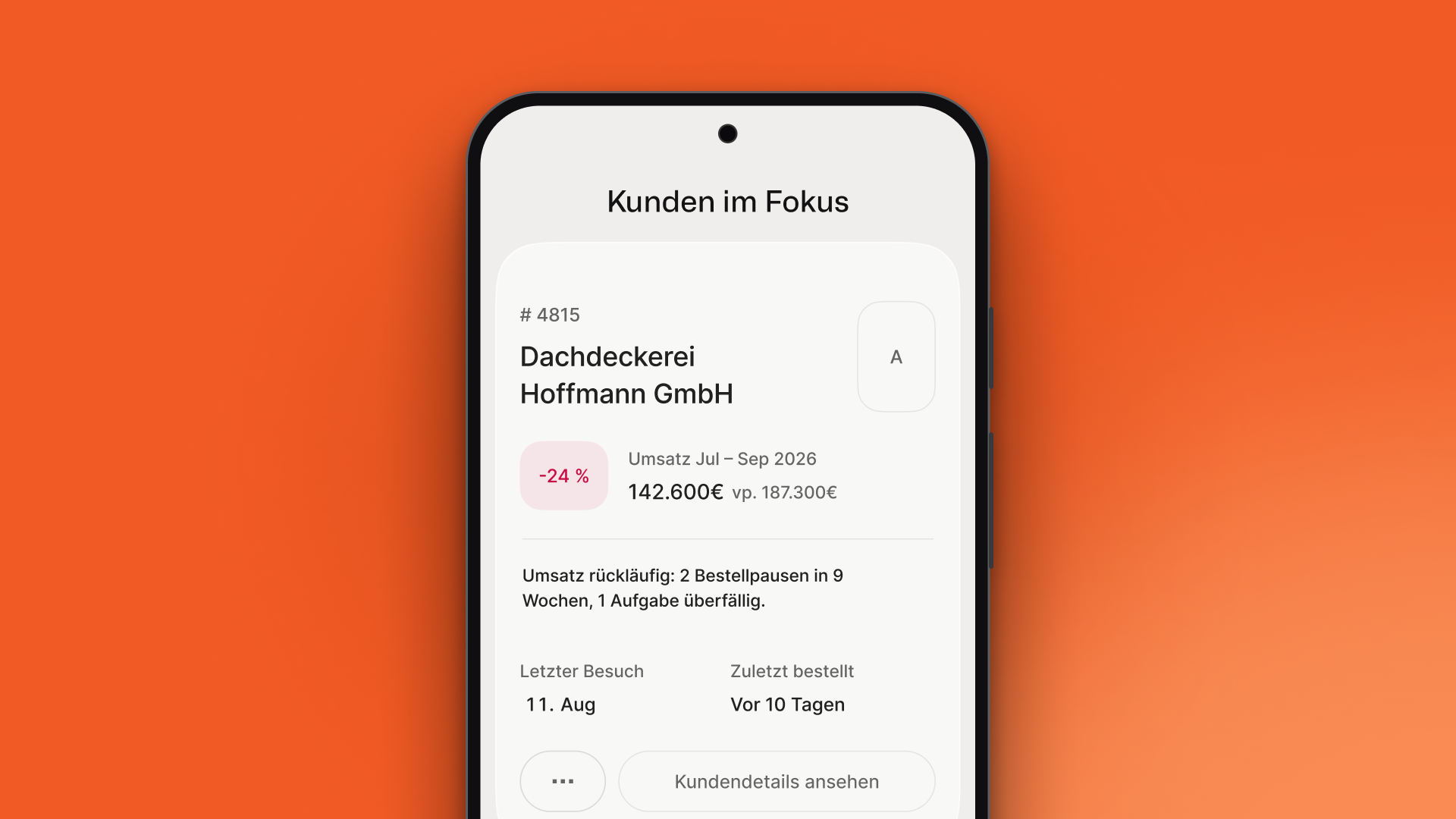
- Reorder overdue: Hoffmann Roofing usually orders fasteners every 21 days, and nothing has come in for 38 days. A call today tells you whether a competitor delivered.
- Assortment gap: Weber Painting buys wall paint and primer but no enamel paint, even though comparable shops buy enamel too. The rep brings the enamel line to the next meeting.
- Churn risk: At Krüger Plumbing & Heating, total revenue is stable, but the faucets product group has collapsed in three months. The rep asks about it at the visit, before the whole customer walks.

Made-up examples: how signals from the order history reach field sales in the morning.
Every one of these signals was already in the ERP. What’s new is that someone finds it without having to go looking.

Where’s the revenue in your existing customers, and which AI unlocks it?
In wholesale, most revenue comes from existing customers, and the signals for it are in the ERP order history. AI unlocks that revenue by analyzing the signals every day and telling sales who’s overdue, who’s slipping and what’s missing.
New customers are expensive: according to Harvard Business Review (Gallo, 2014), winning a new customer costs five to 25 times as much as keeping an existing one, depending on the industry. And wholesale is sitting on better buying signals than any intent database you could buy. Who’s only ordering small parts now, who never takes the seals with the hydraulic hose: it’s been in the ERP for years and it gets left on the table, because nobody has time to look for it.
According to our study “Wholesale Sales 2026”, a wholesale field rep looks after 247 customers on average, with a median of 175 (data from 106 companies, sales conversations and survey, 2024 to 2026). Nobody knows that many customers equally well, not even the best rep on the team.
“With 40 or so field reps, each with 100 to 200 or 250 customers, something’s bound to fall through the cracks.”
– Lean manager, midsize office supplies and stationery manufacturer, first call (translated from German)
Who do I visit today? Prioritizing existing customers with AI
To prioritize existing customers, the AI reads each customer’s order history and builds a short list: which customer, why now, what to bring up. It’s based on the customer’s potential, not their current revenue. Otherwise C customers (the lowest-revenue tier in an ABC analysis) stay C customers forever, because that’s how they get treated.
The logic behind it is called next best action. Data: ERP order history, CRM contacts optional. Maturity: production-ready, for distributors and manufacturers with lots of customer accounts. How that turns into a visit rhythm beyond a fixed rotation is a topic of its own, visit planning. That these lists hold up day to day shows at our customer Schäfer Shop: sales marks 92% of the suggested signals as helpful.
How does AI spot churn before revenue drops?
AI spots churn by comparing each customer’s order rhythm and product groups with their own history and with similar customers. Customers rarely leave all at once. They move one product group after another while total revenue still looks healthy.
In practice, the analysis compares a customer’s revenue over one, three and six months with the periods before and watches the usual order cycle. If a customer usually orders every ten days and hasn’t ordered in six weeks, the signal fires. Without context, that creates false alarms: a restaurant customer who hasn’t ordered in three weeks might be on vacation. Only a visit report that says “closed for vacation” turns the alert into a reminder for after the break.
“All of a sudden this painting customer looks really bad in our system, because he’s stopped buying all the painting products he bought in previous years. But he’s not a bad customer, he’s just buying other products.”
– Head of sales, midsize building materials wholesaler, customer conversation (translated from German)
Maturity: production-ready when data quality and context are right. Which signals there are is covered in detecting customer churn in wholesale.
What isn’t the customer buying yet? Cross-selling and upselling from order history
For cross-selling and upselling, the AI compares a customer’s assortment with that of similar customers and shows the gaps. A painting contractor buys wall paint and primer but hardly any enamel, even though comparable shops do. On top of that come reorder intervals per item.
At our customer Plate, customers added an average of 2.1 more products when they were contacted because of an Acto notification. Data: order history plus assortment structure. Maturity: production-ready. More strategies in cross-selling in B2B.
How far can AI revenue forecasts go in wholesale?
AI revenue forecasts work well at the level of individual customers and product groups, like the next reorder that’s coming due. A company-wide forecast for planning and controlling is a project of its own, with higher demands on history and data quality. The lever is indirect: a forecast doesn’t sell anything; the action that follows does. Use cases are in predictive analytics in wholesale.

Churn shows up in individual product groups first, long before total revenue drops.
How does AI help before and after the meeting?
Before the meeting, AI sums up what’s going on with the customer. After the meeting, it turns spoken notes into CRM entries and follow-up tasks, and that moves both levers.
Sales software gets bought in the office and used in the car, or not at all. That’s why AI belongs in Outlook, in the CRM, on the phone and in voice, not in one more tool with its own login.

The same field sales day, once without and once with the order data analyzed overnight.
Meeting prep: what’s ready and what stays manual
At Acto, the AI pulls risks, potential and customer history onto one page, and prep takes about two minutes. If you have eight meetings a day, you barely prep otherwise:
“We chase them, of course, and track them really hard on how many customers they visited. So the quality of the visits isn’t always what it could be, because when we say 8 to 10 customers, there just isn’t the prep time.”
– Sales operations lead, international wholesaler, first call (translated from German)
At our customer Hitado, new sales colleagues get up to speed six times faster, by the company’s own estimate: in one to two months instead of about a year. What stays manual: who makes the call at the customer and what they’re planning. That knowledge only gets into the system through notes.
Voice visit reports: what works in practice
For 20 years, getting reps to actually enter data was one of the biggest obstacles in sales. What takes effort goes unused: in 214 companies surveyed, only about a quarter of employees actively work with BI tools. A report talked in right after the meeting, in the car, lands in the CRM while the details are still fresh. Maturity: production-ready. How it works step by step is in voice visit reports.
Does AI in the CRM already help with revenue?
AI in the CRM cuts the upkeep, but it doesn’t automatically bring in revenue. CRMs are built for new-business pipelines; with existing customers they mostly document. One person we talked to described their CRM as pure documentation that nobody uses proactively.
Automatic notes and follow-up tasks save time (the second lever). The revenue lever is still in the ERP data. More in why a CRM isn’t always the best choice in wholesale and B2B sales automation.

Every follow-up improves the next recommendation, as long as it gets into the system without typing.
New business and quotes: where other tools are better
Not every use case belongs to analyzing your own order data. For these two, specialist tools are the better choice.
Lead research and prospecting
For lead research, sales intelligence tools with external company data help: industry, size, contacts. A sales AI for existing customers isn’t built for that. In wholesale, winning new customers mostly offsets businesses that close; the bigger lever is your existing customers.
Building quotes, and what comes after
Building a quote (configuration, pricing logic, the document) is a job for quoting and writing tools. Following up, on the other hand, belongs to the existing-customer business. If a quote covered eight product groups and only four got ordered, someone should notice without having to remember.
Not for you: when AI in sales doesn’t pay off
AI for existing customers doesn’t pay off in every business model. The approach is a poor fit if:
- you’re a manufacturer who mostly sells through distributors,
- your business is projects without repeat orders, or you sell to consumers,
- your focus is winning new customers,
- your order history isn’t digital or isn’t usable.
Our typical customers have around 1,500 active customer accounts or more. Well below that, the numbers usually don’t work. And AI doesn’t fix broken foundations:
“AI isn’t going to cure the problems you have today. The question will be: what’s your data like, and what are your processes doing? And are the processes and the data even AI-ready?”
– Daniel Hesmer, Comm. Director, Walraven (Revenue Signals, episode with Daniel Hesmer, translated from German)
Manufacturers and distributors, one-to-many relationships in sales, and AI (in German)
How to tackle AI for existing customers with Acto
Acto is the sales AI for wholesale and for manufacturers with their own B2B direct sales. We’re the company behind Acto. Every night, Acto reads the ERP and CRM data, and in the morning it shows field sales which customers need attention, why, and what to bring up. Acto isn’t a CRM, a BI tool, a copilot or a route planner; for lead research, quote building and controlling forecasts, you’re better off with other tools.
- Prioritize customers and prep conversations, with a one-sentence reason.
- Follow up on visits by voice; notes and follow-up tasks land in the CRM.
- Work in Outlook, as a sidebar in Salesforce, Dynamics 365 or SAP C4C, and in the app; smaller teams use Acto instead of a CRM.
You’ll find real-world cases in AI in wholesale in detail and AI in field sales with real examples, and the software at a glance under sales software for wholesale distributors and AI field sales software.
Where to start: what can you check this week?
Start with the formula: where is your sales team losing visits, and where is revenue per visit being left on the table? Only then pick a use case.
Check your data first, the way Daniel Hesmer recommends: can you export the order history of the last few years with customer and item numbers? Then pick a use case that moves one of the two levers, and plan a pilot with metrics set up front against a control group. The effort goes into data access, agreeing on metrics and getting the team on board.
Your first move: write down every AI idea floating around your company and mark which lever each one moves. Cross out every idea without a lever. Then ask two or three field reps where they lose time away from customers, and put their answers next to your list.
On a call, we’ll show you which customers in your territory need attention right now.
FAQ: common questions about AI in sales
Will AI replace field sales reps?
AI won’t replace field sales reps; it shifts their work. The machine takes over pattern recognition, summaries and documentation, and the conversation stays with the person. The more consultative the product, the sooner the customer wants someone to talk to. In B2B sales, AI shifts the focus of the work from routine to conversations.
Which AI is best for sales?
There’s no single best AI for sales, only the right one for a use case. For writing, a generative assistant is enough; for new business, a research tool; for existing customers, an analysis of your own order data. Decide based on the lever you want to move.
Which KPIs matter for AI in B2B sales?
For AI in B2B sales, performance metrics matter, not activity counts. Good ones are revenue per visit, the share of visits with a concrete reason, the time between orders and the churn rate. Measure against a group that works without AI.
Do I need a data science team for AI in sales?
You don’t need your own data science team for AI in sales if you use an off-the-shelf tool. With Acto, IT effort is two to three days, and getting started usually takes 4 to 6 weeks, depending on your system landscape and data quality. Building it yourself ties up IT capacity that midsize companies usually need for ERP and CRM projects.
Is the AI in my ERP or CRM enough, or do I need a dedicated sales AI?
The AI in your ERP and CRM isn’t enough for selling to existing customers. ERPs think in transactions and roll out new features slowly, and CRMs mostly know what someone typed in. What’s missing is a layer in between that turns order data into recommendations for field sales.
What do I do when my best rep ignores the suggestions?
If your best rep ignores the suggestions, they haven’t been worth anything to them so far. Buy-in is about value, not age. Let them reject suggestions with “not relevant because …”: that feedback improves the next recommendations and shows you where the logic doesn’t fit yet.