Knowledge Transfer in Sales: How to Hand Over Customer Knowledge Safely
Summary
- Knowledge transfer in sales means passing a salesperson's customer knowledge to their successor in a way that lets the successor actually sell with it. Knowledge that's been captured but never used doesn't protect a single euro of revenue.
- A territory handover works in six steps: quantify the risk, analyse the order data, draw out what's in the predecessor's head, set the handover order, visit customers together and follow up in day-to-day work.
- According to our study "Sales in Wholesale 2026", a wholesale field rep looks after a median of 175 customers. Much of what they know is already in the ERP: order rhythm, seasonal patterns, repurchase intervals and the buying patterns of similar customers. Relationships, applications and context exist only in their head.
It takes a new field rep three to five years to know a territory as well as their experienced predecessor.
That's the estimate from sales leaders in technical distribution, according to the German technical trade association Verband Technischer Handel (VTH). When the next person on your team retires or resigns, that knowledge has to reach their successor far faster, and it covers well over a hundred customers at once.
To get there, you need to know which customer knowledge sits where, and how to pass it on so the new rep can work with it from day one.
What does knowledge transfer in sales mean?
Knowledge transfer in sales is passing customer knowledge from one person to another, or to the whole team, in a way that makes a difference in selling. It refers to what experienced field and inside sales reps know about their customers: who really makes the decisions, what the business does with the goods and when which need will come up.
This knowledge comes in two forms:
- Explicit knowledge: It's already in your systems, such as orders, pricing terms, item history and framework agreements in the ERP.
- Tacit knowledge: It's experience nobody has written down, such as when it's better not to call a particular customer, or that the owner's son will soon be taking over.
Several related terms are often used interchangeably, but each means something different:
- Knowledge management: The company-wide system for collecting, organising and sharing knowledge. Knowledge transfer in sales is one slice of it, limited to customers and territories.
- Sales enablement: Equipping sales with content, training and sales collateral. It's about products and methods rather than knowledge of a specific customer.
- Onboarding: Getting new employees up to speed on the company, the product range and processes.
- CRM: It stores whatever someone enters. If there's no entry, there's no knowledge.
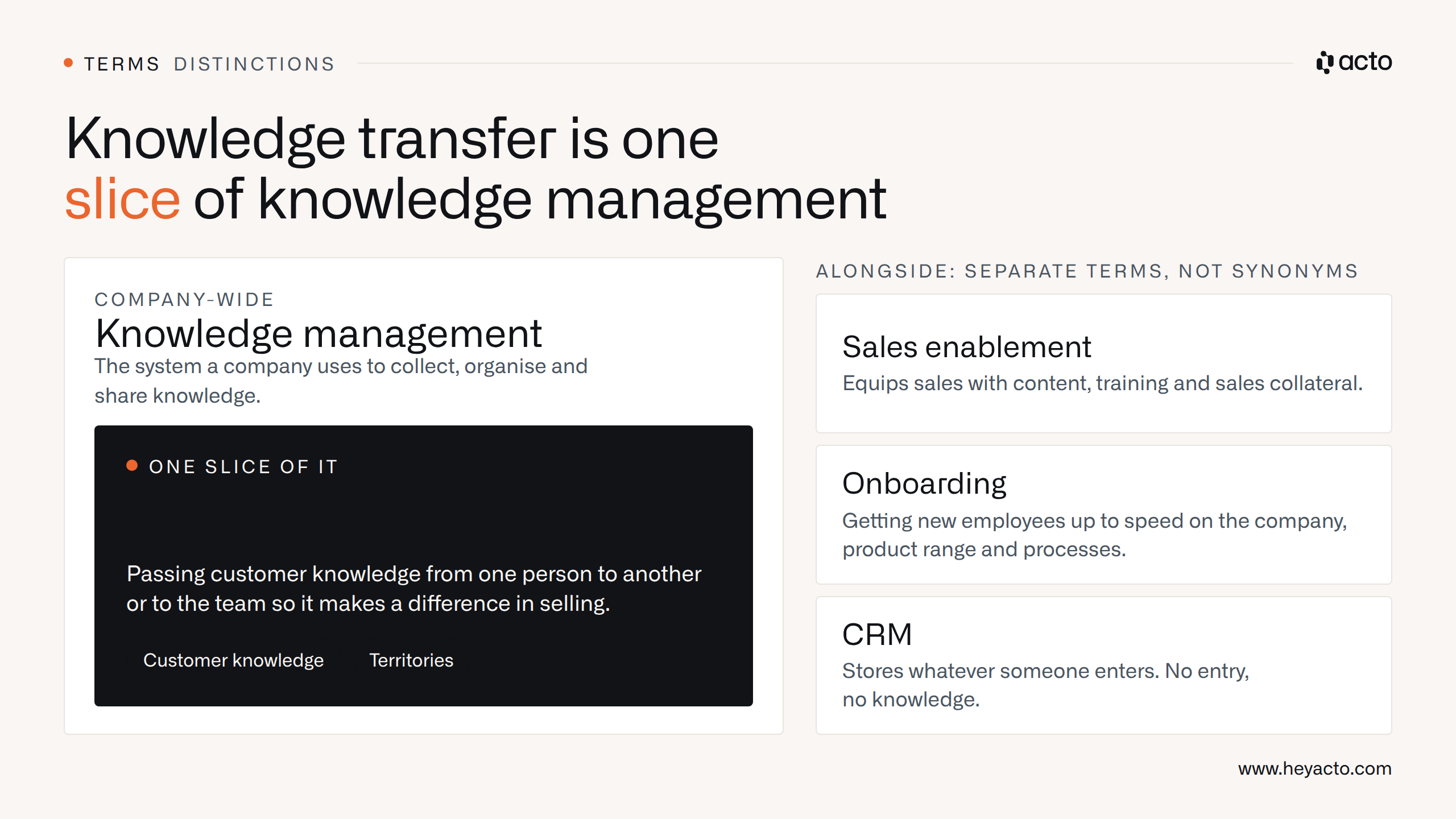
Knowledge transfer in sales is one slice of knowledge management; sales enablement, onboarding and CRM are separate things.
Why is this so urgent right now?
The field reps with the most territory experience will retire over the next few years, and their knowledge often lives only with them. In the building components industry, 44% of field reps are 50 or older and will reach retirement age within 17 years at the latest. In wholesale, according to the VTH, 54% of sales leaders expect at least a quarter of their field force to retire within ten years.
On top of that, knowledge is unevenly spread. Across industries, employees at US companies with 200 or more staff estimate that 42% of their job knowledge sits with them alone and isn't shared with any colleague. Territory handovers become routine, and if you reinvent the process every time, you pay the full price every time.
"Right now, with every employee we lose, we lose a high degree of knowledge. You have to start over every time."
– Sales executive, food wholesale/cash & carry, phone call
Territory handover in field sales: how do you manage succession when a rep leaves?
You organise the territory handover to the successor in six steps: from quantifying the revenue at risk, through analysing order data and drawing out the predecessor's tacit knowledge in a targeted way, to joint customer visits and day-to-day follow-up.
How much lead time you need depends mainly on:
- the number of customers in the territory
- how much revenue depends on a few customers
- whether the predecessor is still on board
With a resignation, the notice period sets the pace; a retirement, by contrast, you can plan months ahead.
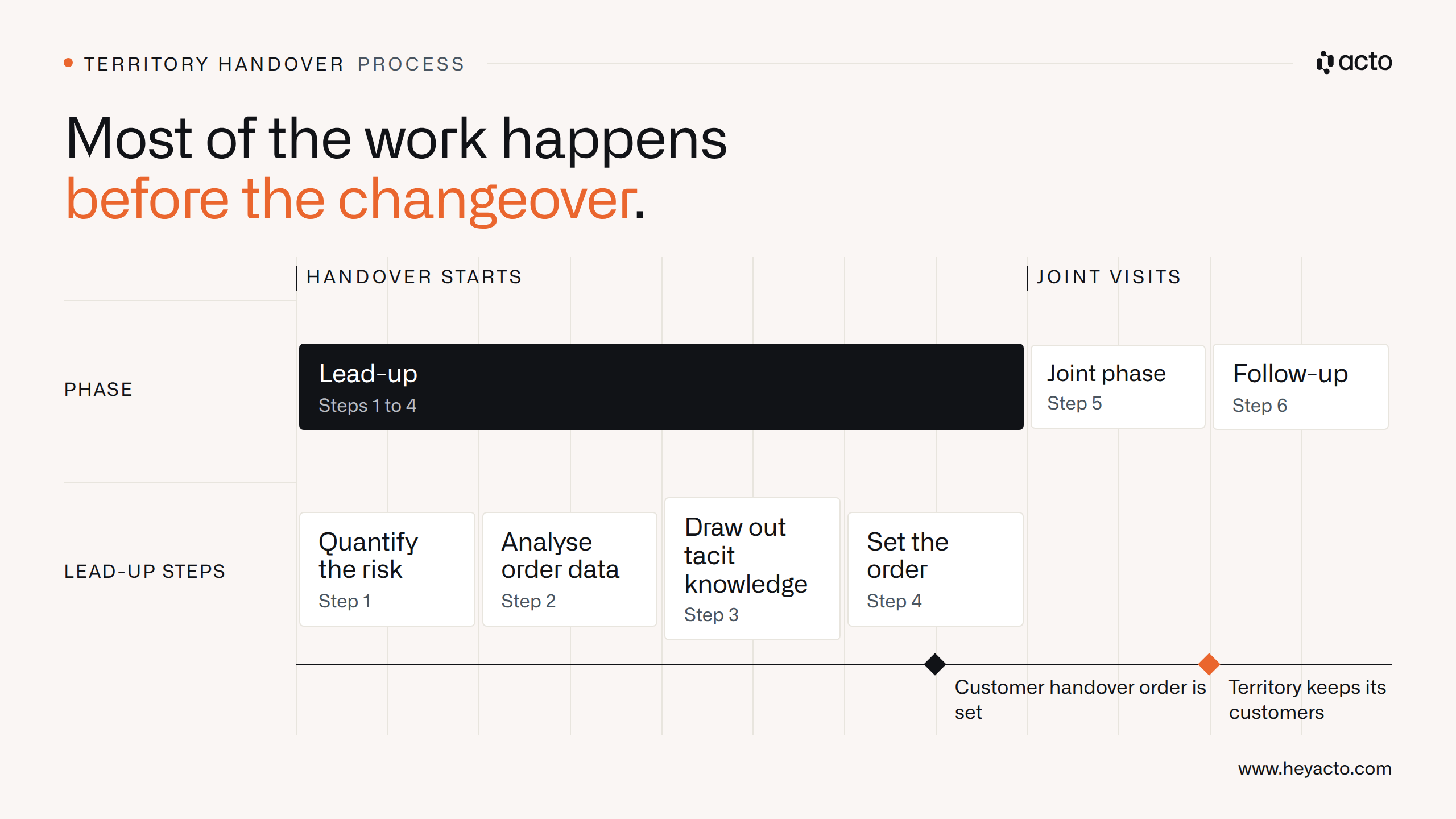
Most of the work in a good handover happens before the predecessor leaves the territory.
Step 1: Quantify the revenue at risk per knowledge holder
Pull revenue per field rep from the ERP and flag who will leave in the next few years or where a change is foreseeable. Then check, territory by territory, which customers run almost entirely through that one person, with no second contact in inside sales. The combined revenue of those customers is the revenue whose customer knowledge currently depends on a single person.
"They're gradually retiring too. They're the old hands, but they bring in so much revenue from their 20- or 25-year histories with these customers."
– Sales/CRM project lead, painting supplies, phone call
Step 2: Analyse order data per customer
Analyse the ERP before you talk to the predecessor. That way you don't have to ask about things the data already shows, and the conversation becomes shorter and more focused. Look at four things for each customer:
- order rhythm
- recurring seasonal patterns
- the repurchase interval for key items
- the product mix compared with similar businesses
The repurchase interval is the number of days between two orders from a customer, per item or product group. The mean and spread of these gaps show when a pause becomes unusual for that specific customer, something a fixed threshold for all customers can't do.
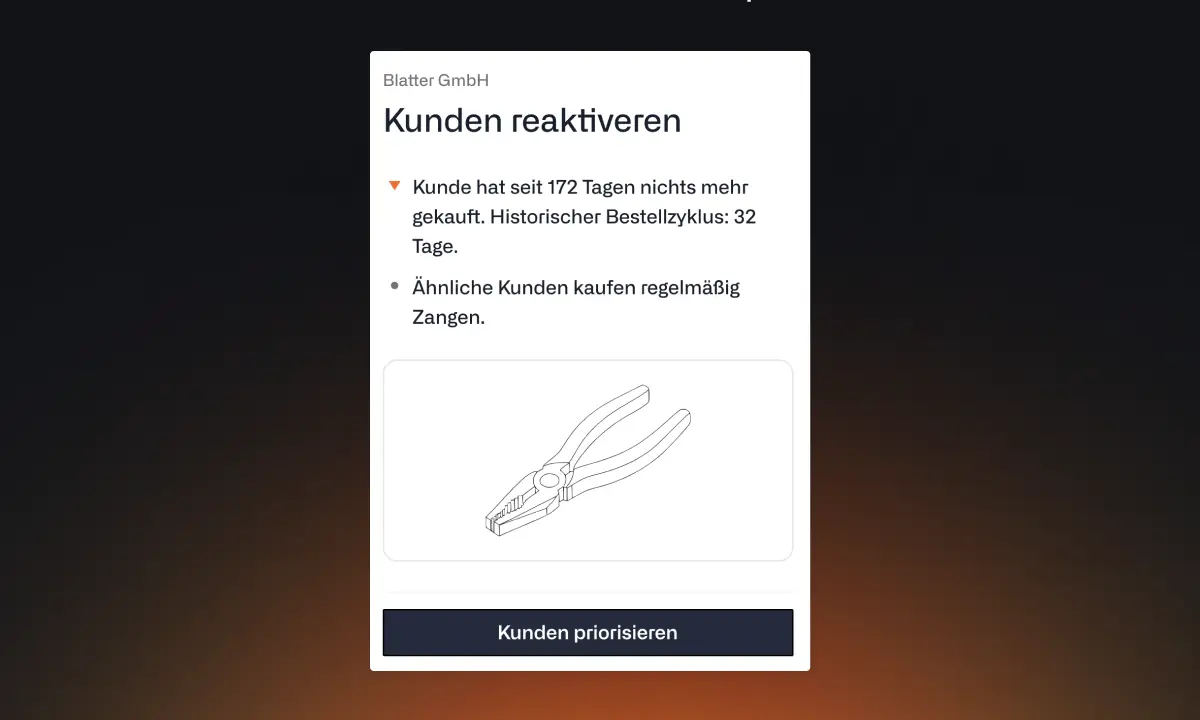
Example (demo data): card for sample customer Blatter GmbH showing no order for 172 days, against a historical order cycle of 32 days.
Step 3: Draw out tacit knowledge per customer
With the analysis from step 2 on the table, ask the predecessor these questions about each customer:
- Relationship: Who really makes the decisions there, and who should you avoid discussing prices with?
- Application: What does the business use the goods for, for example welding, assembly or two-shift operation?
- Context: What's coming up, such as a refurbishment, a big new contract or handing the business over to the son?
Approach the predecessor as a mentor. This isn't an interrogation: their experience is exactly what makes the ERP figures readable in the first place. It works best when predecessor and successor work in parallel for a while, because the new rep can then spot gaps and ask follow-up questions.
Step 4: Set the handover order by revenue and risk
Hand over first the customers where high revenue and a visible risk come together. Typical warning signs are orders tapering off or product groups suddenly dropping out. Customers ordering steadily in their usual rhythm come later, because a gap of a few weeks costs less there.
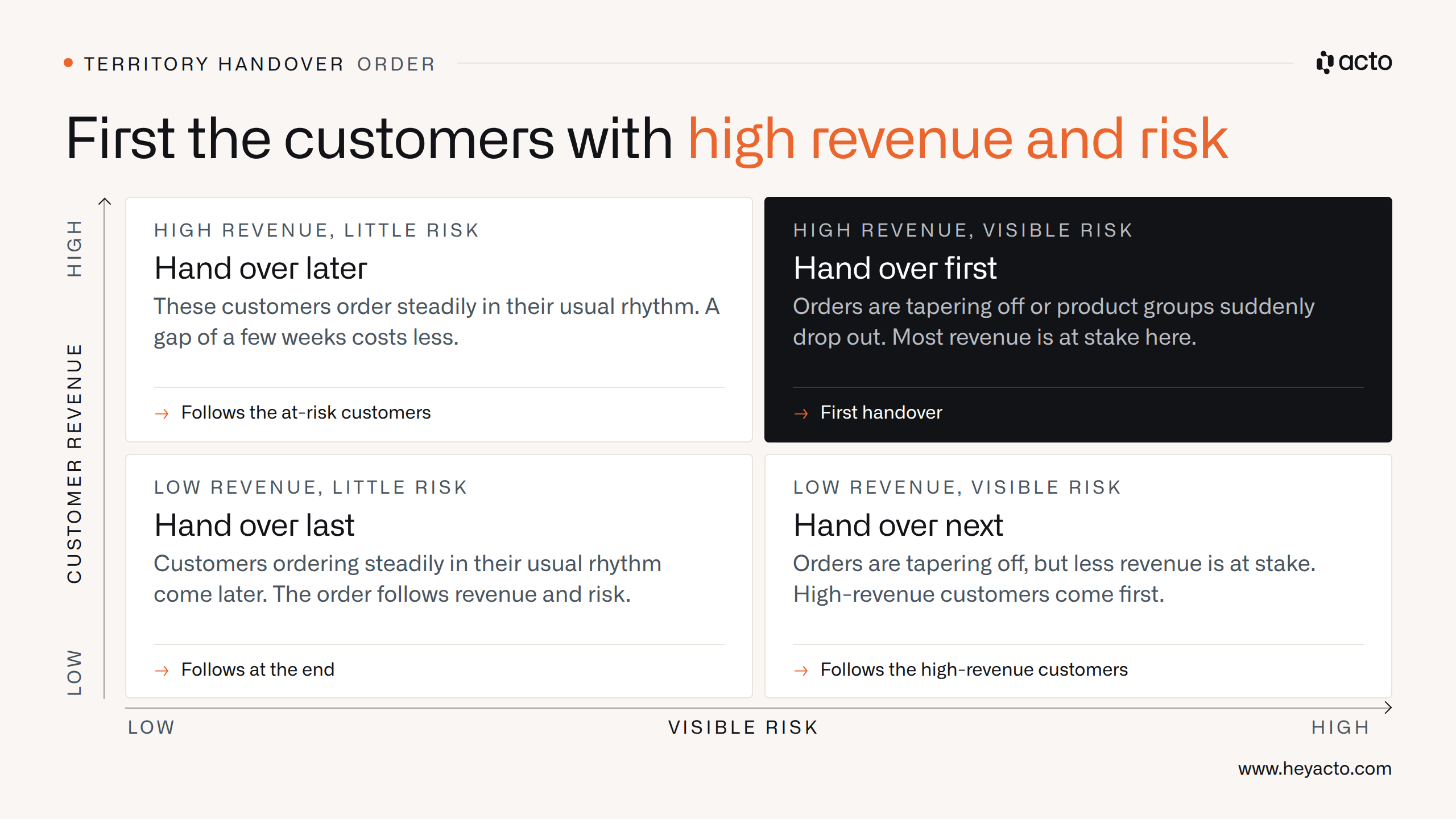
Hand over customers with high revenue and visible risk first; stable customers follow later.
Step 5: Visit customers together
The predecessor personally introduces the successor to the most important customers. In our experience, joint visits are the most effective way to pass on relationship knowledge, and trust in the new contact grows when the outgoing field rep actively supports their successor. The honest limit is time: ride-alongs only ever work one to one, one customer per appointment.
Step 6: Bring the knowledge into daily work and follow up
What you gathered in steps 2 and 3 belongs where the successor looks before an appointment; a folder on the shared drive won't help them. Afterwards, measure whether the territory keeps its customers and whether they keep ordering in their usual rhythm. For what onboarding looks like beyond that, see our onboarding plan for field sales.
Which methods work for knowledge transfer in field sales?
Knowledge transfer in field sales works through a combination of methods: joint visits for relationships, a short handover document for tacit knowledge, and order data analysis for everything that has already left a trace in the ERP. Each method on its own has a clear limit.
| Method | What it's good for | Where it falls short |
|---|---|---|
| Ride-along / tandem | Handing over relationships, meeting contacts | Works only one to one and takes months for a whole territory |
| Ad hoc questions | Quick answers to specific questions | Only works as long as the predecessor is reachable |
| Handover document / wiki | Capturing tacit knowledge about key customers | A snapshot that's out of date after the first appointment |
| CRM | Documenting contacts, appointments and notes | Contains only what someone entered, and is built for new-business pipelines |
| Dashboards | KPIs for sales management | On average, only 25% of employees actively use BI tools |
| Order data plus context | Order rhythm, seasonality and buying patterns per customer, plus tacit knowledge | Requires ongoing orders and recorded conversation notes |
Most guides on the topic recommend wikis, handover documents and mentoring. That's right, but with, say, more than a hundred customers per territory, it doesn't go far enough, because each of these methods depends on time or on discipline in keeping things up to date. What scales is a repeatable process that works the same way for every successor.

Ride-along effort grows with every customer; a repeatable process doesn't.
"[…] this very structured sales approach will increasingly find its way into classic field sales too […], because otherwise you can't implement exactly what you're describing in a sensible, scalable way"
– Daniel Hesmer, Comm. Director, Walraven (Revenue Signals, episode with Daniel Hesmer)
Where does the traditional handover reach its limit?
The traditional handover reaches its limit as soon as a territory has more customers than one person can keep in their head and write into a handover document. From here on, we're talking about wholesale and manufacturers with their own field force.
The best salespeople in wholesale are often those who have been around for 40 years. Take Mr Petersen. He has covered his territory for 30 years, and he has known many of his contacts for 20. He carries a lot about his customers in his head, without ever having to look anything up:
| What Mr Petersen knows | Type of knowledge | Where it lives |
|---|---|---|
| At Heinrich, Ms Koch in purchasing makes the decisions, not the boss | Relationship | Only in his head |
| Vogt doesn't just assemble, it also welds | Application | Only in his head |
| At one of his customers, the son will soon take over | Context | Only in his head |
| Welding shops almost always also buy shielding gas and grinding discs | Buying patterns of similar customers | ERP |
| Siebert's revenue drops every September | Seasonal pattern | ERP |
| Mayer's wear parts will soon be due again | Repurchase interval | ERP |
| Who is currently falling out of their usual order rhythm | Order rhythm | ERP |
So four out of seven things are already in the order data. Combined, they turn into revenue: the ERP knows what welding shops buy, and Mr Petersen knows that Vogt is one. Without that knowledge, you leave shielding gas and grinding discs on the table at scale.
And yet even Mr Petersen regularly lets something slip, because with well over a hundred customers and tens of thousands of items, nobody keeps track of everything. No one truly knows that many customers. That's simple arithmetic, not a criticism of field sales.
I talk to sales leaders in wholesale every day, and the topic comes up often, yet solutions are scarce. Usually the plan is for the experienced rep to write down what they know before retiring. The successor then inherits the territory, not the understanding of it, and has to build that up from scratch.
You don't save experienced field reps' knowledge by having them write it down before they retire. Much of it has long been in the order history, and what matters is that the successor works with it from day one.
Why does it take context to read order data correctly?
Order data shows that something is changing; context from someone's head explains why. Only together do they produce a prompt the successor can respond to correctly.
Without context, with context: Siebert hasn't ordered for three weeks. Without context, the prompt reads: "Siebert at risk of churning, call immediately." With Mr Petersen's knowledge, it reads: "No alarm, company holidays until 15 Sept, reminder on 16 Sept."
Without that context, the successor calls a customer in a panic during their first week while the customer is on holiday, and loses credibility in the process. Which signals point to genuine churn is covered in our article on how to spot customer churn in wholesale.
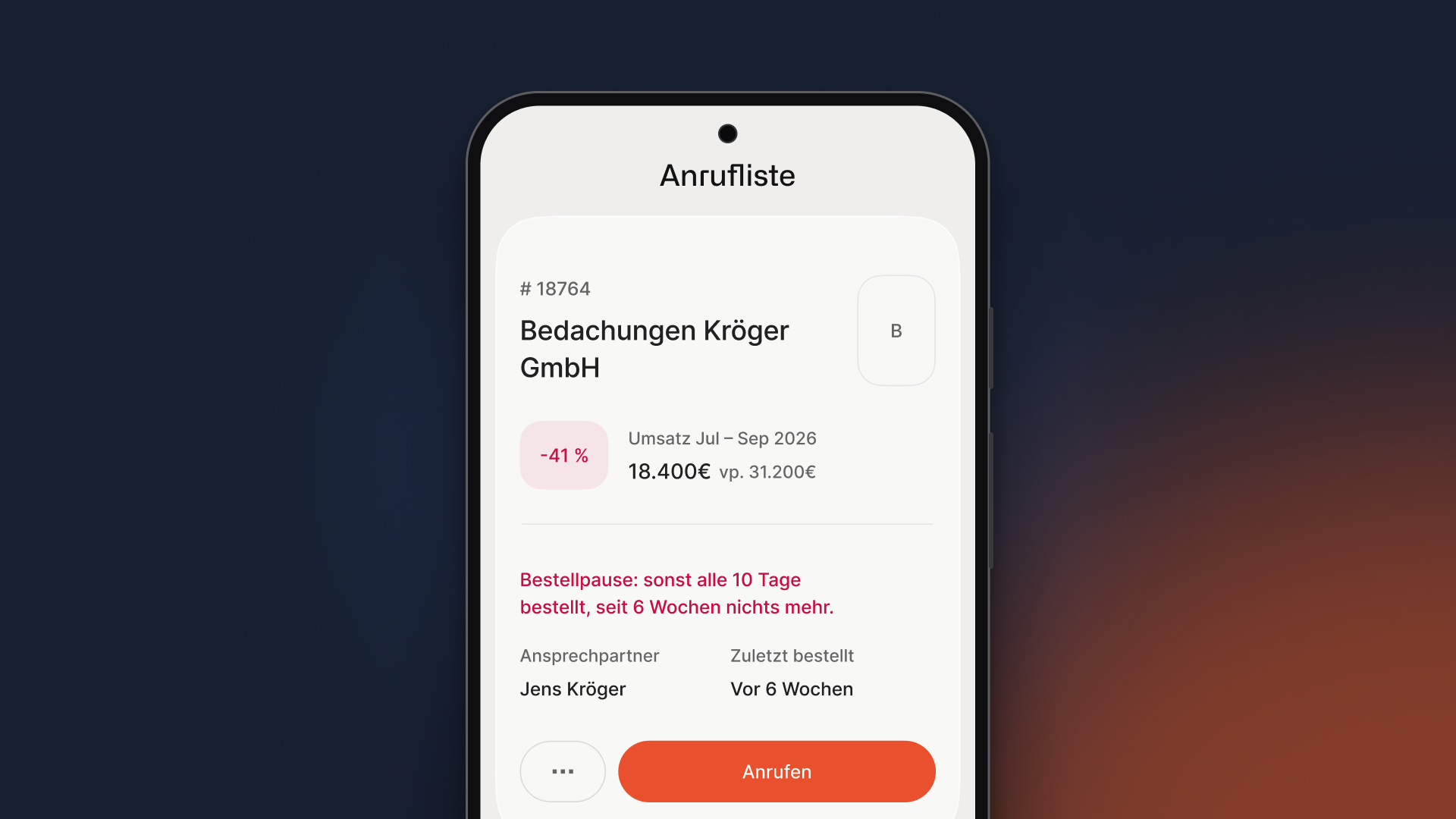
Example (demo data): a prompt based solely on order data shows a 41% revenue decline and a six-week ordering pause for sample customer Bedachungen Kröger GmbH.

How does handed-over knowledge reach day-to-day sales?
Handed-over knowledge sticks when it appears as a ready-made prompt where field sales already works: in the inbox, in the CRM and on the phone in the minutes before an appointment. A report the successor has to open and interpret themselves gets left aside in daily work.
Field reps are salespeople, not analysts. Between traffic jams and five appointments, nobody pores over reports, and nobody should have to. Every morning, a salesperson needs three answers:
- Who am I visiting today?
- What do I offer them?
- Where's the fire right now?
Sales software is bought in the office and used in the car, or not at all. The CRM only helps so much. It was built for new-business pipelines that run from interest to quote to close. In existing-customer business, it documents at most what someone entered, and it won't flag a due reorder on its own. We explain why that's the case in wholesale in Why a CRM isn't always the best choice in wholesale.
How much knowledge will once again live only in someone's head at the next handover depends on the follow-up after each visit: if the successor dictates their visit report in the car right after the appointment, tacit knowledge is captured for the next successor without any typing in the evening. Our article on visit reports by voice recording shows how that works.

Example: a field rep dictates their visit report after the appointment, which produces a report and follow-up tasks.
The real value, though, isn't faster onboarding. It's that decades of sales knowledge no longer vanish when a salesperson retires.
What does a solution for knowledge transfer in sales need to do?
A data-driven solution for knowledge transfer in wholesale's existing-customer business combines order data and tacit knowledge per customer and pushes the result to field sales automatically. Check software for this approach against these points:
- ERP data per customer: It analyses order rhythm, seasonality, repurchase intervals and the buying patterns of similar customers, including from in-house systems.
- Context without typing: It captures conversation notes and visit reports, ideally by voice.
- A prompt with a reason: It combines data and context into a recommendation that explains why in one sentence.
- Push, not pull: It reaches out to field sales instead of waiting for someone to check.
- Where the work happens: It runs in Outlook, in the CRM or on mobile, with no extra login.
- From day one: The successor takes over all of their predecessor's data, notes and prompts.
- ERP left untouched: It reads data but writes nothing back to the ERP.

How Acto brings order data and tacit knowledge together for the successor
What matters for the successor is that order data and their predecessor's knowledge come together in a single prompt from day one. That's what Acto, our sales AI for wholesale, does:
- Data: Every night, Acto reads the ERP order data and identifies order rhythm, seasonality and repurchase intervals per customer.
- Context: Dictated visit reports are factored into how prompts are scored and explained.
- Daily work: Prompts appear in Outlook, as a sidebar in the CRM or in the app.
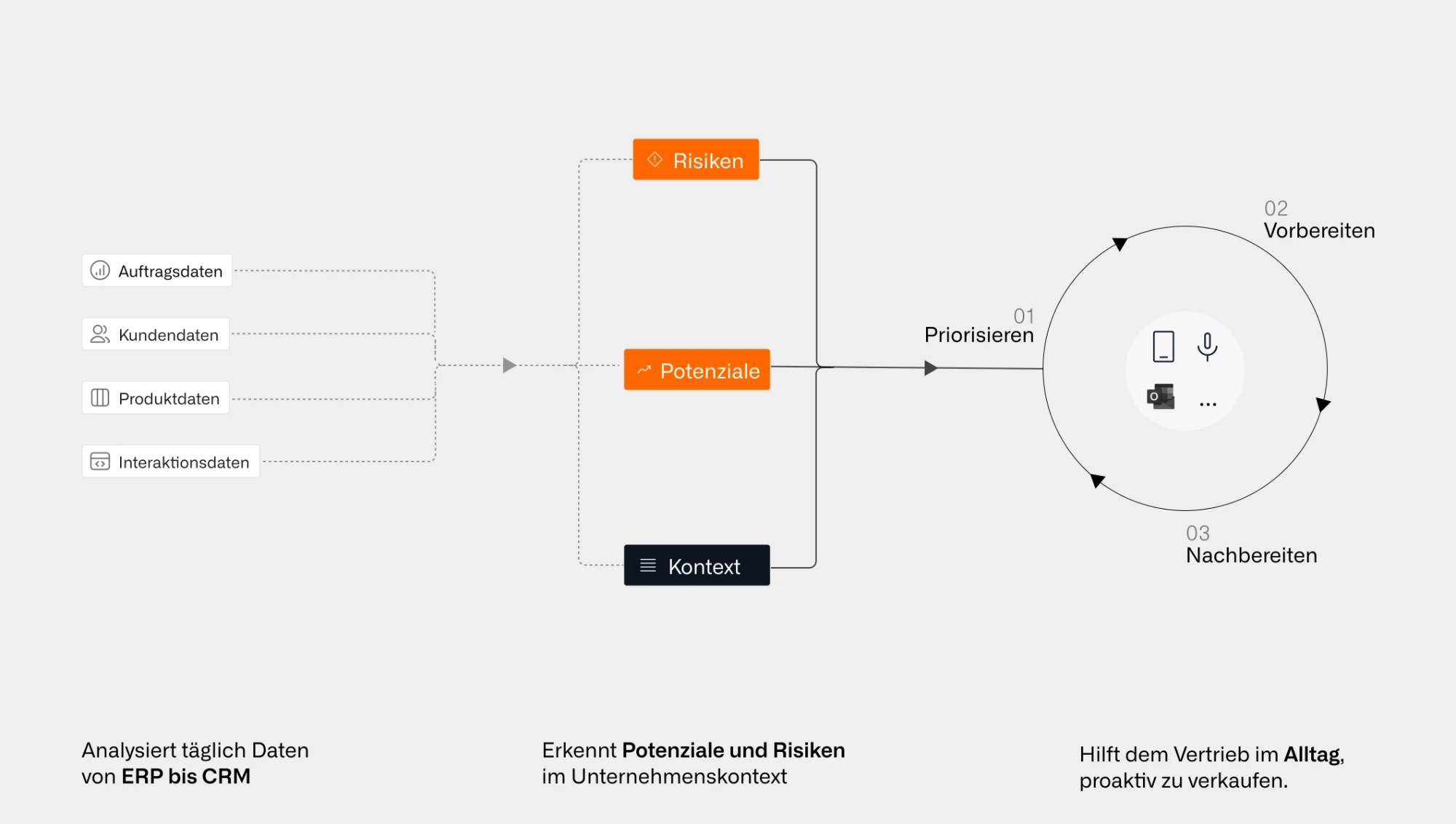
ERP and CRM data become risks, opportunities and context that sales uses to prioritise, prepare and follow up.
At Hitado in medical technology, onboarding new inside sales colleagues now takes one to two months instead of about a year, by the customer's own estimate.
Getting Acto fully live usually takes 4 to 6 weeks, depending on the system landscape, data quality and number of locations. It doesn't replace relationships, which is why joint visits remain, and in pure project business without reorders, the data foundation is missing.
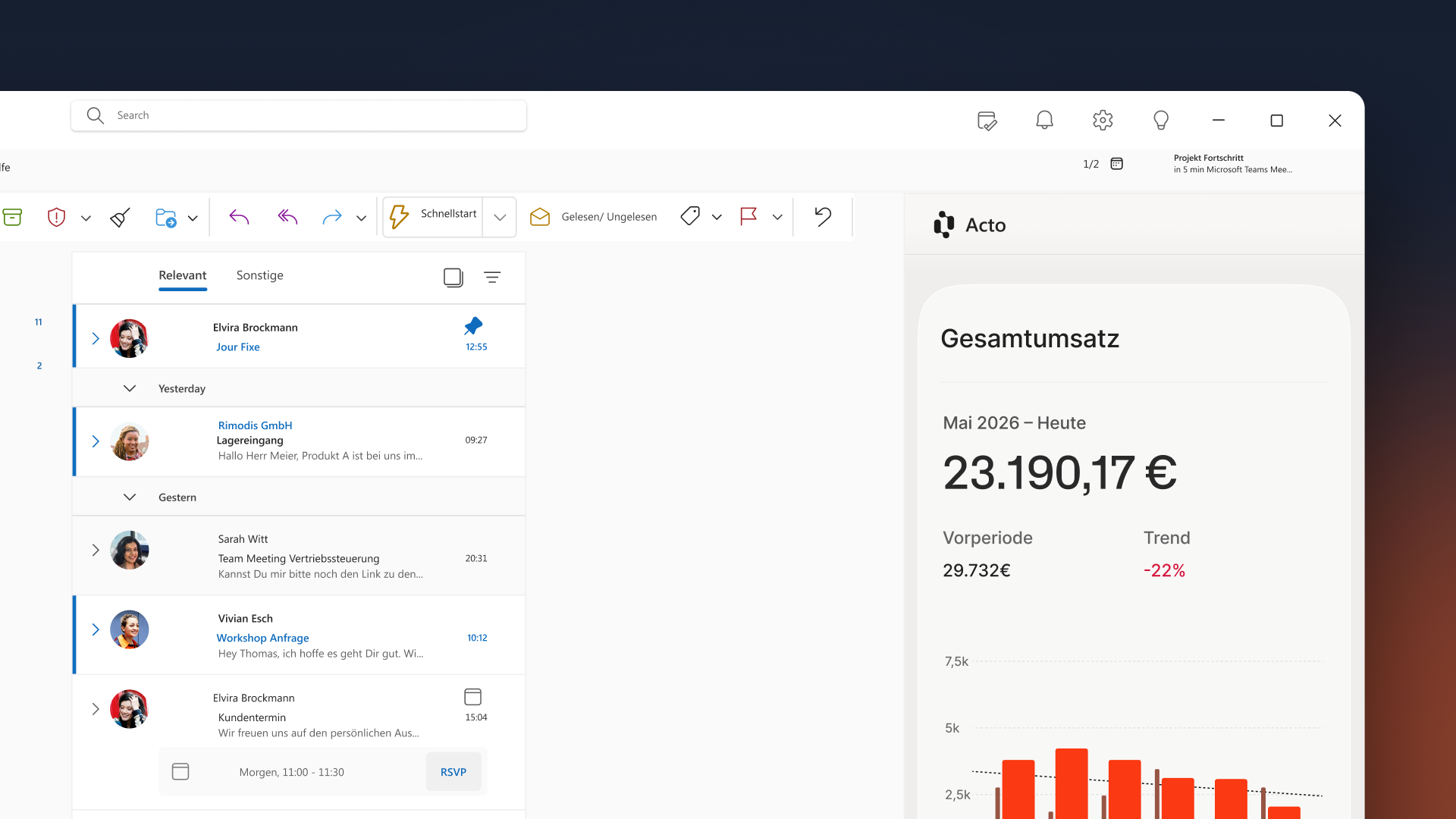
The Acto sidebar in Outlook shows total revenue, prior period and trend next to the prioritised email list (demo data).
This week, pull revenue per field rep from the ERP and flag who will leave in the next few years.
In a conversation, we'll show you which customer knowledge from your territory is already in your ERP data.