Skills for the Future of Field Sales: What the Studies Show and What Follows

Summary
- The studies put human skills first: understanding customers, developing existing accounts, building trust and prioritizing well. Data and AI come on top as tools.
- The gap is widest for the most important skill. According to Mercuri International's report "The Future State of Sales Skills 2025", 88% of B2B sales professionals consider customer understanding and analytical thinking the most important capability, yet only 27% feel confident in it.
- Three trends are driving this: buyers prefer to handle routine purchases without a sales rep but want to check important decisions with one, growth comes from the existing customer base, and selling time is scarce.
- Compare target and actual skills before you train or hire, because the biggest gaps depend on customer knowledge that neither a course nor a new hire brings along.
Nearly nine in ten sales professionals name one capability as the most important, yet only just over one in four feel confident in it. That 88% vs. 27% gap in customer understanding is the most striking finding in the Mercuri report, and it matters to anyone building a sales team for the years ahead.
What does the future of field sales look like? I discussed exactly this question with the Würth Group and Campus Founders at the IPAI center in Heilbronn. For a sales director filling open positions, it boils down to this: what skills does sales, and field sales in particular, need, and what does that mean for your own team?
The answer lies in the studies.
We analyze the Mercuri report, cross-check it against Gartner, Salesforce, McKinsey, LinkedIn and the Business Application Research Center (BARC), and derive five trends and their consequences.
What skills will field sales need in the future, according to the Mercuri report?
Customer understanding and analytical thinking come first, and strategically developing existing customers is also among the most important skills. Precisely the skills that require knowledge across many customers are the ones only a minority of respondents feel confident in.
Mercuri surveyed B2B sales professionals worldwide, not just field sales, so applying the findings to field sales is our interpretation. Does field sales still have a future? The studies shift its tasks; none of them questions its place.
The report and our comparison with the other studies yield five skills. The confidence figures are self-assessments: they show how confident sales professionals feel.
- Understanding customers and thinking analytically: 88% consider it the most important capability, 27% feel confident in it. In wholesale, that means knowing where each of well over a hundred existing customers currently stands.
- Strategically developing existing customers: 78% rank this skill as the fourth most important competency. In wholesale, that means winning a larger share of the total demand of a customer who already buys regularly.
- Building trust and advising: The other studies in particular emphasize this skill. In wholesale, that means being the person the customer calls before a major decision.
- Prioritizing well: Only 32% feel confident deciding which customers to focus their time on, and only 24% trust themselves to drop hopeless opportunities early. In wholesale, that means picking the right appointments for this week from a broad customer base.
- AI-assisted selling: Only 11% feel confident here. In wholesale, that means using data-driven insights in customer conversations.
There's little opportunity to close these gaps: sales professionals get only four training days a year on average.
Where is the gap between importance and self-assessment widest?
The widest gap is in customer understanding: 61 percentage points separate importance from perceived confidence. It is also the skill respondents rank first.
Behind this lies a pattern that runs through the entire report. Wherever a skill requires knowing about many customers at once (understanding, developing, prioritizing), only a minority feel confident. We explain why in the section on the data foundation.
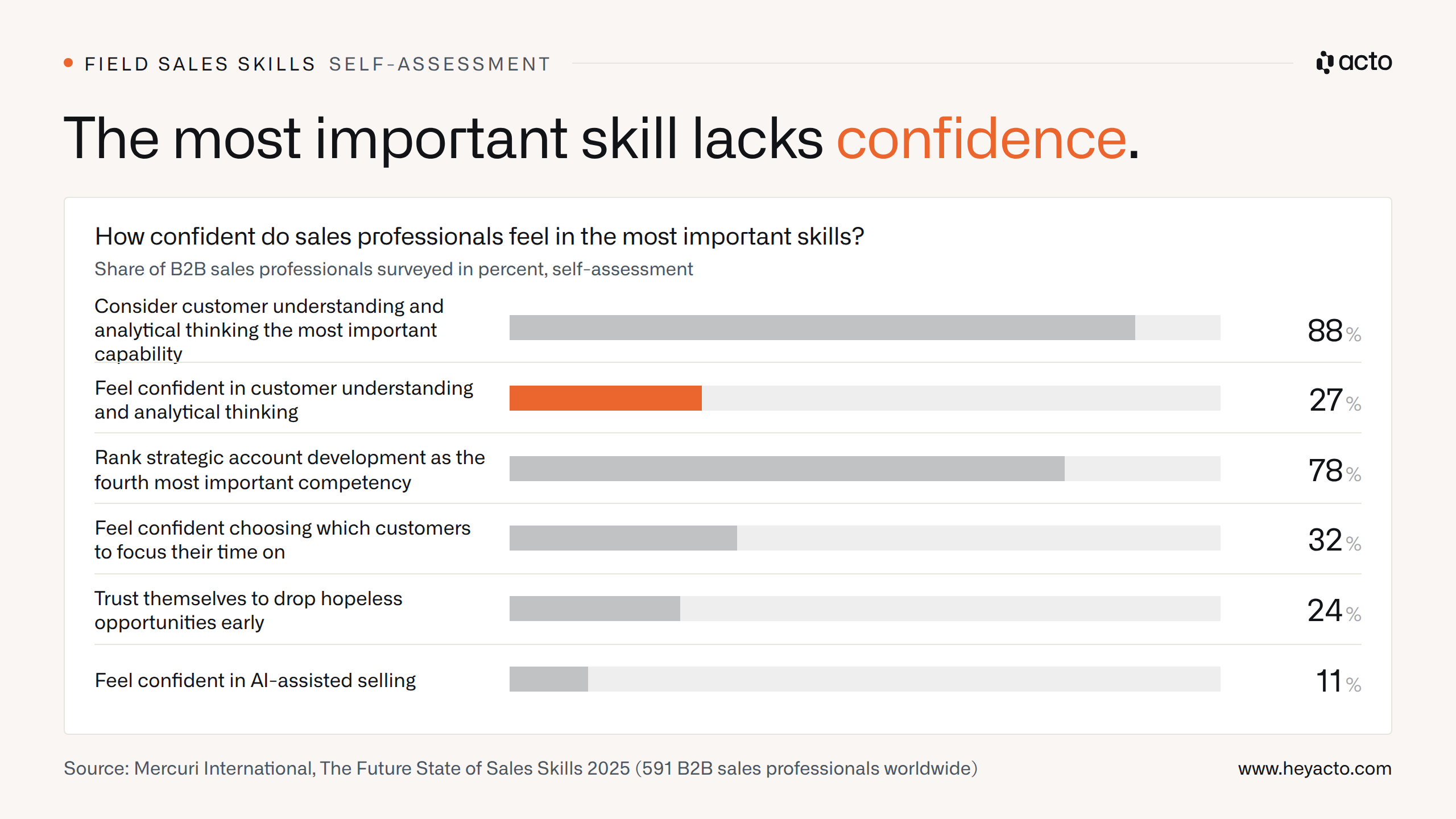
For every skill with a reported self-assessment, only a minority feel confident; the gap is widest for customer understanding.
What do other studies say about the sales skills of the future?
The other studies confirm Mercuri's direction but measure different things: buying behavior, time allocation, tool use or the link between a skill and quota attainment. Their figures therefore describe different sides of the same development and can't be directly compared.
The studies approach the topic from different angles:
- Gartner surveys sellers, sales leaders and buyers separately.
- Salesforce measures how much time goes into selling.
- McKinsey measures how B2B buyers buy.
- LinkedIn measures what sellers believe drives their success.
- BARC measures who works with business intelligence tools (BI tools) day to day.
| Publisher | Year | Sample | What is measured | Top skill or key finding |
|---|---|---|---|---|
| Mercuri International | 2025 (surveyed late 2024) | 591 B2B sales professionals worldwide | Importance and perceived confidence per skill | Customer understanding and analytical thinking ranked first (88% important, 27% confident) |
| Gartner, seller survey | 2024 | 1,026 B2B sellers | Link between skill and quota attainment | Likelihood of hitting quota: collaborating with AI (3.7x), tactical flexibility (3.4x), mentalizing (2.9x) |
| Gartner, CSO survey | 2026 | 227 chief sales officers | Division of labor between AI and sellers | Empathy, judgment, contextual understanding and value articulation stay with the seller |
| Gartner, buyer survey | 2026 | 645 B2B buyers | Buyer preference | 69% prefer to validate AI insights with a seller |
| LinkedIn Sales Solutions | not stated | Sellers in Europe | Self-reported success factors | Building trust as the most important factor in closing |
| Salesforce, State of Sales | 2026 | 4,050 sales professionals, 22 countries | Time allocation | 40% of working time goes into selling |
| McKinsey, B2B Pulse | 2026 | 3,664 respondents, 13 countries | Buying behavior and channels | Buyers use ten channels on average |
| BARC | 2022 | 214 companies | Use of BI tools | Around 25% of employees actively use them |
Where do Gartner, Salesforce, McKinsey and LinkedIn confirm the Mercuri report?
The studies back Mercuri on the weight of customer understanding and advice, and on how little time is left for actual selling. They reach the same picture by very different routes.
- Customer understanding: Gartner finds that sellers who infer a buyer's unspoken intentions and concerns (mentalizing) are 2.9 times more likely to hit quota. Gartner is measuring a statistical correlation, and it matches Mercuri's number one.
- Trust: In an older LinkedIn survey, 38% of sellers in Germany name trust as the most important factor in closing.
- Division of labor: In 2026, Gartner sees the seller's strength in empathy, judgment, contextual understanding and value articulation, precisely the human skills Mercuri ranks highest.
- Time: According to Salesforce, sellers spend only 40% of their working time selling on average. With so little time, you have to prioritize, and that's exactly where just under a third of Mercuri respondents feel confident.
Where do the studies diverge?
The studies diverge on the role of data, AI and tool proficiency. Gartner rates collaborating with AI as the strongest skill, Mercuri measures perceived confidence in AI-assisted selling, and BARC measures employees' use of BI tools.
The strongest counterpoint comes from Gartner itself: sellers who work closely with AI are 3.7 times more likely to hit quota. Nearly every guide to the future of field sales also treats digital competence as a must-have skill for the seller. On the other side, only 11% feel confident in AI-assisted selling, and according to BARC only around a quarter of employees actively use BI tools.
The same Gartner survey also shows the downside. 72% of sellers feel overwhelmed by the number of skills required, and overwhelmed sellers are 45% less likely to hit quota. So whether the answer is to pile yet another skill onto the seller remains an open question.
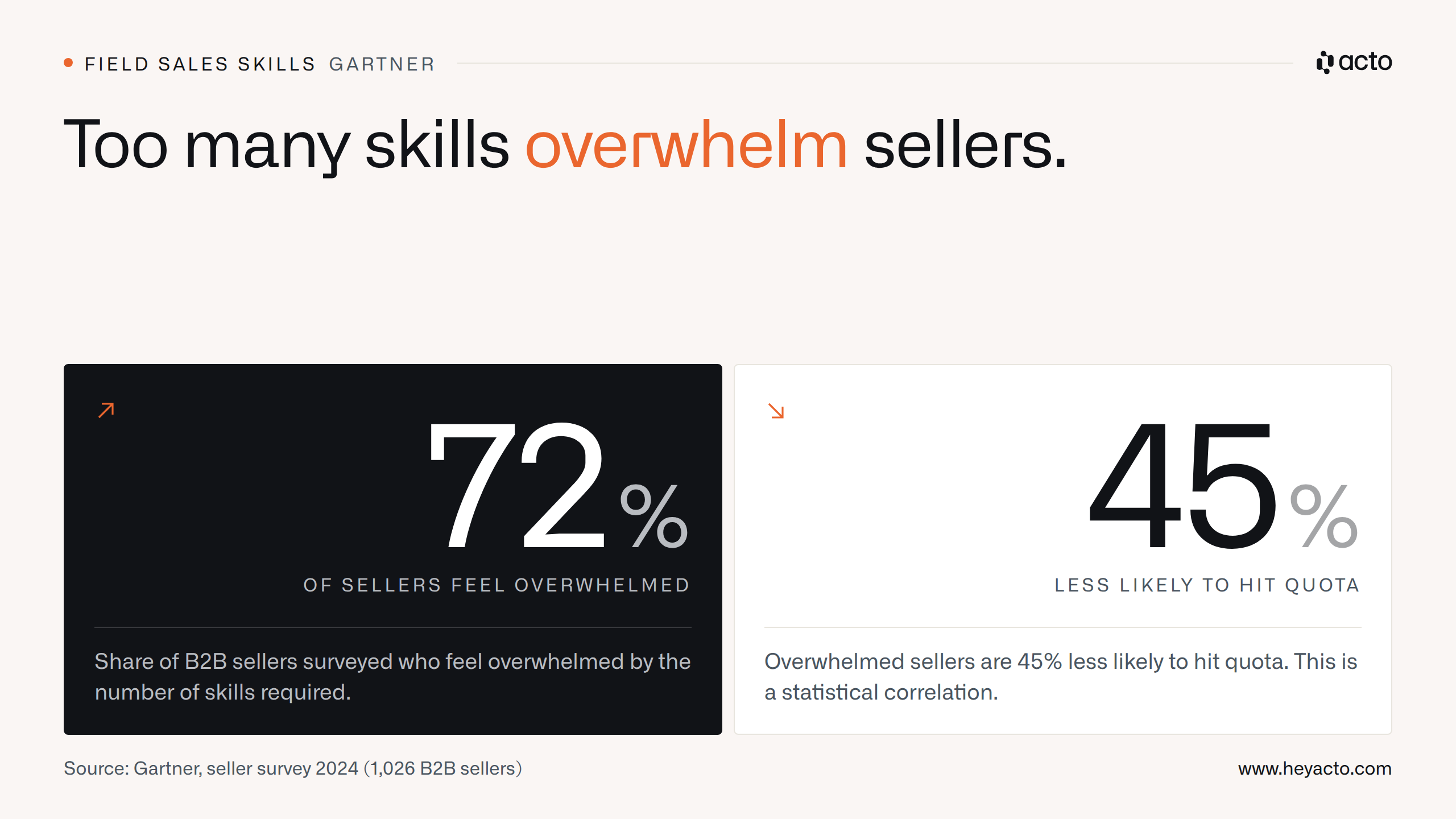
More skills alone aren't the answer: 72% of sellers feel overwhelmed by the number of skills, and overwhelmed sellers are 45% less likely to hit quota (Gartner, 2024).
One distinction helps when reading the figures, because each study measures something different:
- Mercuri: perceived confidence
- Gartner: a statistical correlation with quota attainment
- Salesforce: shares of time
The figures describe the same situation from three directions.
Which five trends are shaping the skills of future field sales?
Mercuri and the other studies point to five trends, each making one of the five skills more important. Together, they explain why human skills come first and why precisely these skills are rated so weakly.
1. Customer understanding becomes the most important competency
Customers come into conversations better informed than they used to. McKinsey counts ten channels on average used by B2B buyers. Whatever is in the catalog or the online shop, the customer already knows before the rep arrives.
So a rep only adds value by knowing the customer's situation:
- how their business is developing
- what projects are coming up
- what's on their mind right now
That calls for the skill of understanding customers, where Mercuri measures the widest gap and Gartner finds a clear link to success through mentalizing.
2. Growth comes from the existing customer base
More revenue has to come from customers who already buy: through a higher share of their total demand and through less churn. Mercuri describes the tension behind this: almost 80% stress the importance of strategic account development, yet many struggle with long-term planning.
Developing existing accounts means keeping two things in view:
- Share of total demand: How much of what a customer buys overall do they buy from you? The metric for this is share of wallet.
- Breadth of products purchased: Does the customer buy only a small slice of your range, even though similar customers buy more from you?
That calls for the skill of developing existing customers. It takes more than a good relationship: to grow your share of demand, you have to know how big that demand is.
3. Trust matters where customers order on their own
Routine purchases are moving to online shops and marketplaces, yet buyers still look for a human for important decisions. According to Gartner, 67% of B2B buyers prefer a rep-free buying experience, while in a second survey 69% prefer to validate AI-generated insights with a seller.
The two fit together: the seller loses the routine and gains the moments that matter. Gartner predicts that by 2030, three in four B2B buyers will prefer buying experiences that put humans ahead of AI.
"But you won't be able to do without personal contact in the future either."
– Ralph Weidling, Managing Director, WEICON
That calls for the skill of building trust. It's a genuine strength of the seller that no machine can take over.
4. Prioritizing becomes a core task
Selling time is scarce, and the number of customers per rep isn't going down. If you only have 40% of your time for selling and visit the wrong customers, you lose twice.
McKinsey has observed what this looks like: underperforming B2B sales teams sometimes spend more than half their time with customers who generate 20% of revenue at most.
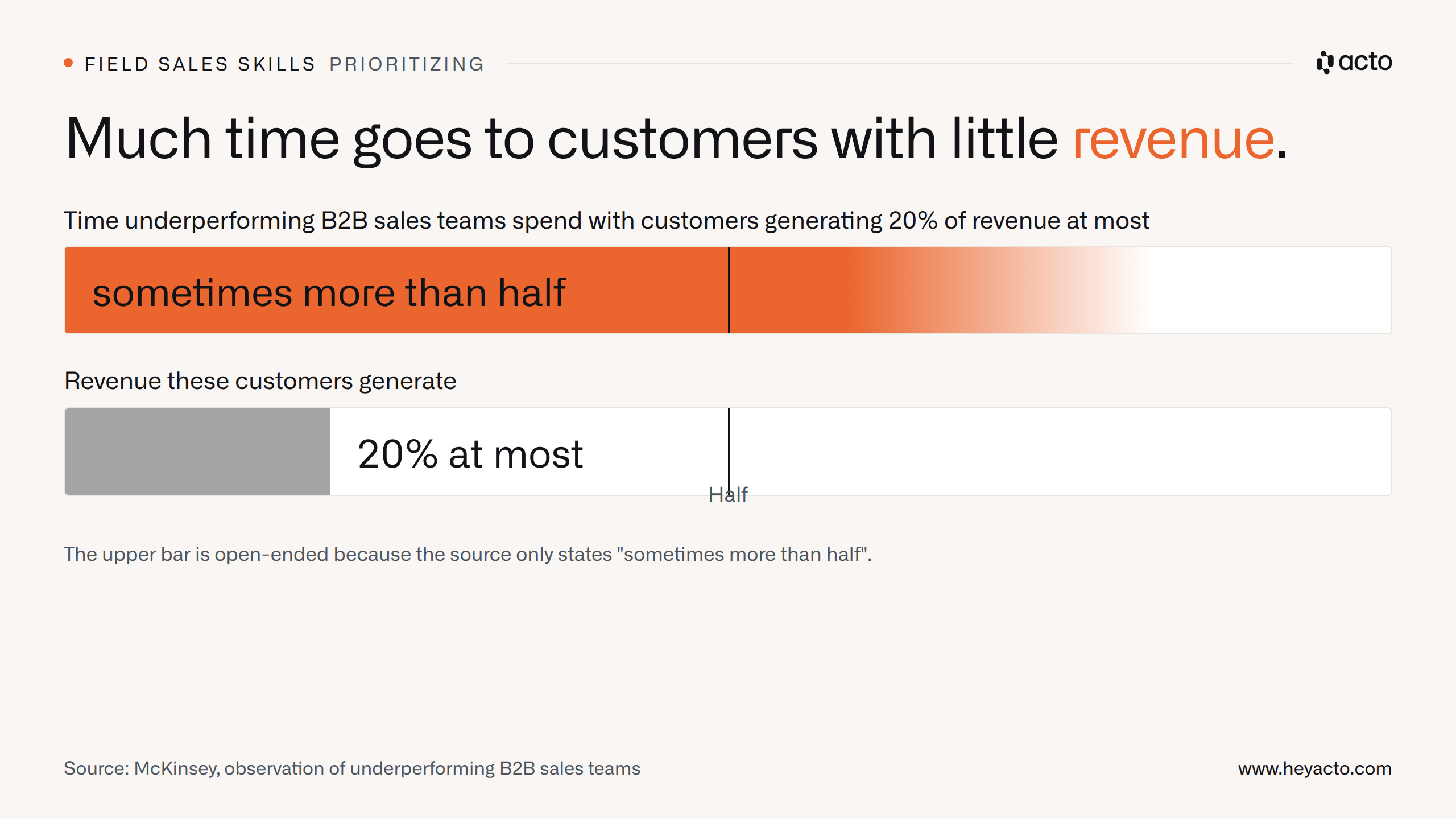
Underperforming B2B sales teams sometimes spend more than half their time with customers who generate 20% of revenue at most (source: McKinsey).
This is exactly the decision where 32% of Mercuri respondents feel confident, and only 24% trust themselves to drop hopeless opportunities early. That calls for the skill of prioritizing: putting time where the potential is and pulling it out where there's none left.
5. Data and AI become the seller's tools
AI and data tools are making their way into sales. According to BARC, around a quarter of employees actively use BI tools, and 11% feel confident in AI-assisted selling.
Will AI replace sales? Gartner describes a division of labor: AI takes over account research and signal monitoring, while the seller keeps empathy, judgment and context. A guest on our podcast describes the same shift from a practitioner's perspective.
"Field sales is changing in terms of what the job involves."
– André Buck, Berner (Revenue Signals, episode with André Buck)
Omnichannel, Pricing & vom Informationsvermittler zum Wertearchitekten
That calls for the skill of AI-assisted selling: using data-driven insights.
How do you compare your team's target and actual skills?
A matrix of the five skills shows you which capabilities your team lacks and what action follows. For each skill, record:
- how important it is for your business
- how strong it is in the team
- what follows from the gap
Only the gap tells you whether to develop, hire or build the foundation a skill needs in order to work.
Without this comparison, sales directors tend to hire the type they already have, because that person impresses in the interview. A guide to structured skill gap analysis describes how to systematically compare target and actual capabilities. Work through the comparison like this:
- Set the target: Use the five trends as a framework and weight which skills your business needs most urgently. A high share of revenue from existing customers points to skill 2; strong pressure from online ordering points to skill 3.
- Check the actual state: Assess the current level during joint customer visits, because the Mercuri figures show how far importance and perceived confidence drift apart. In our experience, ride-alongs are the most effective coaching method, and they cost nothing.
- Draw the consequences: Coaching closes a gap in individual people; the next hire with exactly that focus closes a gap across the whole team. If a gap affects everyone and depends on knowledge across many customers, neither training nor hiring alone will help.
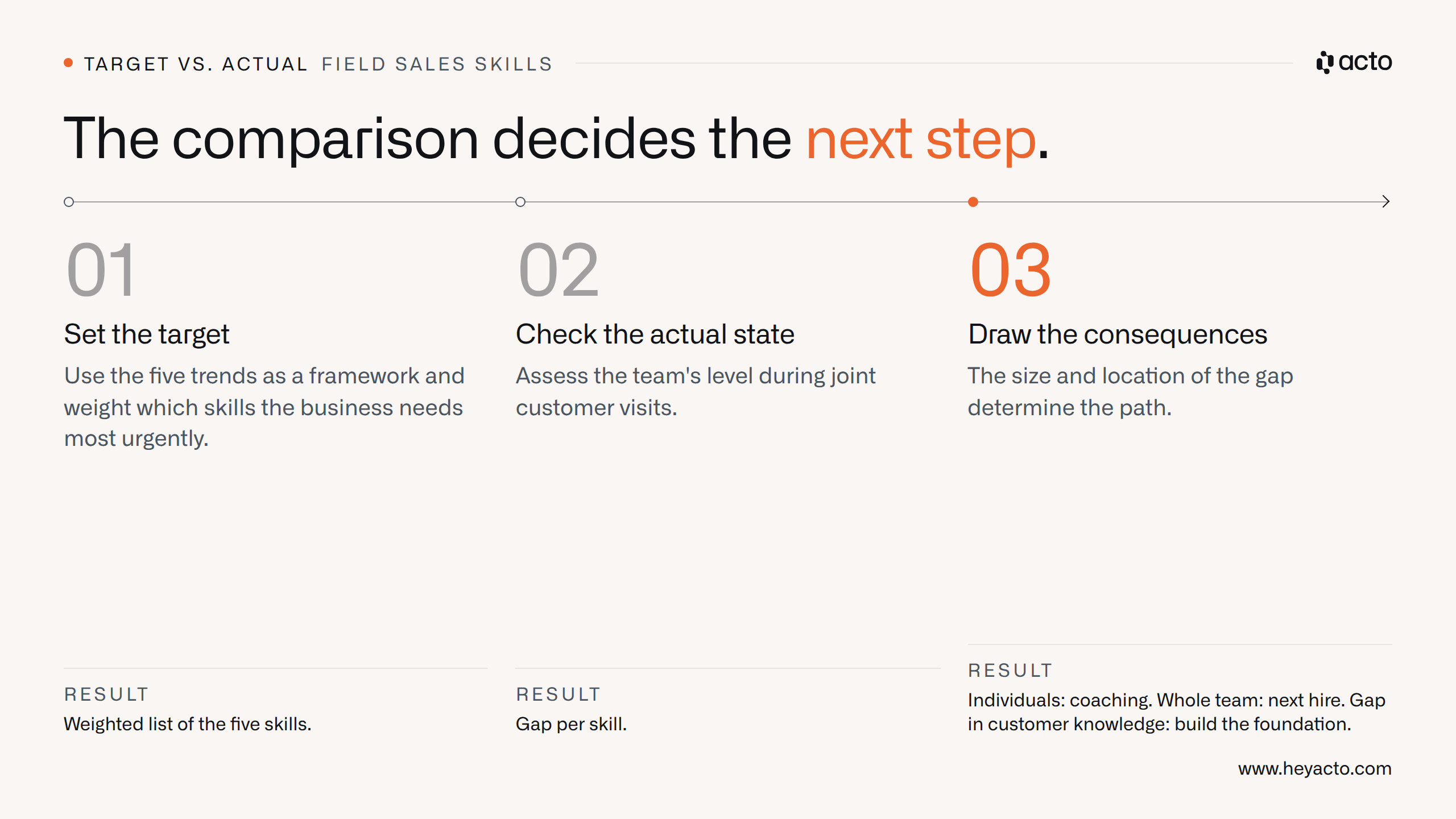
Only the comparison shows whether coaching, hiring or a new foundation is needed.
Example: A team of six field sales reps, rated on a scale of 1 to 5.
| Skill | Target for the business | Actual in the team | Gap | Consequence |
|---|---|---|---|---|
| 1. Understanding customers | 5 | 3 | 2 | Build the foundation, require preparation |
| 2. Developing existing customers | 5 | 2 | 3 | Build the foundation, focus of the next hire |
| 3. Building trust | 4 | 4 | 0 | Maintain |
| 4. Prioritizing | 5 | 2 | 3 | Build the foundation, focus of the next hire |
| 5. AI-assisted selling | 3 | 2 | 1 | Ready-made insights instead of own analyses |
The gaps total 9 points, 6 of them from skills 2 and 4 alone, while skill 3 sits at 0. Another strong relationship seller wouldn't close a single one of the 6 points that matter for this team.
For the next hire, that means:
- Test the skill with the widest gap using a case: Present an anonymized customer case and ask candidates to derive questions for the next appointment and a selection of customers for this week, because tool proficiency says nothing about whether someone understands customers.
- Describe tools in the job ad as something you use: Making analysis a core requirement scares off the very sellers you're looking for, because analysis isn't the core of the role.
- Build in a proper onboarding period, even for experienced people: Someone switching jobs brings sales experience, but no knowledge of your customers and your territory.
Our onboarding plan for new field sales reps shows how a new hire can gain this knowledge as quickly as possible.
Why is working with data the foundation for most of these skills?
Four of the five skills (understanding customers, developing existing customers, prioritizing, AI-assisted selling) require the rep to know the current situation of well over a hundred customers. Nobody does this data work on the side in their day-to-day job, which is why the most important skills remain the weakest.
Our study "Wholesale Sales 2026", based on data from 106 companies, shows how many customers that is: a field sales rep in wholesale handles 247 customers on average, with a median of 175. Purely on paper, with 247 customers a rep sees each one around four times a year. A person can really know a few dozen customers well; for the rest, gut feeling decides. That's simple arithmetic, not a failing on the part of field sales.
For customers someone knows well, gut feeling works. For everyone else, the foundation is missing, and it shows in the skill of understanding customers: in one in four conversations with wholesalers, field sales prepares visits barely or not at all. Preparation is revenue: if you know where a customer stands before the meeting, you ask concrete questions instead of making small talk.
The tools meant to close this gap barely reach field sales. In 49% of the conversations in our study, field sales uses the CRM barely or not at all; it is used well in only 8%.
The lever behind this is simple: revenue equals revenue per visit times number of visits. Prioritizing and preparing work on the first factor, and both need data.

Most guides to the future of field sales conclude that reps must master CRM, BI and AI themselves. We disagree: field sales reps are sellers, not analysts. I see it again and again: new reports and dashboards get added, and in the end the team still drives to wherever it hasn't been for a while, because nobody crunches data between traffic jams and back-to-back appointments.
If you want data-driven sales, outsource the data work and give field sales ready-made recommendations. Otherwise "data-driven" remains an empty phrase.
People don't need another dashboard. A seller needs three answers, not fifty reports:
- Who do I visit today? The customer with the greatest potential or the most acute risk, in other words prioritized by potential rather than gut feeling.
- What do I offer? What the customer needs and doesn't yet buy from you.
- Where's the fire? At the customer who is going quiet.
This also applies to competing with Amazon Business and other marketplaces. Wholesale wins there through the combination of personal relationships and knowledge of its own existing customers, and it can only play that card if field sales has time for the customer and knows what's coming up at the right moment.
What goes wrong in practice?
Skills get trained or hired without the foundation coming along. The typical mistakes all stem from the gap between importance and customer knowledge:
- Training without a foundation: Four training days a year won't close a gap that spans hundreds of customers, and even the best training in customer understanding fizzles out if nobody prepares the customer data afterwards.
- Reports instead of answers: Dashboards deliver metrics, but the rep still has to decide who to visit tomorrow, and in day-to-day work hardly anyone opens them.
- Visits by habit or a rigid schedule: Visiting every customer at fixed intervals is like refueling by the calendar instead of the fuel gauge. It's better to plan visits by need rather than a rigid schedule.
- Treating C customers as C customers: An ABC analysis sorts customers by revenue into classes A, B and C, with C being the lowest-revenue class. These C customers stay C customers if you treat them that way. Prioritize by potential instead, for example by share of total demand and breadth of range purchased.
- Confusing experience with territory knowledge: An experienced new hire can sell but doesn't know their customers' situation, and onboarding gets planned too tightly.
Run a self-test this week: take a field sales rep's customer list and have them mark the customers whose current situation they know without looking anything up, meaning revenue trend, open issues and the next reason to get in touch. All unmarked customers reveal the gap that neither training nor the next hire alone will close.
How Acto takes the data work off your field sales team
Acto, our sales AI for wholesale, handles the data work these skills require. Our AI software for field sales reads the ERP data every night and gives field sales ready-made insights on their existing customers each morning:
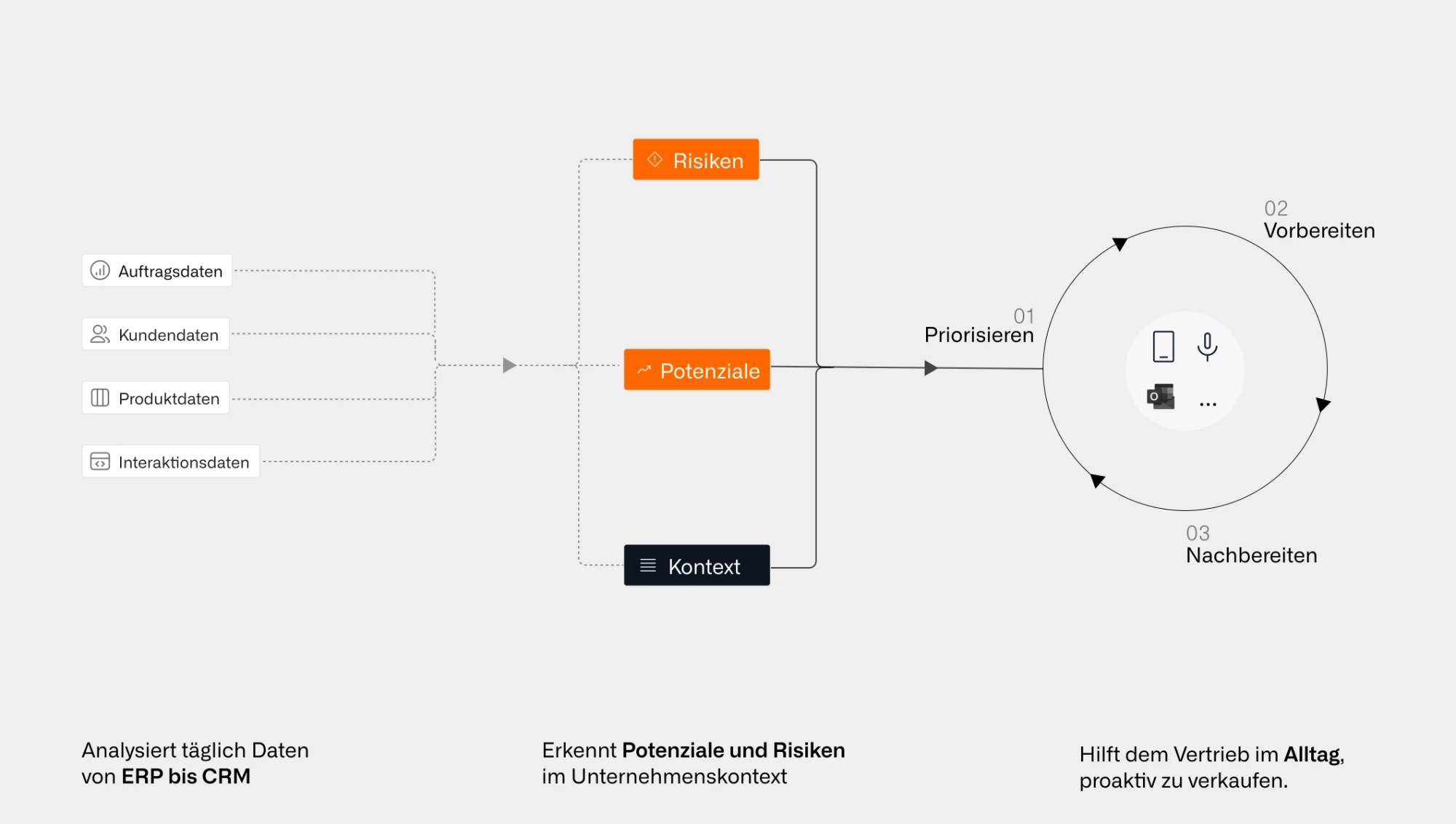
Order, customer, product and interaction data become insights for prioritizing, preparing and following up.
- Prioritize customers: which customers show potential or churn risk today, with the reasoning, such as an overdue reorder or a product group that's dropping off
- Prepare appointments: risks, opportunities and customer history are ready in Outlook, the CRM or the app
- Retain context: the dictated visit report records what was discussed in the meeting, including for successors
The conversation and the trust stay with the seller. At Hitado, new sales colleagues get up to speed in one to two months instead of around a year, according to the company's own estimate.
In a call, we'll show you what ready-made insights on your existing customers look like using your own ERP data.