Field Sales Onboarding: A Ready-to-Use Onboarding Plan Template

Summary
- Expect it to take 3 to 5 years before a new rep knows their territory as well as an experienced colleague. The first twelve weeks decide how well they start, so they deserve a fixed plan.
- The plan has three phases, each with owners and a checkpoint, so you can see early on whether the onboarding is working.
- Knowledge that only the predecessor has gets handed over during joint customer visits. No system records who actually makes the decisions there.
- Order rhythm, seasonality and assortment gaps are already in the order history. Prepare it for the new rep so they start with customers where something is coming up right now.
The contract is signed, the start date is set, and the colleague whose territory the new hire is taking over leaves in a few months. From here on, every week counts: your new field sales rep needs to learn the territory fast, and customers shouldn't quietly order less in the meantime.
Most of the sales leaders we surveyed for our study "Sales in Wholesale Distribution 2026" estimate it takes 3 to 5 years before a new rep knows the territory as well as their predecessor. How well they start those years is decided in the first twelve weeks. Here's the plan for them, ready to copy and fill in.
What does an onboarding plan for new field sales reps look like?
An onboarding plan for new field sales reps splits the first twelve weeks into three phases: first the new rep gets up and running, then they take over customers together with their predecessor, and from week 7 they visit independently, based on need. Each phase has a clear owner and a clear way to measure progress.
Field sales onboarding means more than product training. The new rep takes over:
- the systems
- the assortment
- the territory
- above all, the existing customers they inherit there
The weeks are an example schedule. It shifts depending on the new rep's prior knowledge, the size of the territory, and how long the predecessor is still around.
| Phase | Weeks (example) | Goal | Tasks | Owner | How do you measure progress? | Name, date |
|---|---|---|---|---|---|---|
| 1. Settling in | 1 to 2 | Up and running in the territory | Access to ERP, CRM and app, basics of the main product groups, one day with inside sales, sort the customer list by current demand signals, schedule joint appointments with the predecessor | Sales manager, predecessor, inside sales | Access works, sorted customer list is ready, joint appointments are in the calendar | ____ |
| 2. Taking over | 3 to 6 | Hand over the predecessor's tacit knowledge at the customer | Joint visits to customers with signals and to the key accounts, handover checklist per customer, at least one ride-along with inside sales, gradually handing the conversation over to the new rep | Predecessor or mentor, new rep, inside sales | Checklists completed for these customers, first conversations led by the new rep | ____ |
| 3. Independent | 7 to 12 | Visit alone, based on need | Prepare every visit with specific questions from the order history, ride-along with the sales manager, weekly check-in, wrap-up review in week 12 | New rep, sales manager | Prepared visits and signals raised, sales targets only afterwards | ____ |
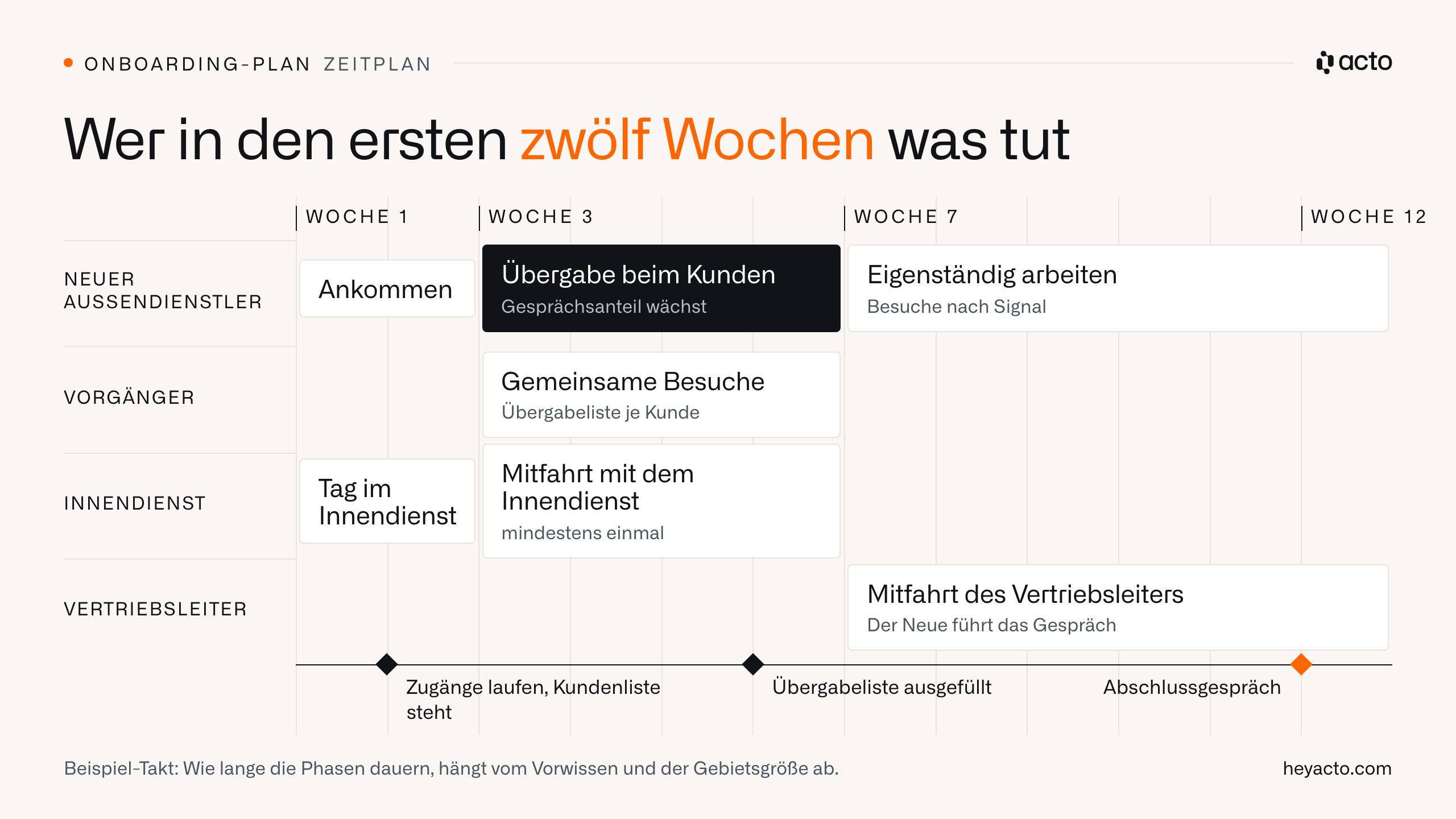
The ride-alongs are the fixed points of the plan; everything else is built around them.
Weeks 1 to 2: Where does the new rep start?
In the first two weeks, the new rep gets up and running before visiting customers alone. They get all their system access, learn the main product groups (in building materials, for example, drywall, insulation, tiles and waterproofing), and spend a day with the inside sales team that supports their territory by phone.
By the end of this phase, the territory's customer list is ready, sorted by what the order data currently shows. The joint visits with the predecessor are firmly booked in the calendar. Without a fixed date, they're the first thing to go once day-to-day business gets busy.
Weeks 3 to 6: How does the new rep take over their predecessor's customers?
The new rep takes over customers at the customer's site, in joint visits with the predecessor. That's where the two of them fill in the handover checklist from the next section, one customer at a time. If the predecessor has already left, inside sales and the sales manager take over the joint visits, and the new rep asks the customer directly for whatever is missing from the checklist.
At first, the predecessor leads the conversation. Over the course of this phase, that flips: the new rep talks, the predecessor listens and fills in the gaps afterwards in the car. This is known as reverse shadowing. The new rep records the outcome of each visit in a visit report, and our visit report template is there for exactly that.

In reverse shadowing, the lead in the conversation shifts from the predecessor to the new rep over the course of the handover.
Weeks 7 to 12: How do you know the new rep is ready to visit alone?
The new rep is ready to visit alone when they prepare every appointment with specific questions from the order history and actually ask those questions at the customer. In this phase, measure preparation and conversation quality; sales targets come only after the wrap-up review in week 12.
In the weekly check-in, go through these questions together:
- How many visits were prepared?
- Which demand signals were raised?
- What came out of them?
Ride along yourself at least once during this phase and let the new rep lead the conversation. For how to shift to sales metrics afterwards, see our field sales KPIs across three levels.
What belongs on the territory handover checklist?
The territory handover checklist captures the knowledge only the predecessor carries in their head, above all who really makes the decisions at the customer and what the customer uses the products for. It gets filled in at the customer, during joint visits, never at a desk by email.
The reason is simple. A rep who knows their customer builds trust, and no email can replace that. When the predecessor introduces the new rep in person, they pass on part of that trust. And in the same conversation, the customer shares things that would never end up on a handover list.
For each customer, the checklist records:
- Contacts and decision-makers: Who places the orders, and who actually decides? At a construction company, these are often not the same person.
- How the customer uses the products: What does the customer do with them? A drywall contractor on commercial projects needs different things from one renovating private homes.
- Context: Is a succession coming up? Is the customer planning a remodel, an expansion or a change of supplier?
- Open issues: Commitments, complaints and open quotes the new rep inherits.
- Relationship history: What went well, what's straining the relationship, what terms did the customer once negotiate and why?
- The one mistake: What would the new rep get wrong with this customer without the predecessor?
Afterwards, check any special terms promised verbally against the terms in the system. The predecessor's memory isn't yet a commitment from the company.
Why does inside sales come along too?
Inside sales comes along because afterwards two people know the customer: the field rep and the inside sales contact who supports them by phone. In our experience, visiting customers together is the most effective coaching method there is, and it costs nothing. It has the biggest impact when inside sales is part of it, and that's exactly what happens least often.
On the ride-along, the new rep learns who supports their customers by phone and how the two of them split the work. Inside sales sees how a customer makes decisions and then understands why field sales pushes so hard on delivery dates or samples.
That said, a ride-along without a purpose achieves little:
"As part of their onboarding, they also went out with the field sales rep and kind of wandered around aimlessly."
– from an initial conversation, specialist distributor with commercial project business
So give every ride-along a customer where something is coming up, and the goal of filling in that customer's checklist afterwards. You'll find more on the role of inside sales in our article on inside sales responsibilities.
What does the order history reveal about customers the new rep doesn't know yet?
The order history shows how a customer normally buys and where they deviate from that: order rhythm, seasonal patterns, overdue reorders, declining product groups and, compared with similar businesses, assortment gaps. That gives the new rep specific questions for the first appointment before they've ever met the customer.
The predecessor doesn't need to dictate any of this from memory, and it doesn't belong on the handover checklist. The limited time together is for tacit knowledge; the order history should be ready and prepared for the new rep. Only the two sources together make for a good question for the customer.

Only order patterns and personal context together produce a well-founded question for the customer.
Customer sheet from the order history
The new rep creates a customer sheet for every customer they visit in the first few weeks. Fill in the last column for one of your own customers.
| Characteristic | What the order history shows | Question for the visit | Customer notes |
|---|---|---|---|
| Order rhythm | Interval between orders, per item or product group | When does the customer usually need to restock? | |
| Seasonality and company holidays | Recurring breaks and peaks over the year | Is the current pause normal or new? | |
| Overdue reorder | An otherwise regular item whose usual interval has been clearly exceeded | "You usually order tile adhesive regularly. Is business slower right now, or are you buying it elsewhere?" | |
| Declining product group | A product group has been declining for months while total revenue looks stable | "You've hardly ordered any insulation lately. What's changed in your projects?" | |
| Assortment gap | Similar businesses buy a product group, this customer doesn't | "You don't currently buy the profiles for your boards from us. Where do they come from?" | |
| Known context | What the handover has already confirmed | Which anomaly is already explained, which is still open? |
An assortment gap is something to check in the conversation, not proof. The fact that similar businesses buy drywall profiles doesn't mean this customer needs them. For how to find the right comparison customers, see our article on white space analysis in wholesale.
An example from building materials: a tiler has ordered tile adhesive and grout every three weeks for years, and nothing has come in for five weeks. Total revenue still looks healthy because waterproofing and tools keep selling. That's exactly how churn begins, one product group at a time, and that's exactly where the new rep's first visit pays off.

In total revenue, the customer still looks healthy, but they haven't ordered two product groups for five weeks.
Which customers should the new rep start with?
We recommend scheduling the new rep's first visits where something is coming up right now. That means customers with:
- an overdue reorder
- a product group that's dropping off
- an open assortment gap
There, they have something concrete to raise at the first appointment, and they sell based on need from day one.
The usual approach looks different: the new rep introduces themselves to the biggest customers or works through the list on the old visit cycle. An introductory round with the A customers is part of it, no question. But planning purely by cycle means planning by experience, and that's exactly what the new rep lacks. Visiting on a fixed schedule is like refuelling by the calendar instead of the fuel gauge: the new rep is standing with a customer who doesn't need anything, while another hasn't ordered tile adhesive in weeks.

Planning by cycle means visiting in list order; planning by signal means starting where something is coming up.
How the selected appointments become a route is a separate question; see field sales route planning.
How does the new rep prepare a needs-based appointment from week 1?
The new rep combines an anomaly from the order history with what they know about the customer and turns it into an open question. In the first week, they do this with their mentor; later on their own. Good, specific questions don't just come to anyone; they come from preparation.
The process stays manageable:
- Check the trigger: Which reorder is missing, which product group is changing?
- Add context: Do company holidays, open deliveries or a known changeover explain the anomaly?
- Uncover the need: What does the customer need to confirm before a quote makes sense?
- Record the insight: Which answer changes the next contact?
With the tiler, the missing order becomes a question: are fewer jobs coming in right now, or is the adhesive now coming from somewhere else? That way the new rep opens with an observation, without accusing the customer of switching suppliers.
The new rep shouldn't have to pull this preparation from reports themselves. Field reps are salespeople, not analysts, and a new rep who spends the time between onboarding and first appointments digging through reports loses exactly the weeks in which they could be selling to existing customers. Doing the customer sheet by hand works for the ten or fifteen customers in the first few weeks, if someone in inside sales pulls the reports. For an entire territory, it doesn't.
Which territory handover mistakes cost you customers?
Customers are lost in a handover mainly when the tacit knowledge was never passed on at the customer, or when the new rep spends the first weeks with the wrong customers. These mistakes come up again and again, and each has a simple fix:
- Handover on the last working day: A customer list sent by email is no substitute for joint visits. Schedule the handover for weeks 3 to 6, while the predecessor is still there.
- "Just write everything down": The predecessor writes pages about customers whose data has long been in the ERP. Have them fill in only the checklist.
- Visits in alphabetical order or by cycle: Customers with urgent needs are left waiting. Start with customers showing signals.
- Inside sales is left out: They only hear about the change from the customer. Build in at least one joint ride-along.
- Sales targets before week 12: They push the new rep to close deals before they understand the customer. Measure preparation and signals raised first.

Where does the onboarding plan stop helping?
The plan stops helping where the sheer number of customers kicks in. Twelve weeks are enough to hand over tacit knowledge, but not for the 3 to 5 years it takes to know a territory fully. That only comes once the new rep can work with the knowledge buried in the order history.
Picture this: Mr Petersen has worked the territory for 30 years. He knows that at Heinrich, Ms Koch in purchasing makes the decisions, and that the dip at Siebert every September is normal. Even so, with so many customers and tens of thousands of items, things regularly slip through the cracks for him too. Next year he retires.
A field sales rep in wholesale looks after well over a hundred customers. One person can truly know maybe 30 to 50 of them; the rest runs on gut feeling. That's not a criticism of field sales, it's simple arithmetic, and it applies to Mr Petersen just as much as to his successor.
Handovers like this are becoming more common: 54% of the sales leaders in our study expect at least a quarter of their field sales team to retire in the next ten years.
"…we lose so much that's in somebody's head or on somebody's phone."
– from an initial conversation
The obvious response is to have everything written down before the experienced reps leave. That doesn't save the knowledge. What gets written down is mostly what's already in the data, and the writing eats up the time needed for joint visits. Much of this knowledge is already in the order data: Siebert's company holidays are in the order history, but with tens of thousands of items, no human picks that out.
A territory's customer knowledge can't be written down before retirement. The successor has to be able to work with the order history from day one.
The context from the handover still matters. Siebert hasn't ordered anything for three weeks: without context, that's a churn alarm; with the note about company holidays, it becomes a reminder for the week after. Data and tacit knowledge belong together.

How does a successor work with the order history from day one?
A successor works with the order history from day one when someone translates it for them every morning. That's what Acto does, our sales AI for wholesale: it reads the ERP data every night and gives the new rep ready-made recommendations each morning.
- Prioritise customers: overdue reorders, product groups dropping off and assortment gaps, each with the reasoning behind it
- Prepare appointments: risks, potential and history in Outlook, the CRM or the field sales app
- Keep the context: notes from the handover are taken into account, and recorded company holidays don't trigger an alarm
Hitado estimates that with Acto, new colleagues get up to speed on the customer base six times faster: around a year before, one to two months now.
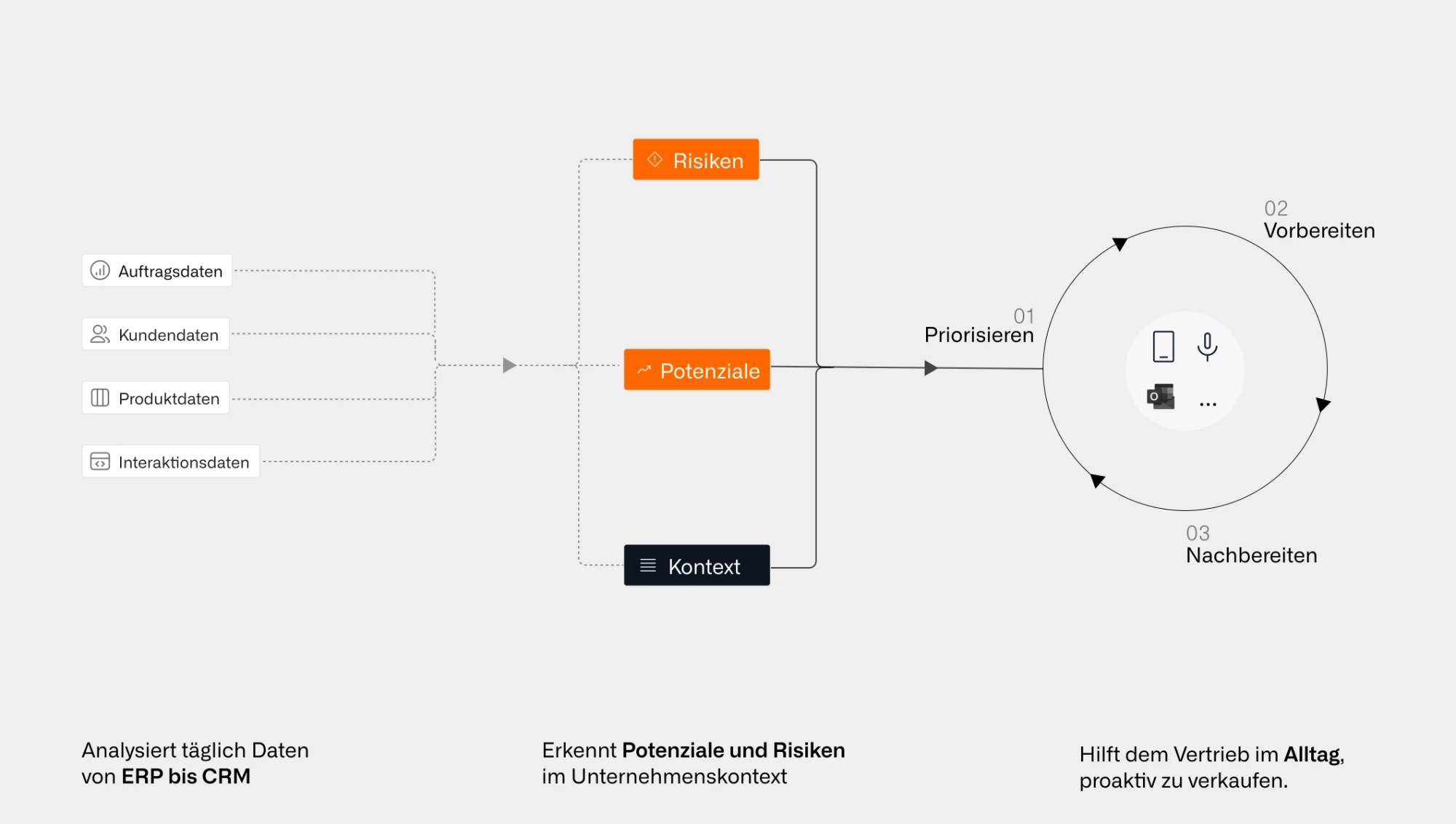
Order, customer, product and interaction data become recommendations for prioritising, preparing and following up.
In a call, we'll show you which customers a new field sales rep in your territory should visit first.