Potential-Based Sales: A Matrix Instead of Gut Feeling
Summary
- In potential-based sales, field sales allocates visits and attention according to the additional revenue a customer could generate. Current revenue, a fixed cycle or habit do not decide it.
- The method is a matrix of current revenue and potential. You derive potential from three variables: assortment breadth, order frequency and share of the customer's total demand.
- You start with the order data from your ERP and a rough estimate from field sales. You don't need an IT project for it.
- The approach works in the existing-customer business with many customers and a broad assortment. With few customers and no repeat purchases, it adds little.
Last updated: October 2026
The field sales rep sits in the car and decides whom to visit after the next appointment. The obvious choice is the customer where the order is certain.
A wholesale field sales rep looks after 247 customers on average, with a median of 175. That is shown by our study "Wholesale Sales 2026". It is based on data from 106 companies, drawn from our sales conversations and our own survey between 2024 and 2026. The same study counts around six visits a day (median from 42 responses).
Every visit is therefore a decision for one customer and against very many others. Anyone who makes it by current revenue or a fixed rhythm leaves revenue on the table that is already sitting in their own customer base.
What is potential-based sales and how does it work?
Potential-based sales manages customer care by the revenue potential of each customer. Who is served, when and how intensively depends on how much of that customer's demand you are not yet serving today. To do this, you place each customer in a matrix by current revenue and potential and distribute visits accordingly.
Definition: A customer's potential is their estimated total demand in your assortment minus the revenue they generate with you today. The share you already win is called share of wallet: spending with you divided by total spending in the category.
In wholesale, this gap is often large, because customer base and assortment are huge. An electrical installer buys cables from you, but switch ranges elsewhere. With thousands of items, the potential often lies in the product groups the customer never requests from you.
The method has three steps: you estimate potential per customer, place the customers in the matrix and then set visit frequency and form of care. How you quantify undiscovered growth opportunities per customer is the real work here.
How does this differ from ABC analysis, potential analysis and lead scoring?
ABC analysis, potential analysis and lead scoring assess current revenue, employee aptitude or prospects, not the additional revenue potential of your existing customers:
| Term | What it is about | Difference from potential-based sales |
|---|---|---|
| ABC analysis | Classification by current revenue | It says nothing about how much of the demand you already cover. |
| Potential analysis in sales | Usually the aptitude of sales staff | This is an HR topic, not about customers. |
| Customer segmentation | Groups by need | [Prioritization additionally assesses the expected value contribution](https://schmitz-wieseke.de/leistungen/betreuungsmodelle/kundensegmentierung). The two are combined. |
| Lead scoring | Assessment of prospects | Potential-based sales works with existing customers. |
| Route planning | Order of the visits | It does not clarify who should be visited in the first place. |
How does the current revenue–potential matrix work?
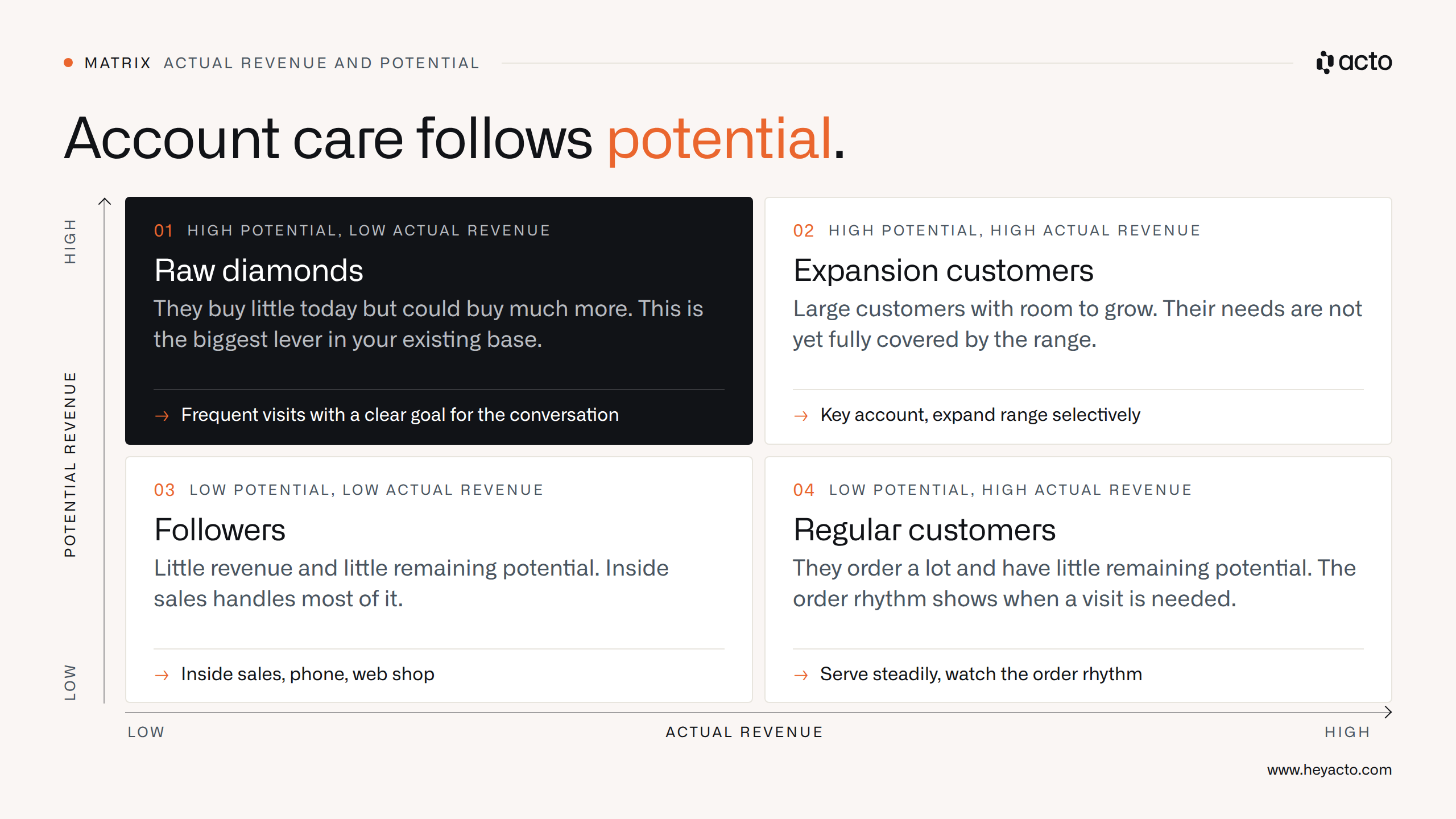
The matrix puts current revenue on one axis and potential on the other. This produces four customer types, each of which gets its own level of care. Most field sales time goes where high potential meets low current revenue.
| Customer type | Current revenue | Potential | Care |
|---|---|---|---|
| Rough diamonds | low | high | frequent visits with a clear conversation goal |
| Expansion customers | high | high | key account, expand assortment deliberately |
| Regular customers | high | low | serve steadily, watch order rhythm |
| Followers | low | low | inside sales, phone, web shop |
C customers stay C customers because they are treated that way. Anyone who segments by current revenue visits the customers who order anyway and overlooks those who could grow. One contact once worked it out for us simply: a customer with €500,000 in revenue who could do five million is 10% tapped. He is big, but poorly served.
At WIKA, even the choice of sales channel follows potential:
Sascha Niederhagen, EVP, WIKA, on the Revenue Signals podcast: "The more potential a customer has, the more direct sales or key account management we want to devote to them, so that we can understand the customer and place our solution as well as possible." (Revenue Signals, episode with Sascha Niederhagen)
The direction is also supported by a study (SMD) cited by the consultancy Prof. Schmitz & Wieseke. According to it, companies that cluster customers deliberately achieve 6.89% more revenue with existing customers. The page does not state sample or year. The matrix is an aid to prioritization, not a verdict on a customer.
Example (hypothetical): How do you calculate the potential of a wholesale customer?
You estimate total demand, subtract current revenue and compare the gaps. The following figures are invented and serve only as illustration; they come from no measurement.
| Painting business A | Roofing business B | |
|---|---|---|
| Current revenue per year | €10,000 | €200,000 |
| Estimated total demand | €50,000 | €220,000 |
| Share of wallet | 20% | just over 90% |
| Potential (gap) | €40,000 | €20,000 |
You derive A's demand from the three variables. Comparable painting businesses buy not only wall paint but also varnishes, masking material and tools, while A buys only wall paint. He also orders less often than similar businesses, and field sales knows he gets tools at the DIY store. A therefore comes before B on the visit list, although he generates only a twentieth of the revenue.
How do you recognize hidden potential in your existing base?
Hidden potential shows in deviations in buying behavior. These include assortment gaps compared with similar customers, growing intervals between orders and product groups that suddenly drop out. All these signals are in your order data. With hundreds of customers, though, nobody sees them by hand.
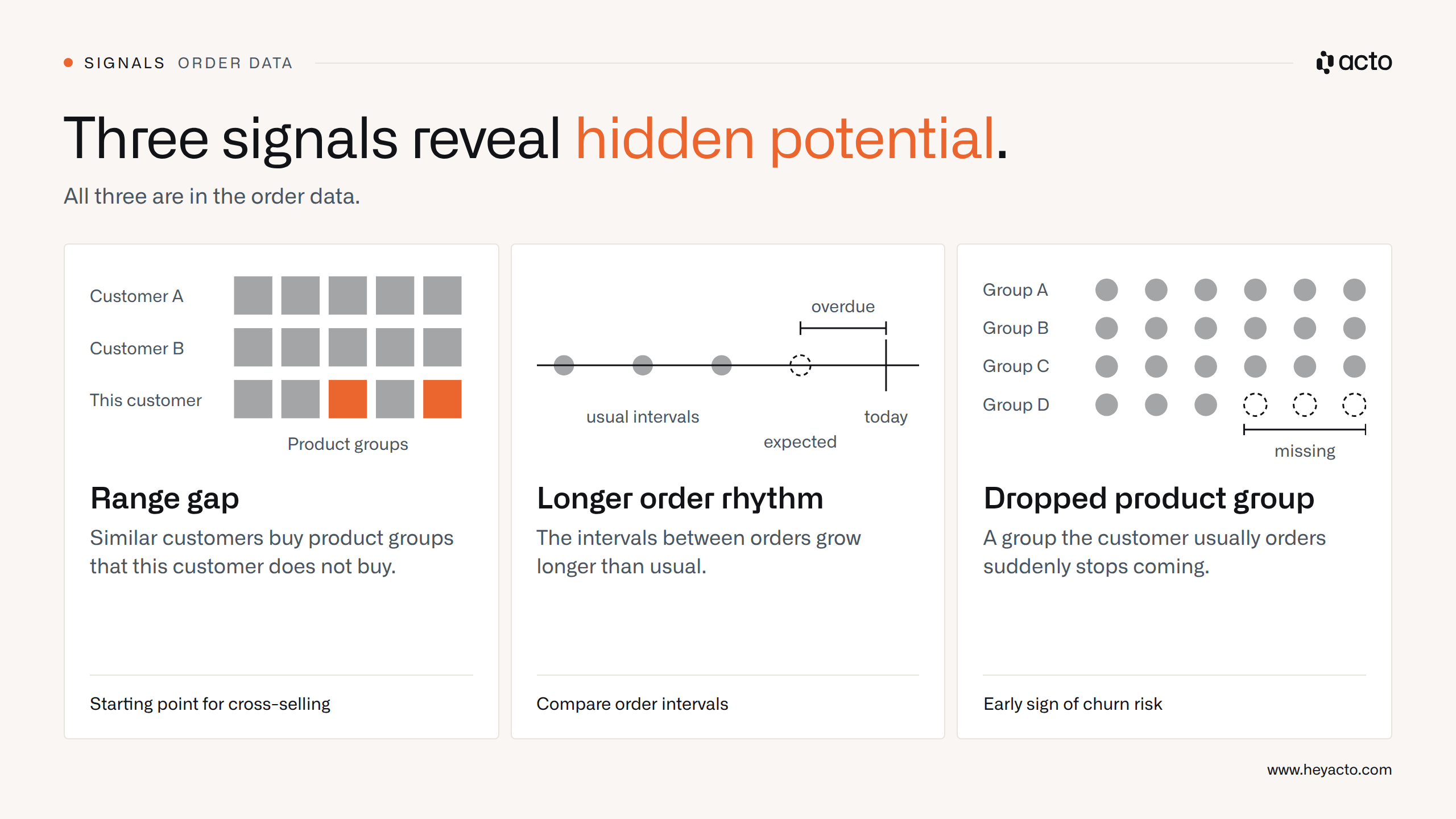
- Assortment gap: Customers of the same industry and size buy product groups that this customer does not. This is the basis for cross-selling in B2B sales.
- A longer order rhythm stands out when you compare the intervals between orders. An example: an item that otherwise comes every three months has not been reordered after four months.
- A product group dropping out is often the first sign for spotting churn risk early.
A signal does need context, though. Not every decline means churn:
"Suddenly this painting customer looks very negative in our system, because he no longer buys all those painting products he bought in previous years. But the customer isn't bad, he just buys other products."
(Sales manager, mid-sized building materials wholesaler, customer conversation)
In a weak market, the biggest lever lies in the existing base. The BGA climate indicator rose to 84.4 points at mid-2026 and thus stayed below the 100-point mark above which sentiment is no longer predominantly pessimistic. According to Harvard Business Review (Gallo, 2014), depending on the industry, acquiring a customer costs five to 25 times as much as retaining an existing one. You will find more methods under uncovering hidden customer potential.
How do you start without a big IT project, and where does the data come from?
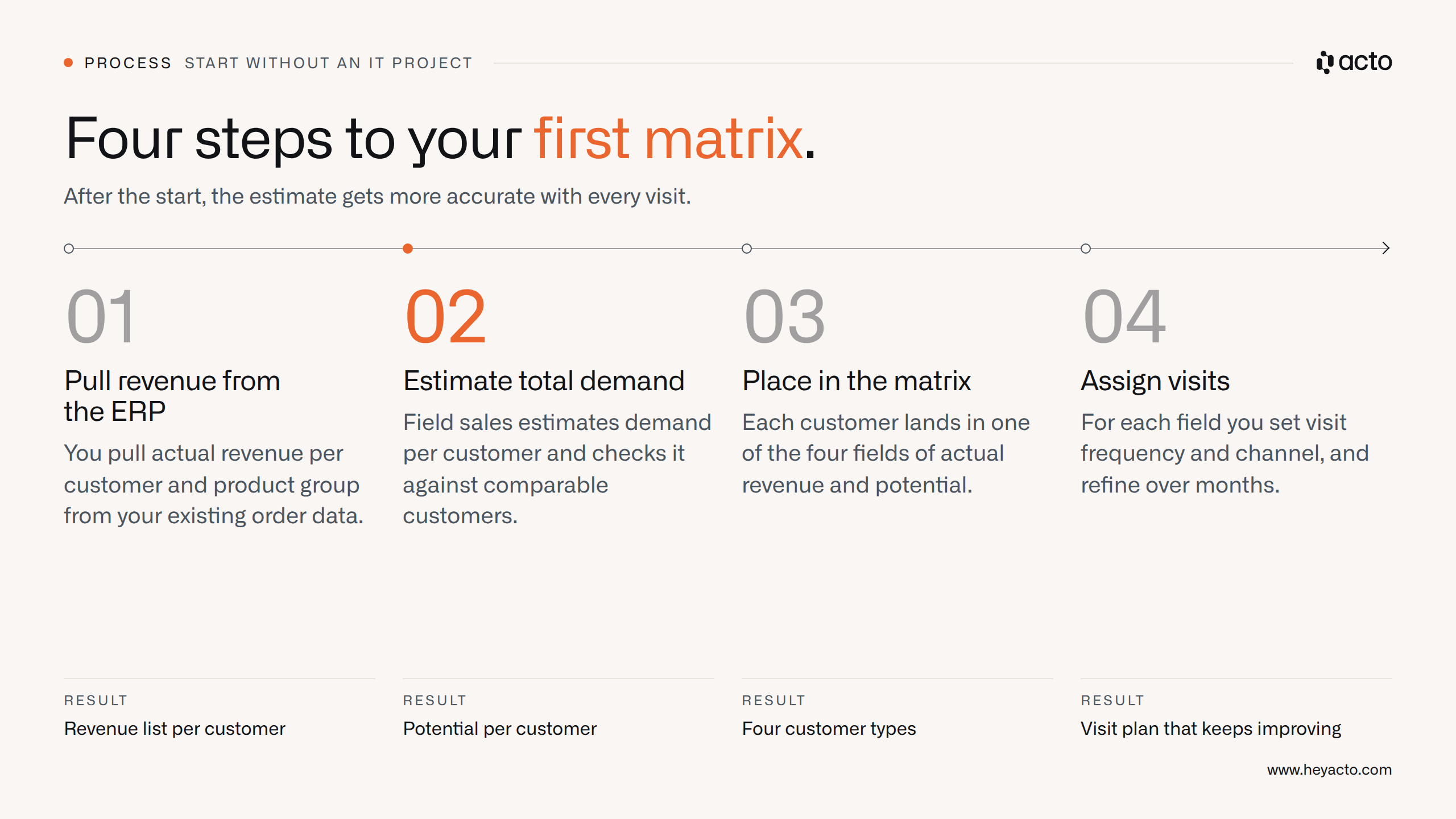
You start with the revenue and order data from your ERP and a rough potential estimate from field sales. You already have both today. Accuracy grows in the months after the start and does not need to be settled beforehand.
- Pull current revenue per customer and product group from the ERP.
- Have field sales estimate total demand per customer and check it against comparable customers.
- Assign each customer to one of the four fields of the matrix.
- Set visit frequency and channel for each field.
The estimate belongs in the hands of field sales. According to the same study, 73% of wholesale field sales reps have more than ten years of professional experience; in inside sales it is 43% (profile sample of 177 field sales reps, as of calendar week 40/2026, not representative). At WIKA, Sascha Niederhagen asks sales staff to estimate potential once, twice, three times a day. If everyone does this regularly, transparency about potential in the market emerges within a few months.
Sascha Niederhagen, EVP, WIKA, on the Revenue Signals podcast: "Don't make a science out of it. Start somewhere, even with a rule of thumb, and if it's wrong at the beginning, so be it, then we improve it over the months and years."
Potenzialbasierter Vertrieb, KI & warum Veränderung Halt braucht
A wholesaler we speak with shows where this can lead:
"For these customers and prospective customers we then also calculate product and product-group potentials, so that sales knows exactly: if this is a company of this size with the following activity, then it will have a demand of X."
(Sales management, wholesaler with over €200 million in revenue, customer conversation)
How do you get field sales to depart from the fixed tour?
Take the analysis off their hands. Field sales reps are sellers, not analysts. Between traffic jams and six appointments, nobody pores over reports. What field sales needs is a ready-made list of the customers with a need this week, each with the reason.
Also let the team help with the potential estimate. Whoever estimated the number themselves will also drive to the customer. Measure the changeover by two variables: revenue per visit and the number of visits.
What goes wrong in practice?
Implementation usually fails on process. The matrix itself is rarely the problem. In our conversations with sales managers, the same patterns keep appearing.
The most common: the route is planned before anyone clarifies who has a need at all. In the end, you visit the customers where the coffee tastes best. Yet neither customers nor market potential are evenly distributed geographically, and territories should be cut by revenue potential rather than by area.
"Route planning is based on geography, not on potential." – Pascal Salmen, Mitgründer & CEO (LinkedIn, translated from German)
Visits on a fixed weekly rhythm are expensive. In an interview with the Vertriebszeitung, an expert estimates the cost per visit at about €60 with high and €200 to €250 with low visit frequency. He does not state a survey methodology.
The second pattern: visits are counted, potential is not.
"Of course we chase them and track very strictly how many customers they have visited. That means the quality of the visits is not always what it could be."
(Sales operations lead, international wholesaler with 4,500 field sales reps, initial conversation)
Three more patterns come on top. Some teams turn the potential estimate into a science and never start. Others build dashboards without a recommendation that field sales never opens. And often the estimate is made once and never fed back into follow-up. Yet the loop only closes like this: prioritize, prepare, follow up, and prioritize again with what was learned.
What software supports potential-based sales planning, and what matters?
Software for potential-based sales planning must turn your existing data into ready-made recommendations and bring them to where field sales works. Another reporting tool doesn't help. Check vendors against these criteria:
| Criterion | How you recognize it |
|---|---|
| Uses existing data | Connection to ERP and CRM, the ERP stays unchanged |
| Derives potential per customer | Comparison with similar customers by assortment, frequency and share |
| Delivers recommendations | Answers on whom field sales visits, what it offers and where things are urgent |
| Is reachable in daily work | Runs in Outlook, in the CRM and on mobile, not as an additional program |
| Closes the loop | Follow-up flows back into prioritization |
| Knows wholesale | Takes into account assortment structures, customer groups and seasonality |
Not for you if:
- Your field sales looks after few customers and knows their potential anyway.
- Your revenue hardly comes from repeat purchases.
- You have no usable order and revenue data.
What does a day with Acto look like?
Acto is a sales AI for wholesale and turns your ERP and CRM data into daily recommendations for field sales. We are the provider of Acto. It replaces neither CRM nor ERP. Here is how a run of the method looks, in the order in which it happens.
First, the data is connected. It usually takes four to six weeks until the start, and the IT effort is two to three days. How long it takes in an individual case depends on system landscape, data quality and number of sites.
At the start of the week, field sales sees in the Outlook sidebar, in the CRM or in the app which customers show revenue potential or churn risk, each with a reason (signals directly in Outlook, CRM and mobile).
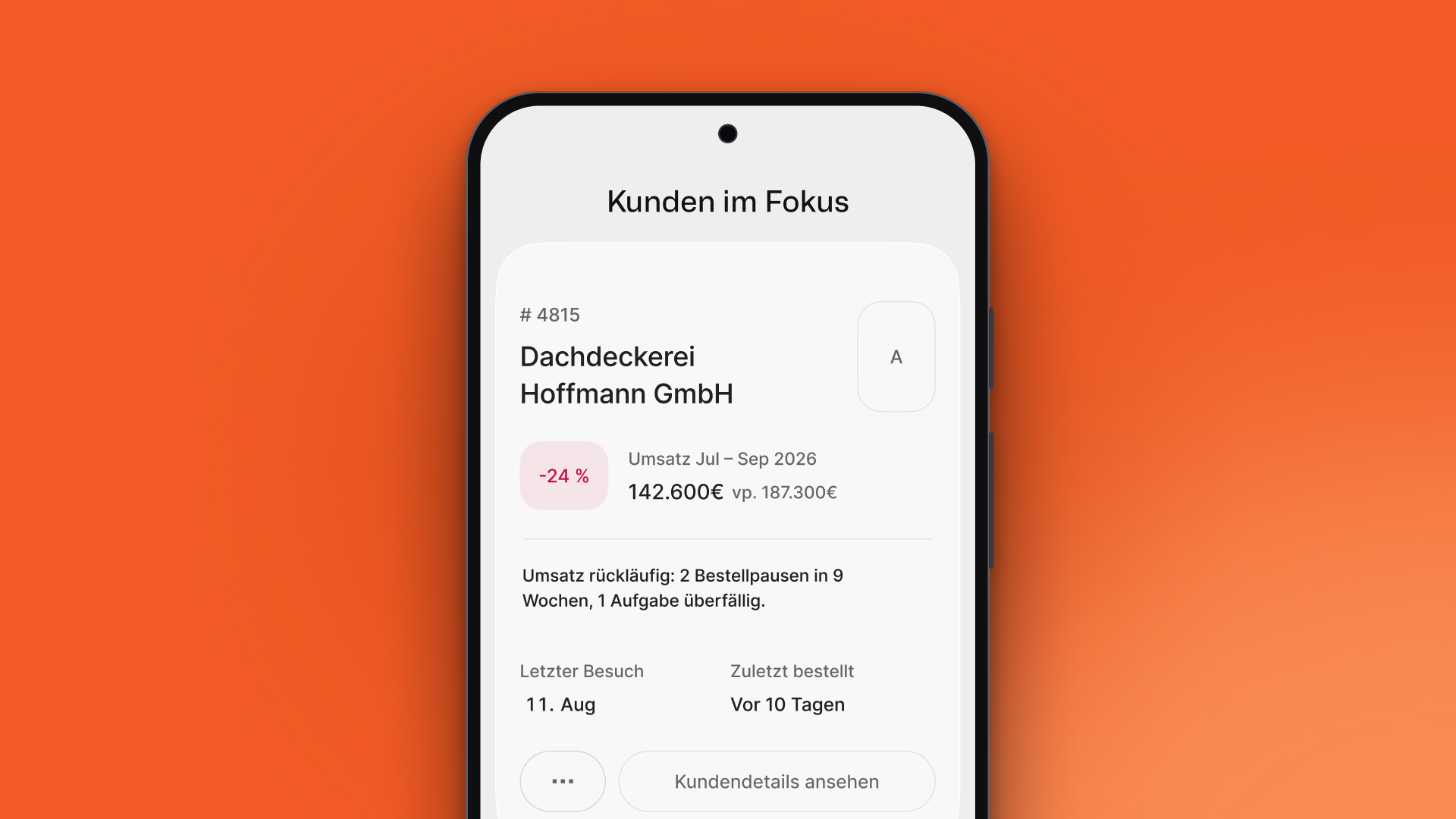
Before the appointment, Acto summarizes risks, opportunities and the customer's order history. After the appointment, the field sales rep speaks their notes in by voice call. From this come the CRM note and follow-up tasks, and both feed into the next prioritization.
In the pilot project at Böllhoff, Acto users generated 8.6% more revenue than non-users. At Plate, customers approached after an Acto notification bought 2.1 more products on average. Both are pilot and user results without a guarantee. How good the recommendations are depends on your data.
What first step can you take this week?
Pull a customer list with current revenue from the ERP, for example for the last twelve months. Have your field sales reps roughly estimate total demand for, say, their twenty largest and twenty smallest customers. A rule-of-thumb estimate is enough.
Calculate the share of wallet, enter the customers in the matrix and count how many of your visits last month went to rough diamonds. Schedule, for example, the first three of them for next week.
If you want to know which of your data is already sufficient today and where in your customer base most rough diamonds lie, we are happy to clarify this together with your own figures.
Frequently asked questions about potential-based sales
How do you define "high potential" when territories or countries differ greatly?
Set the thresholds per territory or country, not company-wide. A customer with high potential in South Africa looks different from one in Central Europe. Therefore compare customers only with similar customers in the same market.
What if no CRM is in use or the data is patchy?
To start, invoice and order data from the ERP are enough. Gaps are filled by field sales' assessment, which you record in a simple spreadsheet. A CRM makes follow-up easier but is not a prerequisite for the first matrix.
Will I lose my large customers if field sales visits less often?
Regular customers with little remaining potential need fewer visits, but not less attention. Watch their order rhythm closely and go there as soon as it changes. A fixed visit date without a reason does not protect them better.
What role does inside sales play?
Inside sales takes over a large share of the followers and responds to signals by phone. In our study, wholesale has around two field sales reps per inside sales rep, in electrical wholesale only 1.4 (sample of sales profiles, as of calendar week 40/2026, not representative). The stronger your inside sales staffing, the more customers it can take over.
How do the quarter's focus products get into prioritization?
Store them in the logic by which recommendations are generated instead of distributing them by email. Customers for whom a focus product fits then automatically get priority in daily work. This reaches field sales, inside sales and marketing alike.