Field Sales Visit Planning: From Fixed Cycles to Prioritization

Summary
- Field sales visit planning decides which customers are visited, when, how often and with what goal. It only makes sense when customers are first selected by need and the route is planned afterwards.
- In our study “Sales in Wholesale 2026” (186 sales conversations with wholesalers, 2024 to 2026, not representative), customer visits are planned by gut feeling or experience in 47% of conversations and with the CRM in only 8%.
- Fixed visit intervals per customer are too coarse for wholesale distributors, because every customer has their own repurchase intervals across thousands of items. Visits belong planned by signal: order pause, declining product group, open quote, assortment gap.
- Where the visit itself is the order intake, the fixed tour remains the right choice.
Last updated: October 2026
In one of our sales conversations, a contact explained how a visit week comes together at their company. It starts with classification. Every customer has a class, and the class determines how often it is visited.
Some customers are due twice a year and get mixed into a tour somewhere. Others are on the schedule every two weeks and form the backbone of every week. The system assembles tours from this until the target visits are reached, per customer and per employee.
The plan is built cleanly. Every customer gets their turn, and every field sales rep has a full week. But one question never comes up: which of these customers really needs a visit this week?
What is visit planning in field sales, and where does route planning end?
Visit planning in field sales determines which customers are visited, how often and with what goal. It is a selection among customers. Route planning comes only afterwards and merely puts the journeys in order.
Four terms often get thrown together. Each one governs something different:
| Term | What it governs | What it does not govern |
|---|---|---|
| Territory planning | Which customers belong to which field sales rep, often by postal code | Whom the rep visits this week |
| Visit planning | Which customer is visited when, how often and with what goal | The order of the trips |
| Route or tour planning | Order and routes of a single day | Whether a customer belongs in the tour at all |
| Visit report | What came out of the visit | Who is visited next |
A well-thought-out territory design improves market coverage and workload, but it says nothing about the individual week. ABC classification sorts customers by revenue, with A the highest-revenue class and C the lowest. It usually follows the Pareto principle and is an input to visit planning, not the planning itself.

How do wholesalers actually plan their customer visits?
Most often by gut feeling or experience. In our study "Sales in Wholesale 2026", customer visits are planned by gut feeling or experience in 47% of conversations and with the CRM in only 8%. We evaluated only the statements of our contacts; multiple answers were possible.
| How customer visits are planned | Share of conversations (n = 186) |
|---|---|
| Gut feeling / experience | 47% |
| ERP reports | 31% |
| Fixed cycle | 29% |
| Software / route planner | 17% |
| Excel lists | 12% |
| CRM | 8% |
So the purchase data sits in the ERP. Even so, planning is based on experience six times as often as on the CRM, and in 49% of the 182 conversations evaluated on this point, the CRM is barely used or not used at all in field sales. A sales trainer observes the same thing in ride-alongs: experienced employees tend to rely on their gut feeling rather than on well-thought-out tour planning.
That experience is often spot on. A head of sales put it this way:
"Salespeople often can't say why this customer is the right one, but most of the time they're right."
– Head of Sales, mid-sized manufacturer in occupational safety, initial conversation
The catch lies elsewhere. Knowledge that nobody can articulate can't be handed over either. According to the German Federal Employment Agency, it takes a median of 85 days to fill a position for wholesale and foreign trade clerks (summarized in our study Sales in Wholesale 2026). For that long, someone covers the territory without knowing their predecessor's reasons.
Why should visits be planned by signal instead of by date?
Because a calendar doesn't know which customer is currently ordering less, growing or waiting for a follow-up. Rigid intervals send field sales to the customer whose appointment is due, not to the one who needs a visit.
Time for this is scarce. By our calculation, a field sales rep in wholesale makes around 1,000 visits a year. With an average of 247 customers, the rep sees each of them about four times, according to our own calculation in our study based on 106 companies, 2024 to 2026. Based on our analysis using the German wage atlas (BA Entgeltatlas), 2026 social insurance and 2026 ADAC vehicle costs, each visit costs just under €100 on paper. We have worked through a breakdown of these costs separately.
Common guides take the opposite view. They recommend fixed rhythms by class, such as four to eight visits a year for A customers and one to three for B customers. For wholesale, that isn't differentiated enough. A wholesaler carries tens of thousands to hundreds of thousands of items, and every customer has their own repurchase interval for each item. A fixed rhythm per customer can't reflect that: it overlooks the B customer who hasn't ordered press fittings for six weeks and sends field sales to the A customer where nothing is pending.
In my work with wholesalers I keep seeing the same pattern, and I described it on LinkedIn: rigid 4-, 8- or 12-week intervals. The tour is full, but the team is rarely where revenue is currently being made or lost.
A signal is an event in the purchase data that justifies a visit. Four signals are enough to get started:
| Signal | How it shows up in the purchase data | What the visit clarifies |
|---|---|---|
| Order pause | The gap between two orders is longer than usual for that customer, for example four months instead of three for one item | Switch to a competitor, delivery problem, company holidays |
| Declining product group | A product group is falling when compared over one, three and six months, while total revenue still holds | Whether part of the range is migrating away |
| Open quote | Several product groups were quoted, but only part was ordered | What didn't fit for the rest |
| Range gap | Comparable businesses buy a product group, this customer doesn't | Whether there is a need there that someone else is covering |
Churn begins with missing reorders in individual product groups. If you only react when total revenue falls, you are too late.
How should you plan customer visits? Four steps
In four steps: collect signals from the purchase data, weigh them by potential, fill the week with signal customers first and plan the route last. Free slots go to the next-strongest signal, not to a due appointment.

Step 1: Pull signals from the ERP data
Once a week, the four signals per customer belong on a list. For a single territory, an ERP report and an Excel list will do. With hundreds of customers and thousands of items, nobody keeps that up, and nobody should expect field sales to: field sales reps are salespeople, not analysts.
Step 2: Weigh by potential
Not every signal is worth the same. Weighting is based on customer potential, meaning share of wallet and white spots, not on current revenue alone. C customers stay C customers as long as you treat them by what they buy today. A manufacturer of fastening technology describes where the lever in a visit lies:
"The lever, the revenue lever for field sales no longer lies in 20 more clamps sold, commodity business, but in convincing a plumber on technical grounds to switch to a Walraven system."
– Daniel Hesmer, Comm. Director, Walraven (Revenue Signals, episode with Daniel Hesmer)
Manufacturers & trade, 1:n relationships in sales and AI
Step 3: Fill the week with signal customers first
The weighted signal customers go into the weekly plan first. If slots remain, they go to the next-strongest signal in the ranking, not to the customer whose appointment would be due in the calendar. If you already have a potential matrix for your territory, use it here for the sequence.
"When we look at coverage, the question is: are we covering the market properly at all? Are we on site with the right customers?"
– André Buck, Berner (Revenue Signals, episode with André Buck)
Omnichannel, pricing & from information broker to value architect
Step 4: Field sales tour planning comes last
The signal customers are the anchors of every tour, and the remaining visits fall into place around them along the way. How to save travel time in the process is covered in our article on tour planning. Each visit also gets a goal derived from its signal, because in one in four conversations in our study, field sales barely prepares visits or doesn't prepare them at all. What the visit produced is recorded in a short visit report for the following week.
Example (hypothetical): A week in a building services territory
All figures are made up and serve only for the calculation. A territory has 180 customers, and 25 visit slots are free in the week.
| Group | Customers | What happens |
|---|---|---|
| Order pause, such as a plumbing business without press fittings for six weeks | 4 | Visit |
| Declining product group | 3 | Visit |
| Open quote, only partly ordered | 2 | Visit |
| Range gap with high potential | 3 | Visit |
| Weaker signals, by ranking | 13 | Visit along the route |
| No signal | 155 | Contact as needed by phone or email from inside sales, no visit |
All 25 appointments thus have a named reason. A successor can trace each of them without asking the predecessor.
What does software for sales visit planning need to do?
It must deliver the selection, not just the routes. Whether you start with an Excel list or are looking for a tool, check it against these points:
- It reads order and revenue data from the ERP regularly, without double entry.
- It detects order pauses and declining product groups per customer, not just total revenue.
- It justifies every recommendation in one sentence that field sales can verify.
- It leaves the final decision and the territory logic to field sales.
- It delivers conversation preparation where the team works: calendar, CRM or smartphone.
Not for you: when signal-based visit planning doesn't fit
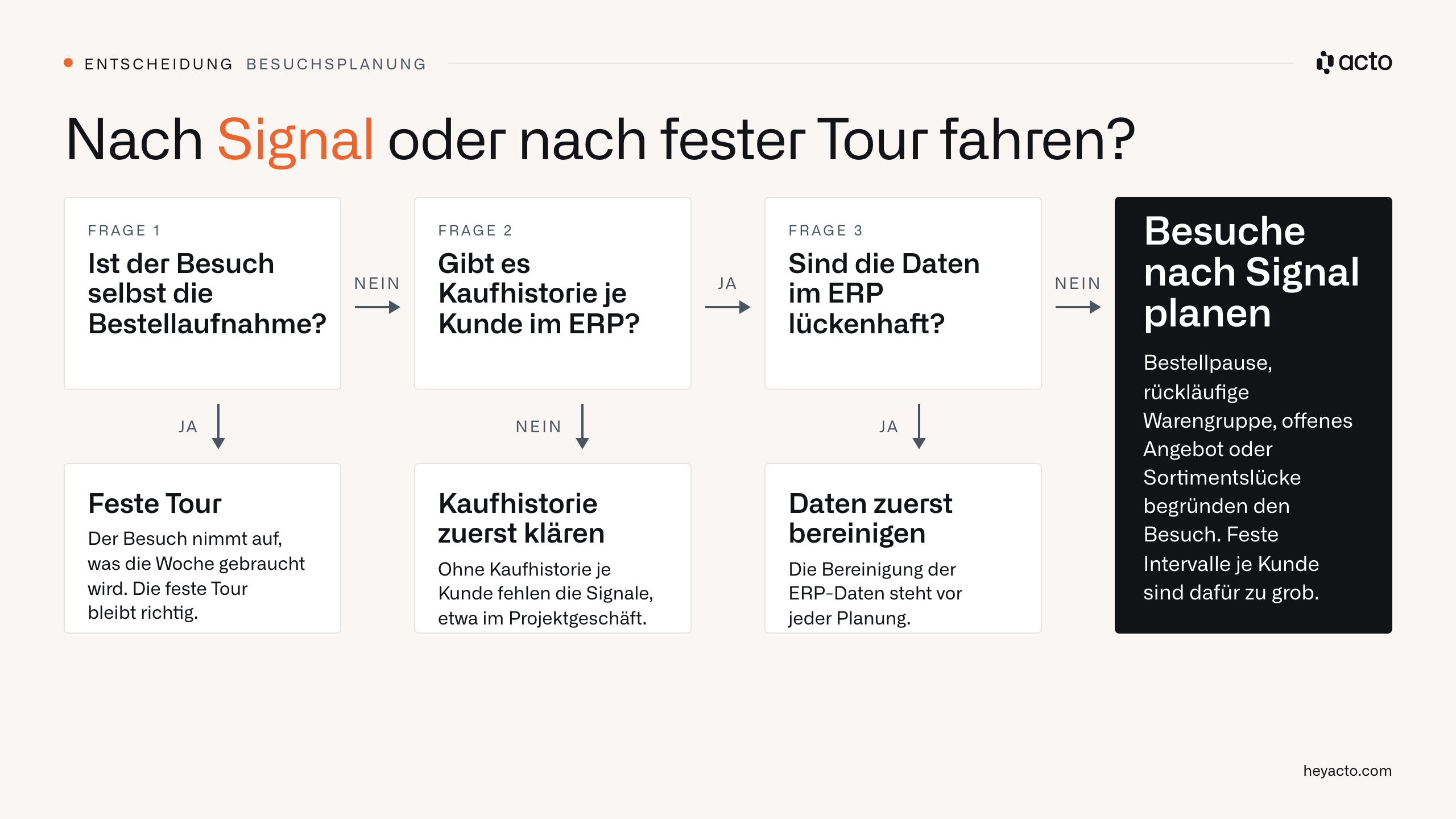
If the visit itself is the order intake, the fixed tour remains the right choice. A manufacturer for the butchery trade described this case to us:
"Our colleagues in field sales basically have a fixed tour that they've prepared and work through, where the individual butchers are visited and they take down what's needed again that week."
– Head of IT, mid-sized manufacturer of food ingredients, customer conversation
Without purchase history per customer, the signals are missing. That affects manufacturers that sell through specialist wholesalers and can't see the sell-out, and pure project business with planners and architects. If the data is in the ERP but incomplete, cleanup comes before any planning.
How to approach visit planning with Acto
Transparency: Acto is our own product. Acto is a sales AI for wholesale and takes steps 1 and 2 off your field sales team's plate. It reads the ERP and CRM data daily, detects order pauses, declining product groups, open quotes and range gaps, and every morning presents reasoned signals on which customers need a visit now. Which of them make it into the week and how the route runs is still decided by field sales. At Schäfer Shop, the revenue of Acto users rose by 11.2% in the pilot project with a control group, and the sales team there marks 92% of the proposed signals as helpful. Acto replaces neither the CRM nor the route planner and runs in Outlook, in the CRM or on the smartphone.
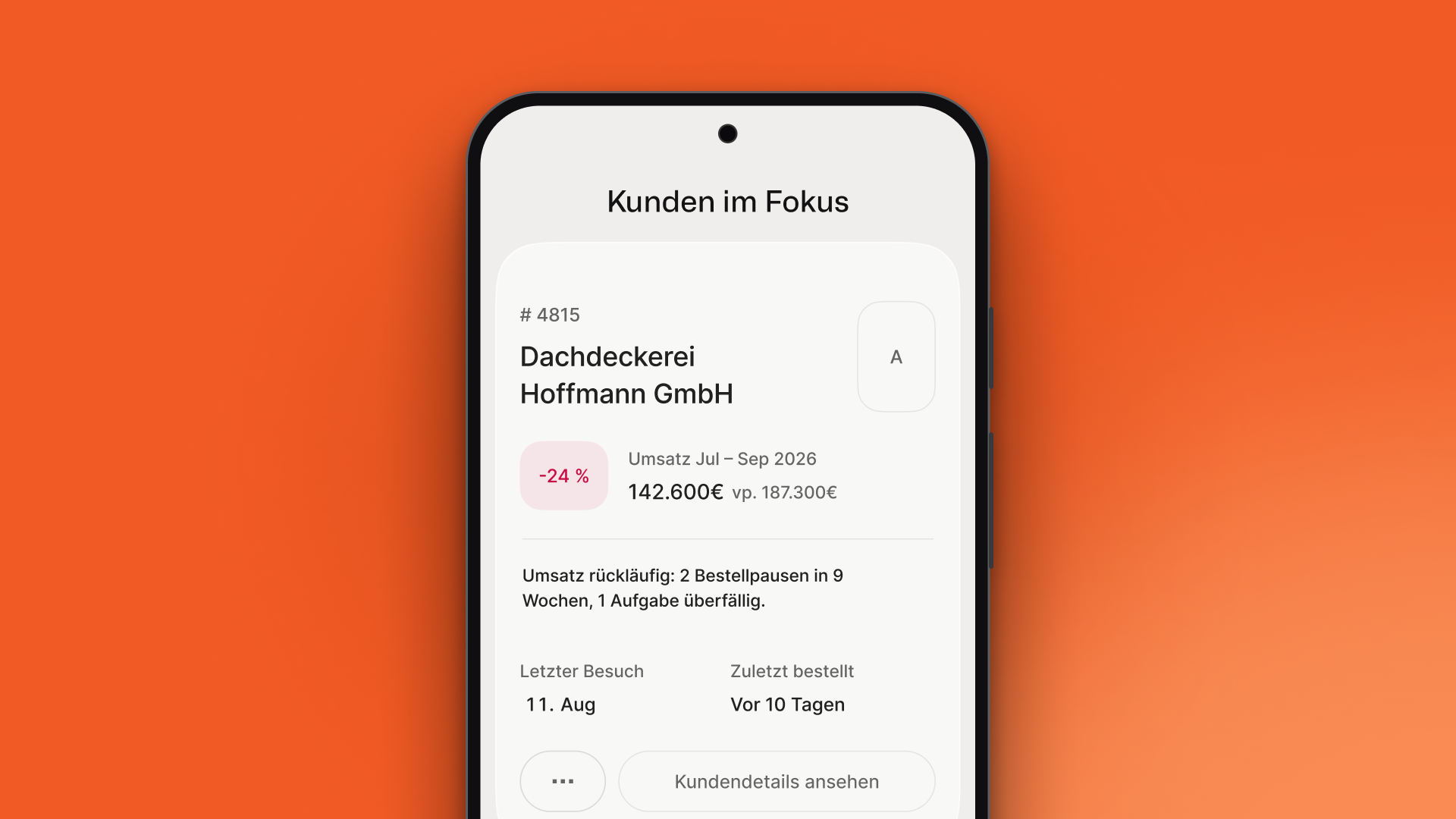
A customer card shows a 24% revenue decline, two order pauses in nine weeks and the last visit at a glance.
Self-test for your visit planning
Take your team's visit list from last week and answer three questions with your own numbers:
- How many visits had a reason other than a due appointment?
- How many customers have stopped ordering a product group in the last three months, and how many of them did someone visit?
- Could a successor explain tomorrow why these customers are on the plan in this order?
In a conversation, we'll show you which customers in your territory are worth a visit right now.
FAQ
My experienced field sales reps know whom they need to visit. Why signals?
For their most important customers, they're usually right. In our study, 73% of field sales reps in wholesale have more than ten years of professional experience (profile sample of 177 field sales reps, as of calendar week 40/2026, not representative). Signals cover the customers who slip out of view among hundreds of accounts, and they make the selection transferable.
Is a route planner enough for field sales?
A route planner solves step 4: the shortest sequence for a fixed customer list. It doesn't answer which customers belong on that list. If you only shorten the route, you just get faster to customers who don't need anything.
How many customer visits per day are realistic?
In wholesale, the median in our conversations is around six visits a day (42 data points, 2024 to 2026). Other industries are well above that, ad sales for example at 15 to 25. But more visits only bring more revenue if each of them has a reason.
Are A customers neglected if their appointment has no signal?
No. An A customer without a signal doesn't need a visit this week, but does need care: inside sales keeps in touch by phone or email. As soon as one of its many repurchase intervals falls due or a product group declines, the customer is back at the top of the list. That way, travel time ends up with customers who have a reason.