Predictive Sales for Wholesale Distributors: How Does It Work?

Summary
- Predictive sales (also called predictive selling or predictive customer analysis) analyzes the order history in the ERP and forecasts which customer will order again soon, which product they are missing and who is at risk of churning.
- In wholesale, this is a question of volume: a field sales rep serves 247 customers on average, median 175, and manages around four contacts per customer per year (Acto study Wholesale Sales 2026 (in German)).
- A prediction without context is a false alarm. A customer who has ordered nothing for three weeks may be churning or may simply be on company holiday. Only the field sales team's knowledge turns the signal into a sound decision.
- Predictive selling does not replace field sales. It takes over the search that nobody can do by hand across hundreds of customers.
Last updated: October 2026
What is predictive sales? A definition for wholesale
Predictive sales means using purchase history, order cycles and comparison data from similar customers to predict when a customer will order again, which product they will need next or when they are at risk of churning. In German-speaking countries it is also called "prädiktive Kundenanalyse" (predictive customer analysis).
Predictive analytics in general detects patterns in data. Predictive sales aims these patterns at a single question: whom should sales contact today, and with which topic? Which analyses are actually used for this in wholesale is shown in our five use cases for predictive analytics in wholesale. This article describes the step after that: how a signal becomes a visit.
For wholesale this means something different than for a software company that analyzes leads' website visits. A specialist wholesaler often carries tens of thousands of items, and revenue comes from the existing base: order rhythm, seasonal patterns, assortment gaps. Generic sales tools from software sales don't know this logic, because they were built for new-customer pipelines.
Why is experience no longer enough with hundreds of customers?
Because time runs out. A field sales rep serves 247 customers on average. With around six visits a day and 176 field days, that comes to roughly 1,000 visits a year, or arithmetically about four contacts per customer (Acto study Wholesale Sales 2026 (in German)).
How does field sales decide whom to visit on those days? In 47 percent of our conversations with wholesalers, the answer was gut feeling or experience, and only in 8 percent the CRM (ibid., n = 186 conversations). I keep seeing the same pattern, and I have described it on LinkedIn: with the most experienced salespeople, management from memory still works, for about 30 customers. But they serve hundreds.
Experience remains valuable. A field sales rep who has been working the territory for decades knows their most important customers in detail. The gaps appear with the customers in the middle, who are neither at the very top nor at the very bottom and are therefore visited less often. How field sales can be managed by potential instead is described in our article on potential-based sales. What a field sales rep costs per year, we have broken down as the full cost of one position: by our own calculation in the study Wholesale Sales 2026 (in German), around €98,000, so every visit to the wrong customer is expensive.

You can find all figures from 106 wholesale companies in the study Wholesale Sales 2026 (in German).

How does predictive selling work in wholesale?
Predictive selling detects patterns in the order history, condenses them into a priority per customer and delivers a daily list with reasons. The data is usually already in the ERP. What is missing is the time to go through it every day for every customer.
Technically, it comes down to a few recurring comparisons: the time since the last order compared with the customer's own rhythm and with similar customers, the development of individual product groups, and the products that customers with a similar profile also buy. If a customer deviates clearly from their pattern, a signal with a reason is generated.
What matters is where this signal arrives. On average only about a quarter of employees actively work with BI and analytics tools, as BARC found in 2022 in a survey of 214 companies. I like to compare it to a navigation system: it tells you at the right moment where to turn (my LinkedIn post on this). For sales, that means a concrete statement of who needs attention today and why, right where they already work.

Which signals show revenue potential and churn risk?
Five signal types deliver the most hits in practice: missing reorders, declining product groups, missing complementary products, open quotes without follow-up and price deviations compared with similar customers. How much depends on this is shown by the range in churn: depending on how they are served, wholesalers lose between 4 and 17 percent of their customers per year, according to our churn benchmark.
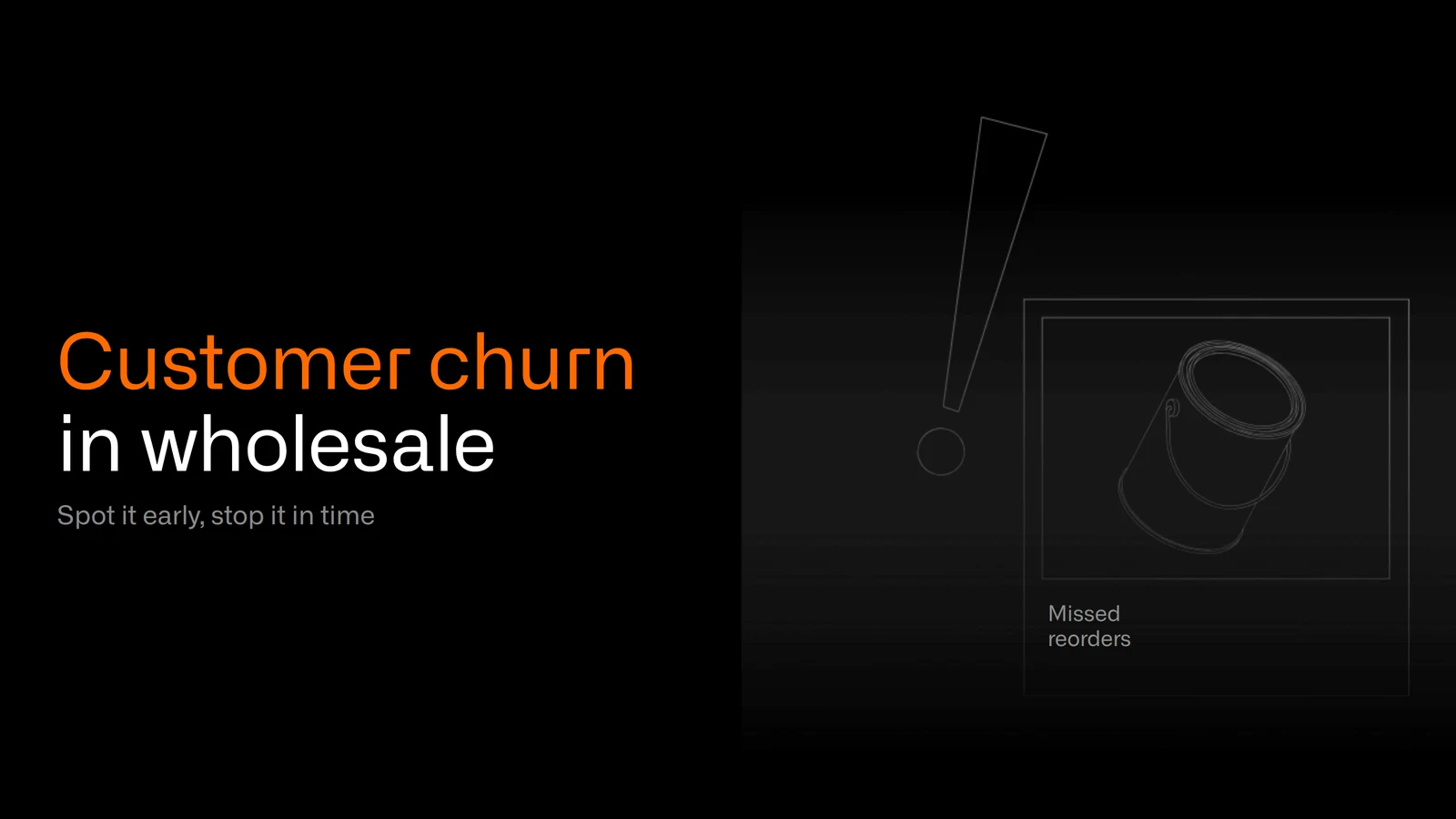
Missing reorders
A customer who normally reorders a product group every 16 weeks has ordered nothing for 25 weeks. The comparison is made with their own rhythm and with the average of similar customers for the same product.
Declining product groups
A customer keeps buying standard items, but an entire category drops away over months. Total revenue still looks healthy because the ongoing items mask the picture. Customers rarely leave with a bang: they order more quietly and shift product groups to the competition.
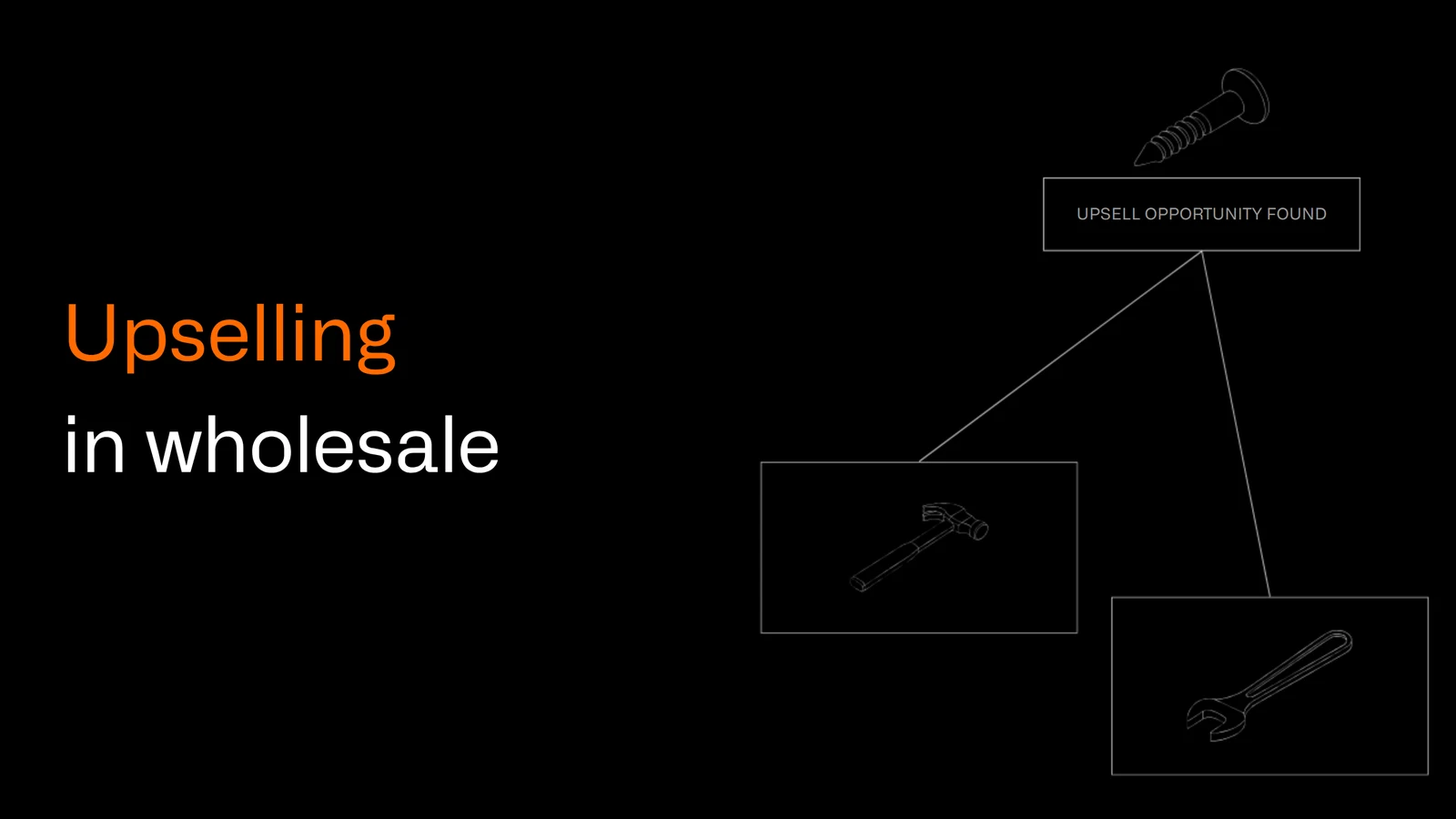
Missing complementary products
Similar customers regularly buy a second product along with one product, but one particular customer never does. Usually this is an assortment gap that can be addressed in a targeted way.
Open quotes without follow-up
A quote covering several product groups has been open for days, and only part of it was ordered. Without a system, this hint disappears into the filing cabinet.
Price deviation
A customer systematically pays less than comparable businesses of the same industry and size. This points to a need for negotiation, not necessarily to an error.
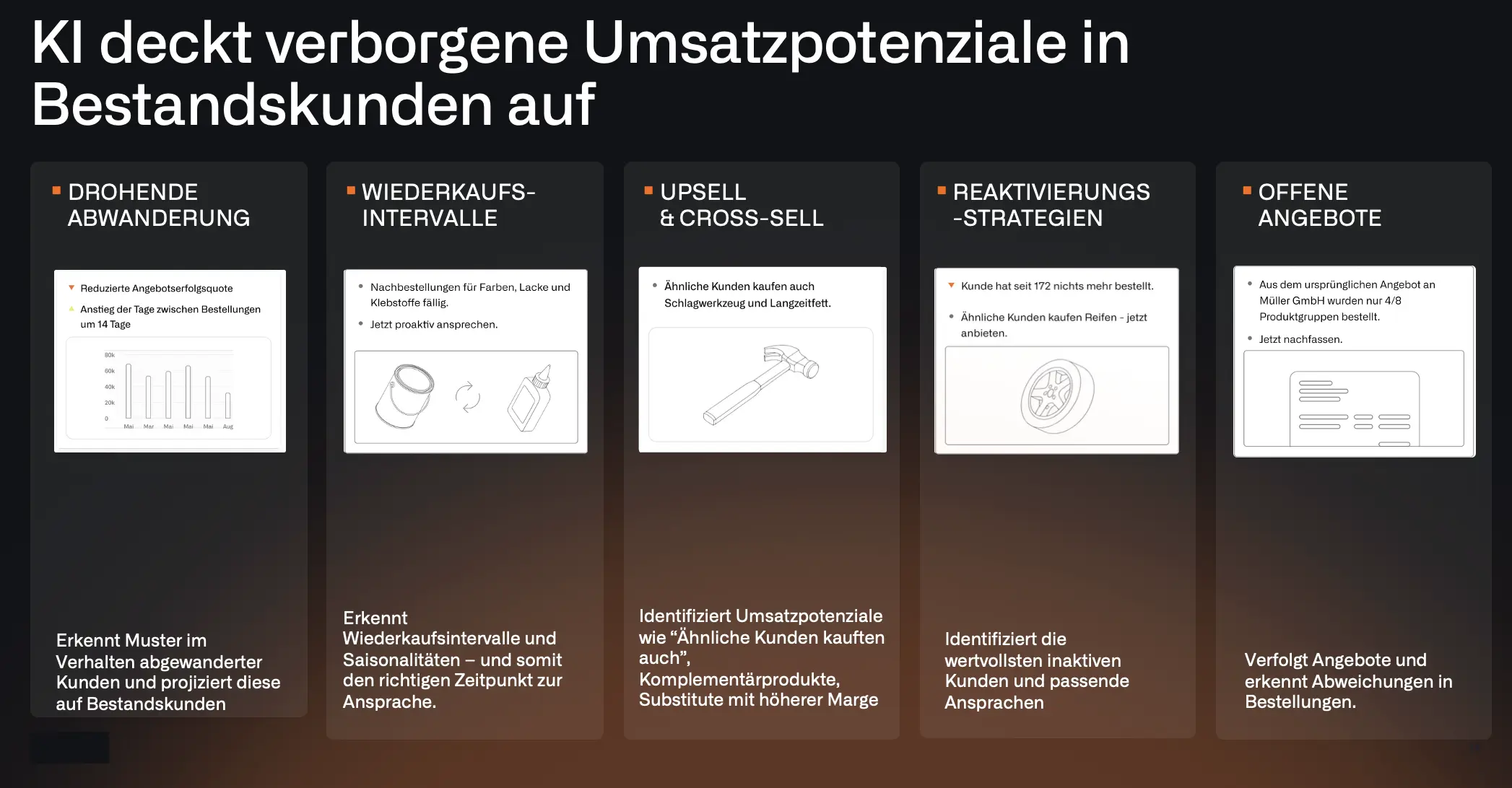
Signals from churn risk to open quote in one view instead of five different reports.
The example of Plate, an office supplies wholesaler, shows what such signals achieve: in the pilot team, users' revenue rose by 10 percent. Customers who were contacted after a notification bought 2.1 more products on average, and the time between two orders fell by 35 percent, because customers were approached proactively about reorders.
What don't the data know?
The data don't know why a customer deviates from the pattern. An example from our webinar: a customer has ordered nothing for three weeks. Without context, the signal reads "at risk of churning, call immediately." With context, it reads "no alarm, company holiday until mid-September, reminder afterwards."
Of seven things an experienced field sales rep knows about their customers, four are already in the order data: purchase patterns of similar customers, seasonal patterns, repurchase intervals and order rhythm. Three are only in their head: who actually decides at the company, how the product is used at the customer and what is changing right now, such as an upcoming handover to the next generation.
That is why a good prediction in wholesale always has two parts. The system finds the deviation, field sales adds the context, and this context flows back so that the next signal becomes more accurate. A predictive sales approach without this feedback channel produces false alarms in the long run, and false alarms are the fastest way to get field sales to stop opening the list.
Predictive sales vs. visits on a fixed cycle: the decision table
The difference shows in the daily routine: does field sales plan by fixed cycle and gut feeling, or does it get a list with reasons in the morning? How sales managers manage the team as a whole is shown in the article on field sales management.
| Criterion | Visits on a fixed cycle | Predictive selling |
|---|---|---|
| Visit planning | Fixed cycle or gut feeling | Daily priority by signal |
| Churn detection | Visible only after a noticeable revenue drop | Visible as soon as the order pattern deviates |
| Cross-selling | Random, depends on the individual rep | Systematic, based on similar customers |
| Time spent on analysis | Manual, customer by customer | Automatic, daily for the entire customer base |
| Data basis | Experience in the rep's head | ERP data plus feedback from field sales |
The table has no "winner" column, because the answer depends on the customer base. With a few dozen customers, the fixed cycle works. With several hundred customers, it no longer does: 64 of 106 surveyed wholesale companies report up to 200 customers per field sales rep, nine report more than 500 (Acto study Wholesale Sales 2026 (in German)). Our assessment: the routine visit by date is disappearing. Visits will be planned by signal.
Is it worthwhile for a mid-sized wholesaler?
Yes, if the order history is reliable. Field sales revenue is revenue per visit times the number of visits. Predictive selling works on the first lever, because field sales goes to the right customers with the right topic. The second lever, time with the customer, is addressed by relieving reps of administration: a global manufacturer gained 15 percent more selling time according to McKinsey.
Not for you: when predictive selling doesn't (yet) fit
Predictive selling is not worthwhile if the data basis is missing or the customer base is so small that an experienced salesperson can still keep it all in their head.
Without a reliable order history in the ERP, no model has a foundation. With a small customer base, such as the roughly 30 customers that in my experience can still be managed from memory, the salesperson's knowledge carries on. If project business without recurring orders dominates, for example in special-purpose machine building, the repurchase signals are missing. And a system that field sales doesn't open changes nothing, however good the signals are.
The pressure to change is growing nonetheless: in the wholesale sector study by BGA and Deloitte (2022), 94 percent of wholesalers name the skilled labor shortage as a major challenge, and 86 percent digitalization. Data quality can be fixed. The team's willingness needs more time.

How do you introduce predictive selling in five steps?
Start small and measurable: check the data, choose a pilot territory, hold the first list up against the knowledge of experienced salespeople, involve the team and measure against a comparison group after one quarter.
Step 1: Check the data basis
Is there a continuous order history in the ERP, as a rule of thumb at least one year back, with clean product groups? Without this basis, every model lacks a foundation.
Step 2: Choose a pilot territory
Start with one territory or one team. A manageable group shows more quickly whether the signals hit.
Step 3: Hold the first list up against experience
Have the system create a first list and compare it with the knowledge of your most experienced salespeople. Where the two differ, both sides learn the most.
Step 4: Involve field sales
Show the team why a signal was generated. Acceptance comes from a comprehensible reason and from the fact that feedback from the appointment improves the next signal.
Step 5: Measure after one quarter
Check whether contacted customers actually ordered more often or more than a comparison group. That is the only proof that counts.
How Acto implements predictive selling for wholesale
Acto is the sales AI for wholesale and for manufacturers with their own B2B direct sales. Acto reads the ERP order data daily and shows field sales which customers are slipping, where assortment gaps cost revenue and which reorder is due, with reasons, in Outlook, in the CRM or in the app. Feedback from the appointment flows back into the next signals.
"All inside sales reps at Hitado use acto every day as the central basis for their customer care. Each day they receive 10 prioritized signals with the most relevant customers to contact that day." – Ilka Greco, Head of Inside Sales, Hitado (case study)
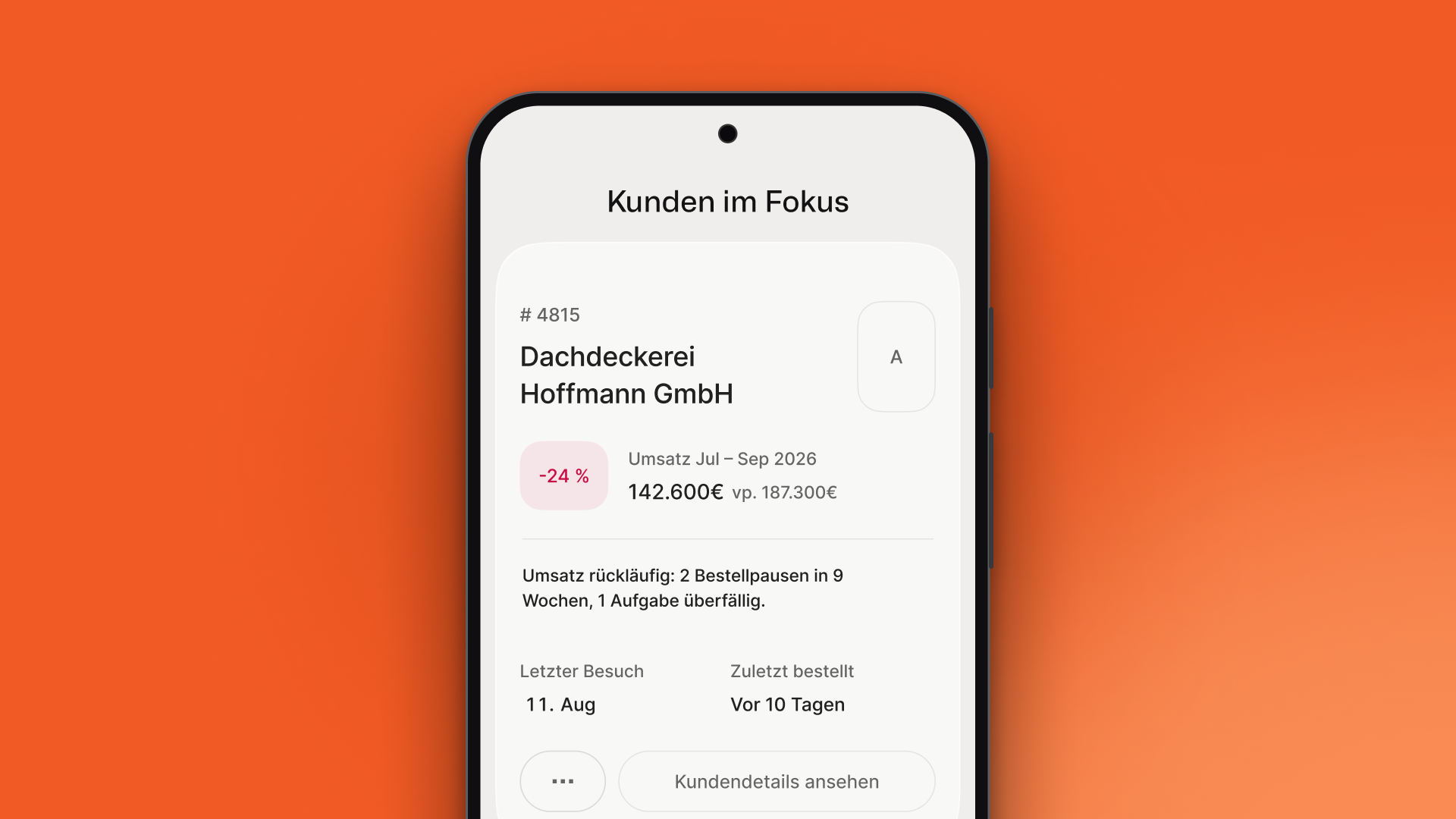
A customer with -24% revenue, two order pauses and an overdue task, shown directly with a reason instead of just a number.
In pilot projects with a control group, the revenue of Acto users rose by 11.2 percent at Schäfer Shop, by 10 percent at Plate, by 8.6 percent at Böllhoff and by 5.4 percent at Hitado.
Which signals are already hiding in your own ERP data?
FAQ
How can I forecast my revenue in wholesale?
Analyze order history, order cycles and product groups per customer and compare them with the behavior of similar customers. The forecast comes from the deviations of individual customers, not from total revenue, which often masks such deviations for a long time.
What is predictive customer analysis?
Predictive customer analysis is another name for the same method: past buying behavior is used to predict how a customer will behave, for example whether they will order again, need an additional product or are at risk of churning.
What is the difference between predictive marketing and predictive selling?
Predictive marketing predicts which lead is likely to buy and targets new customers. Predictive selling focuses on existing customers and predicts when and what an existing customer will need next.
Can AI really forecast revenue in wholesale?
Yes, if a reliable order history is available. The forecast gets better the more context field sales reports back, because only they know whether an order pause means churn or company holiday.
Does predictive selling replace my field sales team?
No. It replaces the search for patterns in tens of thousands of records, not the sales conversation. Field sales reps are salespeople, not analysts, and between traffic jams and five appointments there is no time for this analysis anyway.